
Tag: LNG shipping

  • A Vessel Was Struck Near Hormuz. The Freight Risk Now Runs Through Fuel, Insurance and Capacity.

    A Vessel Was Struck Near Hormuz. The Freight Risk Now Runs Through Fuel, Insurance and Capacity.

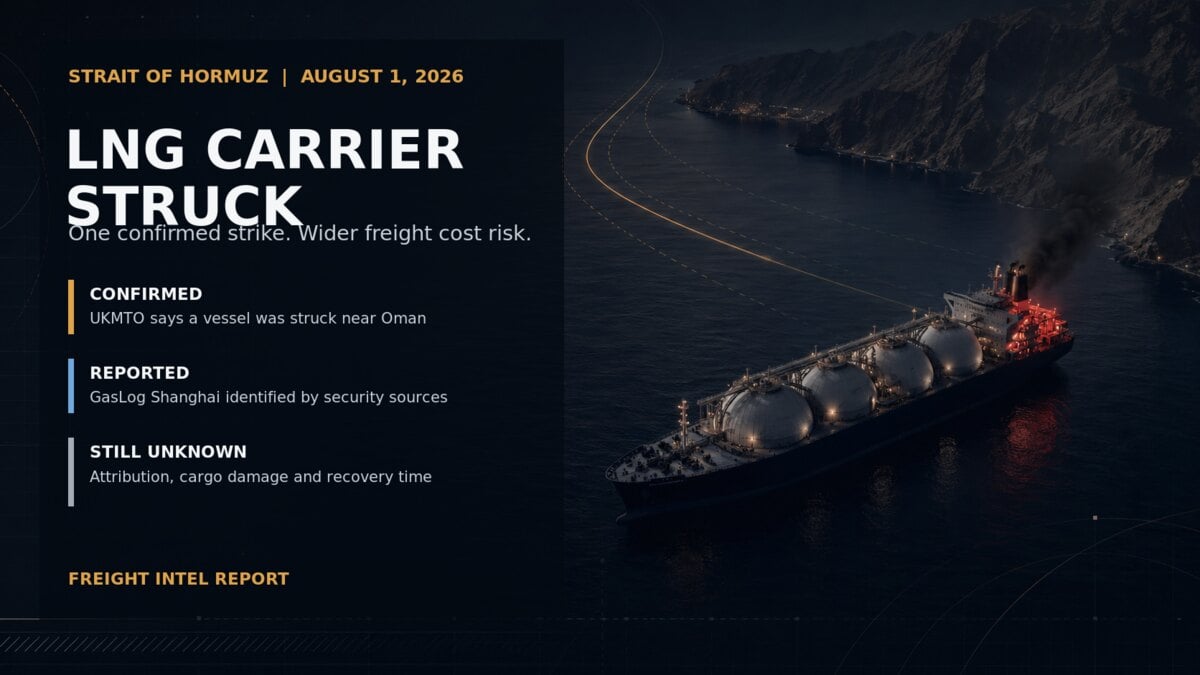
    August 1, 2026 — Breaking analysis: A commercial vessel was struck near Oman overnight, adding a newly confirmed attack to an already dangerous Strait of Hormuz operating environment. Reporting identifies the vessel as the LNG carrier GasLog Shanghai, but the vessel name, weapon, cargo condition and responsibility for the attack remain provisional.

    By Eric Bratton, Founder and Executive Editor, Freight Intel Report

    The United Kingdom Maritime Trade Operations center confirmed that a vessel was struck in the area and authorities are investigating. The Associated Press separately reported a damaged tanker near Oman amid renewed regional escalation. Security-intelligence sources cited by Bloomberg and other reporting identified the vessel as the Bermuda-flagged GasLog Shanghai and said engine-room damage left it inoperable.

    Those layers of evidence should not be collapsed into a single certainty. The occurrence of a vessel strike is confirmed. The identification of GasLog Shanghai, the reported missile strike and the extent of its damage have not yet been confirmed publicly by UKMTO, the vessel operator or a flag-state authority. Iran has not claimed responsibility.

    Why an LNG-carrier casualty changes the freight calculation

    GasLog Shanghai is a 155,000-cubic-meter LNG carrier built in 2013, according to GasLog Partners’ corporate disclosures. If the identification and loaded status are confirmed, the incident would directly connect escalating maritime security risk with the specialized fleet that moves liquefied natural gas through one of the world’s most important energy corridors.

    The immediate freight consequence is not that all Hormuz traffic stops. It is that every successful attack can change the commercial decision made by shipowners, charterers, insurers, crews and cargo interests. The effects can appear through war-risk premiums, routing restrictions, security costs, delayed sailings, unavailable vessels and higher replacement-charter rates before any formal closure is declared.

    The shock also moves inland. Reuters reported on July 31 that oil rose more than 1% after Iran said it had stopped two U.S.-escorted ships and caused four others to reverse course. Brent gained roughly 23% during July. Higher crude and refined-product costs eventually reach trucking through retail diesel, but carrier fuel surcharges do not always reset at the same speed. That timing mismatch can temporarily transfer cost to carriers, brokers or shippers depending on contract language.

    The four freight exposures

    • Ocean and energy cargo: LNG and tanker operators may require additional security, delay transits or hold vessels outside the corridor while threat information is reassessed.
    • Trucking and brokerage: diesel can rise before weekly or monthly surcharge tables catch up, compressing carrier margins and creating disputes over extraordinary fuel movements.
    • Shippers and manufacturers: higher energy, ocean and insurance costs can affect transportation budgets, production inputs and inventory policy even when the shipment never passes through Hormuz.
    • Insurers and finance providers: a disabled high-value LNG carrier can affect risk pricing, voyage approvals, collateral assumptions and vessel availability across a specialized fleet.

    What decision-makers should do now

    • Separate confirmed maritime alerts from attributed or unnamed security reporting in executive briefings.
    • Review fuel-surcharge formulas, reset timing and emergency-cost provisions before the next diesel move.
    • Ask ocean and energy suppliers about war-risk coverage, force-majeure language, alternative load ports and vessel-substitution rights.
    • Model a short disruption separately from a prolonged transit restriction; the inventory, capacity and cash-flow responses are different.

    What remains unknown

    Public authorities have not confirmed the vessel name, attacker, weapon, exact cargo damage, environmental impact, crew status or recovery timeline. GasLog has not issued a public incident statement located by Freight Intel Report. It is also unclear whether other LNG or tanker operators will suspend voyages, whether war-risk terms will change immediately, or whether the incident will materially reduce daily transit volume.

    Freight Intel Report analysis: The pivotal development is not merely another security headline. A confirmed strike near Oman, coupled with credible reporting that a loaded LNG carrier may be disabled, moves the risk closer to the physical energy assets that influence freight costs worldwide. Companies should act on the confirmed increase in operating risk while refusing to treat provisional attribution and damage estimates as established fact.


    Primary and corroborating sources