
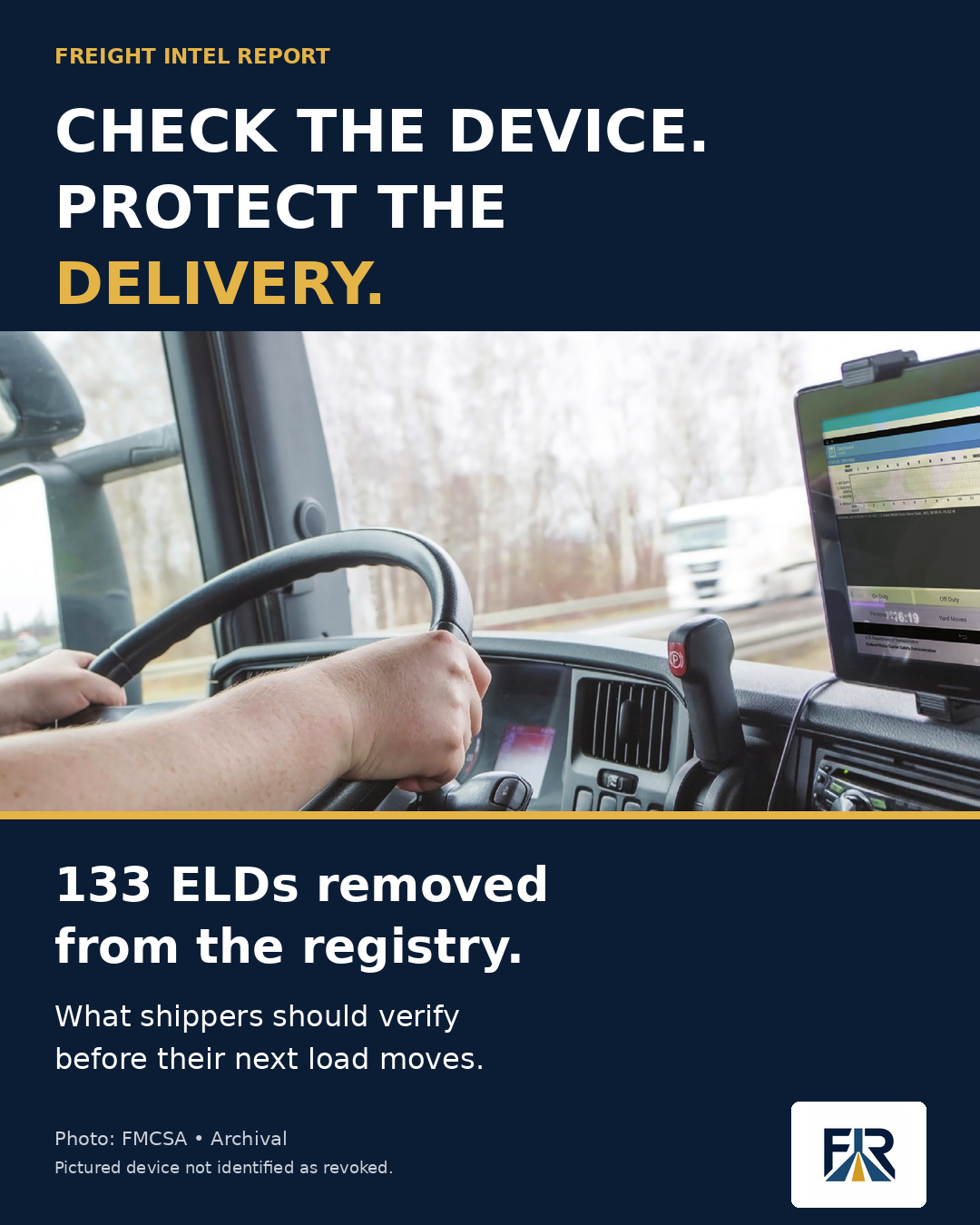
A carrier can accept your load while a compliance problem is developing inside its cab. A new federal action against electronic logging devices gives shippers a reason to ask a more specific question before pickup: has the carrier checked the exact device it uses, and can it protect the delivery if replacement is required?
On November 12, the U.S. Department of Transportation announced that 133 electronic logging device registrations were being removed from FMCSA’s registered list: 121 agency revocations and 12 voluntary withdrawals. These are device registrations, not a count of affected carriers, drivers or trucks. The announcement does not establish how much freight capacity is exposed. DOT attributes the action to noncompliant devices and investigations into falsified logs; it anonymized its examples because investigations remain open. [1]
The removal is confirmed. The replacement clock needs clarification.
DOT’s announcement contains conflicting timing language. It says motor carriers have up to 60 days to replace revoked devices, but also directs enforcement against drivers using revoked devices on or after November 24, 2026. Those statements do not describe the same replacement window for a November 12 action. [1]
FIR has not verified a single replacement deadline that resolves this conflict for every affected registration. Shippers should ask carriers to identify the applicable agency notice and confirm their operating plan. Treating either date as a blanket assurance could leave a delivery dependent on an unverified assumption.
FMCSA maintains separate registered and revoked device lists. Check the exact identifier, model and software information rather than relying only on a familiar provider name. The registry is based on providers’ self-certification; a registered listing should not be described as an independent government endorsement of a product. [2]
Why this matters to freight buyers
FIR analysis: The immediate commercial exposure is a shipment assigned to a carrier that cannot demonstrate a workable compliance and replacement plan. That can create uncertainty around pickup coverage, delivery appointments and recovery capacity. It does not establish that all users of an affected device will miss deliveries.
The announcement also does not support a forecast of a nationwide truck shortage, a specific rate increase or a particular number of disrupted loads. Procurement teams should assess their own carrier exposure before changing awards or accepting a compliance-related surcharge.
What to verify before the next load
Identify the exposure. Ask the carrier’s safety or compliance contact whether it uses any affected registration on equipment serving your freight. Record the exact ELD identifier, the status-check date and the person responsible for resolving any issue. Have the carrier explain any applicable exemption rather than assuming every truck has the same ELD obligation.
Test the replacement plan. For exposed equipment, request the planned replacement device, installation status, driver-training arrangements and the agency notice supporting the carrier’s timeline. A promise to switch software is less useful than confirmation that the equipment assigned to your shipment is ready.
Protect the appointment. Identify loads with little recovery time, including fixed receiving windows and production-critical deliveries. Confirm qualified backup coverage and escalation contacts before pickup. Do not pressure a driver to make up lost time by exceeding legal hours.
Keep the checks separate. Continue normal authority, insurance, identity and safety screening. An active carrier record does not answer whether a particular ELD registration remains on the registered list; a device-list check does not replace the rest of carrier qualification.
Prepare for either outcome
If an earlier enforcement date applies: prioritize verification of exposed equipment and protect time-sensitive loads with qualified alternatives where the assigned carrier cannot demonstrate readiness. Notify customers promptly when a specific shipment becomes uncertain.
If the agency clarifies a longer replacement period: use the time to complete and verify the transition. Keep confirmed, compliant service moving; do not treat extra time as a reason to leave an unresolved replacement plan until the final dispatch.
If a device is reinstated: recheck its exact registration before closing the issue. DOT says devices can return to the registered list after deficiencies are corrected. A provider’s assurance alone is not the same as a verified registry change. [1]
FIR will continue to follow this story as it develops and update this article when authoritative guidance clarifies the timing or materially changes the operational assessment.
Primary sources
[1] U.S. DOT announcement, November 12, 2026
[2] FMCSA ELD program and official device lists



Leave a Reply