
The most consequential freight choice in a major construction program can be made before the first load is tendered: where to put the dock, stockpile and processing equipment.
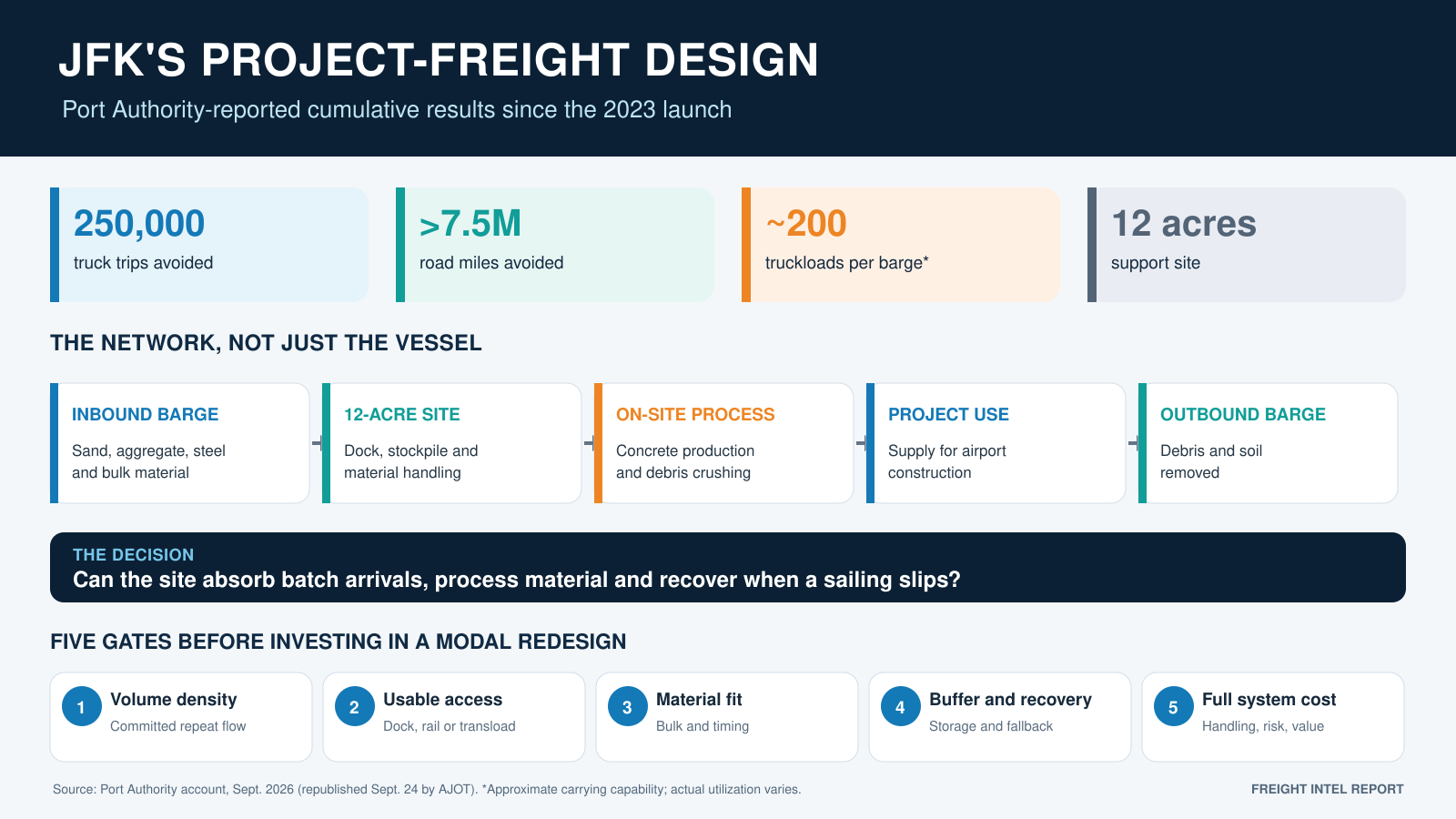
The Port Authority of New York and New Jersey says its barging program for the $19 billion redevelopment of John F. Kennedy International Airport has replaced 250,000 truck trips and avoided more than 7.5 million road miles since launching in 2023. A barge can carry the equivalent of roughly 200 truckloads. Those are striking numbers, but the barge is only part of the explanation. The airport also set aside a 12-acre logistics site with a dock, material-handling space, on-site concrete production and debris crushing. The Port Authority’s account, republished September 24 by AJOT, describes a redesigned supply chain, not a cheaper substitute for each individual truck.
For a project owner, that distinction changes the procurement question. Before buying more highway capacity, test whether the site and flow can be designed to require fewer road moves at all.
Four figures, and what they do not prove
- 250,000 truck trips replaced: Cumulative avoided road moves, not a daily run rate.
- More than 7.5 million road miles avoided: A reported network effect, not a measured saving for every route.
- Approximately 200 truckloads per barge: Potential batch size; actual loads and utilization vary.
- 12-acre support site: Land and handling capacity were part of the transport solution.
The reported totals imply roughly 30 road miles per avoided trip when rounded: 7.5 million divided by 250,000. FIR uses that calculation only to put the two aggregate claims on a common scale. It does not describe the length of any particular truck route, and the underlying published figures are rounded.
The Port Authority says the mileage reduction exceeded its initial projection by more than fivefold. The public account does not provide an independently audited modal cost model or a shipment-level comparison. The logistics contractor said the program did not increase project costs; that is its claim, not proof that barging will cost less on another project.
The freight system behind the result
At JFK, barges bring sand, aggregate, steel and other building material to a dock on Bergen Basin. The adjoining site provides room to unload and stockpile material. A concrete plant produces supply near the work, while a crusher recycles non-hazardous construction debris for reuse, including in roads. Barges also remove soil and remaining debris. The Port Authority’s published account identifies each of those functions.
They address different sources of truck demand. Inbound barges consolidate bulk deliveries. On-site production can avoid repeated trips from an off-site concrete plant. Recycling can reduce both waste haulage and replacement material brought in. Outbound barges carry material that still must leave. Trucks remain useful for irregular, urgent and final-placement work; the public figures do not mean the project stopped using them.
A linehaul comparison would miss most of that design. The real unit of analysis is delivered and removed material at the required time, with the dock, handling, land, inventory, processing and fallback capacity included.
The batch advantage has a schedule cost
One vessel may replace many individual movements, but it concentrates delivery into a larger event. A missed barge, berth conflict, weather interruption or unloading delay can put a bigger portion of the work plan at risk than a single late truck.
Three clocks need to match:
- Arrival: transit, berth availability, unloading and the final move from dock to work area.
- Consumption: how quickly crews use each material and how much safe stockpile room exists.
- Recovery: the time and cost of replacing a delayed batch with trucks, another vessel or a changed construction sequence.
The advantage of a large batch disappears if the project pays for excessive inventory, congests its worksite or misses a critical construction window. The supply plan needs a buffer sized to actual consumption, not merely a vessel’s theoretical carrying capability.
Five gates before committing capital
1. Volume density. Is there enough repeatable, committed tonnage to support fixed dock, transload or processing costs? Separate contracted base-load volumes from optimistic forecasts. Ask what happens to the economics if a phase is delayed or a material specification changes.
2. Usable access. A waterfront location alone is insufficient. Verify draft, berth geometry, water-level and weather constraints, crane or ramp needs, permits, security, operating hours and the last move to the point of use. For rail, the equivalent questions are siding condition, switching windows, car storage and transload capacity.
3. Material fit. Bulk, heavy and repeatable freight may tolerate batching. Sequence-critical components, fragile equipment and emergency replacements may need truck flexibility. Divide the bill of materials by density, timing and consequence of delay instead of issuing an all-or-nothing modal mandate.
4. Buffer and recovery. Write the fallback before the first sailing: trigger, decision owner, available truck or rail capacity, alternate berth or sailing, and cost responsibility. Check whether the receiving site can hold a full batch without blocking work.
5. Fully allocated cost. Compare the entire system with the road-only plan: site and dock construction, marine or rail linehaul, handling, cranes, drayage, storage, financing of inventory, security, insurance, damage, weather downtime, processing and recycling value. Include community and road-access constraints, while keeping monetary and nonmonetary benefits distinct.
What the next project should actually test
Consider a project with a steady flow of aggregate and soil, water access nearby and limited truck gates. It is a plausible candidate for a JFK-style feasibility study. A project with small irregular deliveries, no usable berth and a tight sequence of engineered components is not. Most large projects sit between those cases: shift the predictable bulk base load, retain trucks for variable and urgent freight, and price the transfer points honestly.
The test belongs in site selection and early engineering, while land and access options are still open. If it waits until the annual freight bid, the project may already have built away the dock, siding or stockpile area that would have made another mode feasible.
JFK’s reported reductions show the scale a purpose-built network can reach. They are not a promise that every barge is cheaper or every road trip removable. The transferable decision is to design the whole material flow before paying for more capacity in the mode the site happened to inherit.
Sources and related FIR intelligence
- Port Authority milestone, republished by AJOT on September 24, 2026. Agency-reported program figures and facility description.
- FIR: Tightening Truck Capacity Is Reshaping Shipper Strategy. Context for retaining flexible truck capacity in a mixed network.

Leave a Reply