
A warehouse customer can gain access to a broader ocean-to-distribution network and still lose time if a late container, missed receiving appointment or damage claim has no clear owner during the transition.
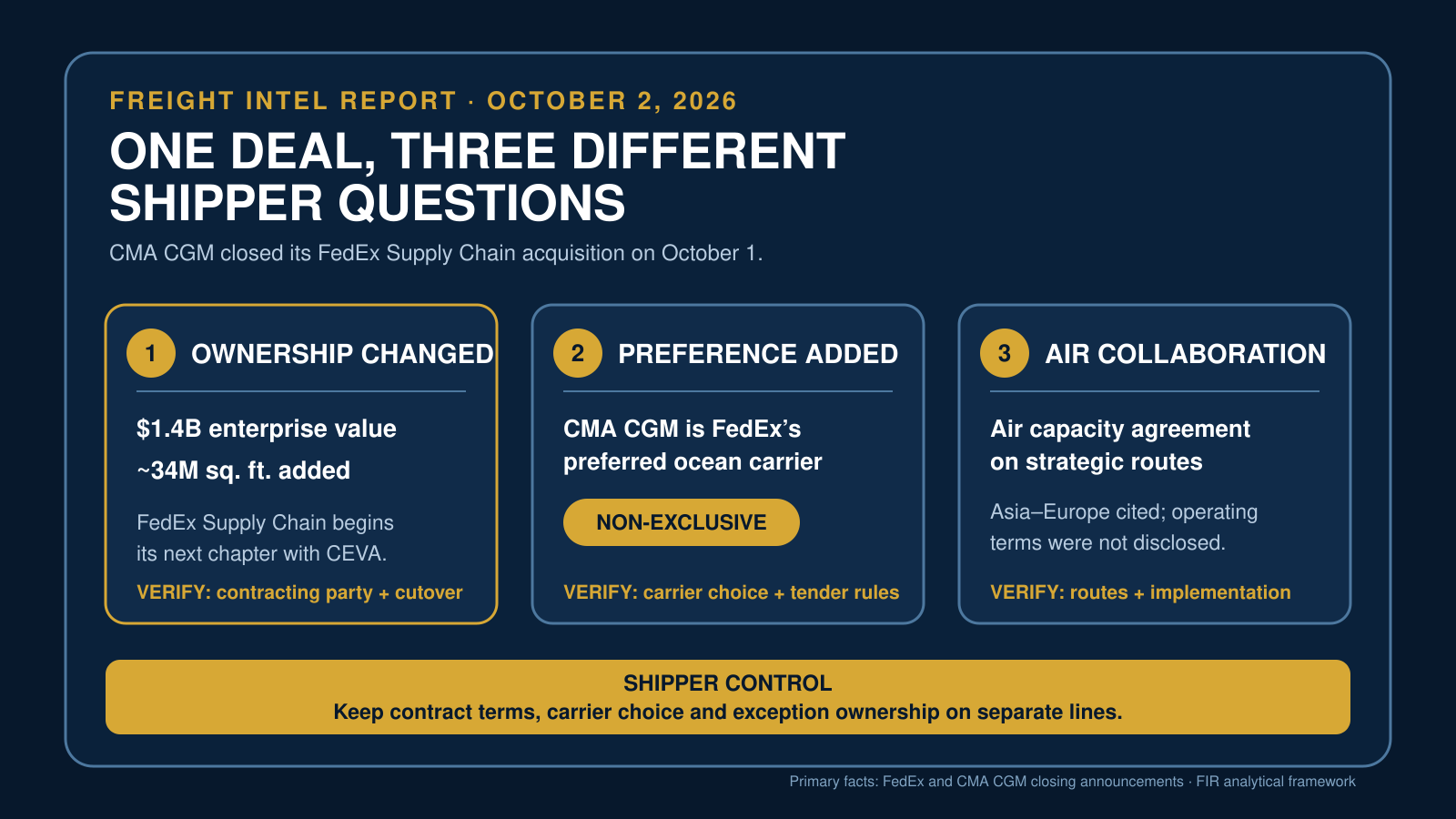
FedEx completed the sale of FedEx Supply Chain to CMA CGM on October 1 for an enterprise value of $1.4 billion. The business begins its next chapter with CEVA Logistics, CMA CGM’s logistics subsidiary. CMA CGM says the acquisition adds approximately 34 million square feet of warehouse space and nearly 10,000 employees, almost tripling CEVA’s North American contract-logistics footprint.
The physical scale is important. The more immediate customer question is what changes at the handoff between the former FedEx Supply Chain operation, CEVA, ocean transport and any other carrier serving the account.
The closing announcements also describe two commercial arrangements between FedEx and CMA CGM: CMA CGM will become a preferred ocean carrier for FedEx under a non-exclusive agreement, and the companies plan to collaborate on air-cargo capacity on strategic routes, including Asia–Europe.
Those are meaningful developments. They are not one promise.
The analytical finding: ownership, preference and collaboration are different commitments
Shippers should separate the transaction into three lines.
Ownership changed. CMA CGM now owns FedEx Supply Chain, which moves into CEVA. That can change the contracting entity, account structure, systems roadmap and escalation chain even if day-to-day work initially looks familiar.
A commercial preference was added. CMA CGM is FedEx’s preferred ocean carrier, but the agreement is explicitly non-exclusive. The notice does not say that every FedEx-controlled ocean shipment must move on CMA CGM or that existing shipper routing instructions have been replaced.
Air collaboration is planned. The companies say they plan an air-capacity agreement on strategic routes, including Asia–Europe. “Plan to collaborate” is different from an operating schedule, committed allotment, service guarantee or customer rate.
Collapsing those three lines into a single “end-to-end integration” claim would overstate what the closing notices establish. The useful next step is to document where the transaction changes a customer’s actual workflow.
Where coordination could improve—and where it could fail
CEVA now has a larger North American warehouse base inside a group that also controls ocean, terminal, inland and air capabilities. That creates a plausible opportunity to coordinate inbound bookings, terminal availability, drayage appointments, warehouse labor and inventory visibility with fewer disconnected planning cycles.
Potential does not guarantee execution.
A container can arrive on a CMA CGM vessel and still miss a CEVA warehouse appointment. An integrated commercial proposal can still contain separate contracts, liability limits, invoices and claims channels. A shared data feed can still fail if customer master data, purchase-order references or appointment rules do not match across systems.
For a current FedEx Supply Chain customer, the transition test is therefore not whether the new owner offers more services. It is whether the combined operating chain has one current answer for the next exception.
That answer should identify:
- the party that controls the transportation decision;
- the party responsible for warehouse receiving and inventory accuracy;
- the party authorized to change a route, appointment or carrier;
- the party that owns customer communication when a handoff fails; and
- the contract and evidence needed to resolve a claim.
If those answers remain split across account teams, the broader network can add options without reducing customer work.
Non-exclusive ocean preference preserves a choice the shipper should make explicit
The non-exclusive language matters because it preserves commercial room for other ocean carriers. It also creates a governance question: when does “preferred” influence a tender, routing guide or integrated solution?
A shipper should not assume either extreme. The announcement does not establish that CMA CGM will automatically carry all eligible freight. It also does not establish that the preference will have no effect on how FedEx-related ocean opportunities are presented or routed.
Current customers should ask for written confirmation of:
- who selects the ocean carrier under the existing contract;
- whether customer routing instructions remain controlling;
- whether any minimum-volume, service or pricing condition changes;
- how an exception carrier can be approved; and
- whether performance reporting will remain carrier-specific.
Those questions protect optionality without rejecting the potential value of coordinated capacity. A preferred carrier can improve planning when the lane, sailing, service and price fit. It should not become a substitute for comparing the shipment requirement with the available service.
Planned air collaboration is not yet a capacity guarantee
CMA CGM’s announcement says the companies plan to collaborate on an air-cargo-capacity agreement on strategic routes, including Asia–Europe. It says the arrangement is intended to improve aircraft utilization and flexibility.
The announcement does not disclose operating dates, routes beyond the example, allotments, priority rules, recovery commitments or customer prices. Until those details are available, shippers should treat the air agreement as a development to monitor—not capacity already secured for a peak, product launch or expedite.
For time-critical freight, the commercial test is concrete: what flight, what allotment, what cutoff, what recovery path and what written service commitment apply to this shipment?
The transition checklist for existing customers
The acquisition closed; the customer transition may take longer. Existing FedEx Supply Chain customers should request one dated transition sheet covering six controls.
1. Contracting party
Confirm the legal entity that will invoice, hold inventory, provide the service and receive notices. Ask whether an assignment, consent, amendment or new purchase-order setup is required. The acquisition itself does not prove that every customer contract, rate or renewal date changes automatically.
2. Service levels and scorecards
Record which service-level agreements, key performance indicators, remedies and reporting definitions remain in force. Preserve a pre-transition baseline so later performance changes are visible instead of absorbed into a new dashboard.
3. Systems and data
Identify any planned WMS, TMS, EDI, API, portal or account-identifier change. Require a test window, data-reconciliation owner and fallback process before a cutover affects live orders or inventory.
FIR’s earlier analysis of freight-technology adoption reached the same practical standard: measure whether the entire transaction becomes easier to complete, not only whether one organization automates a step.
4. Carrier authority
Document who can tender freight, select an ocean or inland carrier, approve a substitute and accept a rate or accessorial. Keep the non-exclusive ocean agreement separate from the shipper’s own routing and procurement rights.
5. Claims and inventory responsibility
Map responsibility at each custody transfer. A warehouse shortage, concealed damage or missed appointment can involve the ocean carrier, drayage provider, warehouse operator or shipper. The transition plan should say where the claim starts and who assembles the evidence.
6. Exception escalation
Name the person with authority to act when the operating plan breaks. A shared mailbox or new organization chart is not enough. The customer needs a primary owner, backup owner and escalation time for inventory, transportation, billing and systems issues.
What prospective customers should test before buying the broader network
The enlarged CEVA footprint may be relevant to shippers evaluating warehouse consolidation, import distribution, omnichannel fulfillment or a more coordinated international solution. The right comparison is not “integrated versus fragmented” in the abstract.
Use a real lane and facility flow. Price the ocean movement, inland handoff, receiving, storage, value-added work and final distribution. Then test three cases: the normal plan, a late vessel and a warehouse or inventory exception.
For each case, ask:
- which legal entity provides each service;
- whether rates are bundled or independently auditable;
- whether the shipper can choose a different carrier for one leg;
- how data moves across the handoffs;
- which service-level commitment applies; and
- who owns recovery when the issue crosses organizational boundaries.
That comparison gives an integrated provider credit for coordination it can demonstrate while preserving the shipper’s ability to see price, performance and accountability by service.
What to watch next
Three developments will show whether the transaction changes the customer experience.
First, account and system notices. These will reveal how quickly contracts, billing, portals, identifiers and operating contacts move into CEVA’s structure.
Second, use of the preferred ocean agreement. Customers should watch how often CMA CGM is offered, whether alternatives remain visible and how service performance is reported.
Third, implementation of the air-capacity plan. Route scope, launch timing, commercial access and recovery provisions will determine whether the collaboration becomes a usable shipper product.
The acquisition creates scale immediately. Coordination benefits arrive only when a customer can see who decides, who performs and who fixes the problem at every handoff.
For shippers, the most useful transition document is not a combined network map. It is a one-page responsibility matrix that keeps the contract, carrier choice and exception owner on separate lines.
Sources
External addresses are presented as plain text under FIR’s source policy.
- FedEx Newsroom, “FedEx Completes Sale of FedEx Supply Chain to CMA CGM Group,” October 1, 2026: newsroom.fedex.com/fedex-completes-sale-of-fedex-supply-chain-to-cma-cgm-group
- CMA CGM Group, “CMA CGM Group completes acquisition of FedEx Supply Chain, strengthening its logistics presence in North America, and enters into multi-year commercial agreements related to air and ocean freight,” October 1, 2026: www.cmacgm-group.com/en/news-media/cma-cgm-group-completes-acquisition-fedex-supply-chain-strengthening-its-logistics
Leave a Reply