
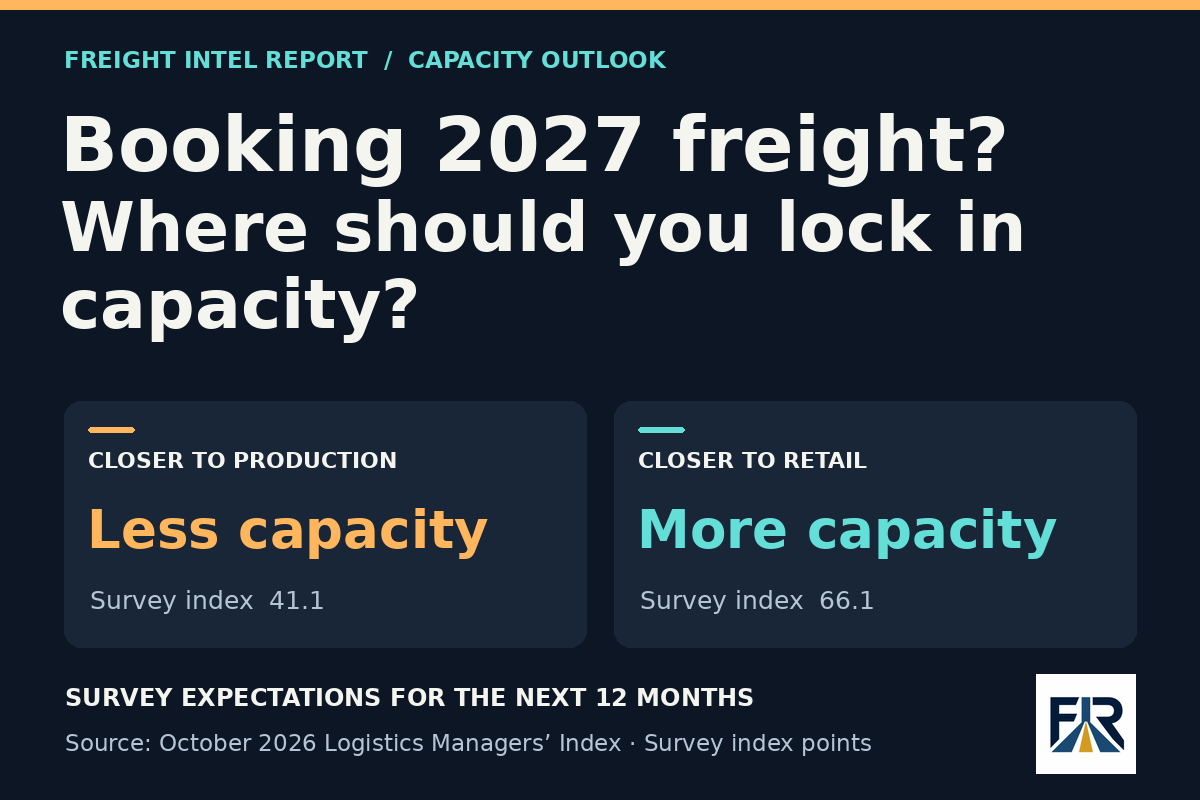
A shipper buying freight for both plant supply and retail replenishment has two decisions to make in its 2027 bid. How much capacity should it commit to on lanes where a missed pickup can shut down production? Where can it keep options open without risking a delivery commitment?
The October Logistics Managers’ Index, released November 3, gives procurement teams a reason to answer those questions separately. The overall transportation capacity index was 38.0 in October, marking the eleventh consecutive month of contraction. Current readings were 38.9 for upstream respondents and 39.3 for downstream respondents. The survey authors found no statistically significant difference between those current readings.
The split is in expectations
In September, both groups expected capacity to contract over the following 12 months. Their forward readings were 34.8 upstream and 42.6 downstream. In October, the upstream reading rose to 41.1, still in contraction territory, while the downstream reading moved above the 50 dividing line to 66.1. The survey authors found the October gap of 25 index points statistically significant. The aggregate forward reading was 49.3.
The LMI groups respondents by where their businesses sit in the supply chain. It does not track the inbound and outbound lanes of the same shipper. The readings measure the direction respondents expect capacity to move. How much capacity will be available on a given lane, when it might improve and what carriers will charge remain open questions.
How to set up the bid now
Rank lanes by what a service failure would cost the business. On loads that could halt a production line, cause a stockout or miss a fixed receiving appointment, ask primary carriers what volume and pickup windows they can cover. Qualify a backup against the same requirements. On lanes with more scheduling flexibility, test whether backup carriers can cover the actual origin, equipment and pickup window before committing the full volume for the year.
- If capacity opens up on some lanes while others stay tight, keep core commitments on lanes where service failures carry the biggest cost. Stagger awards on lanes where better tender acceptance and dependable backup coverage give you room to do so.
- If relief is delayed and capacity stays tight across the network, keep backups active on vulnerable replenishment lanes. Agree in advance who moves the load when a primary carrier rejects a tender or misses a pickup, and how soon that decision has to be made.
- If capacity improves across both groups, reopen selected lanes when your own results support it. Compare primary-carrier acceptance, on-time pickup and the price and availability of backup quotes before shifting volume.
FIR will follow this story as it develops. We’ll track whether subsequent survey readings reinforce the split and look for evidence that it is showing up in carrier bids, tender acceptance and pickup performance.


Leave a Reply