
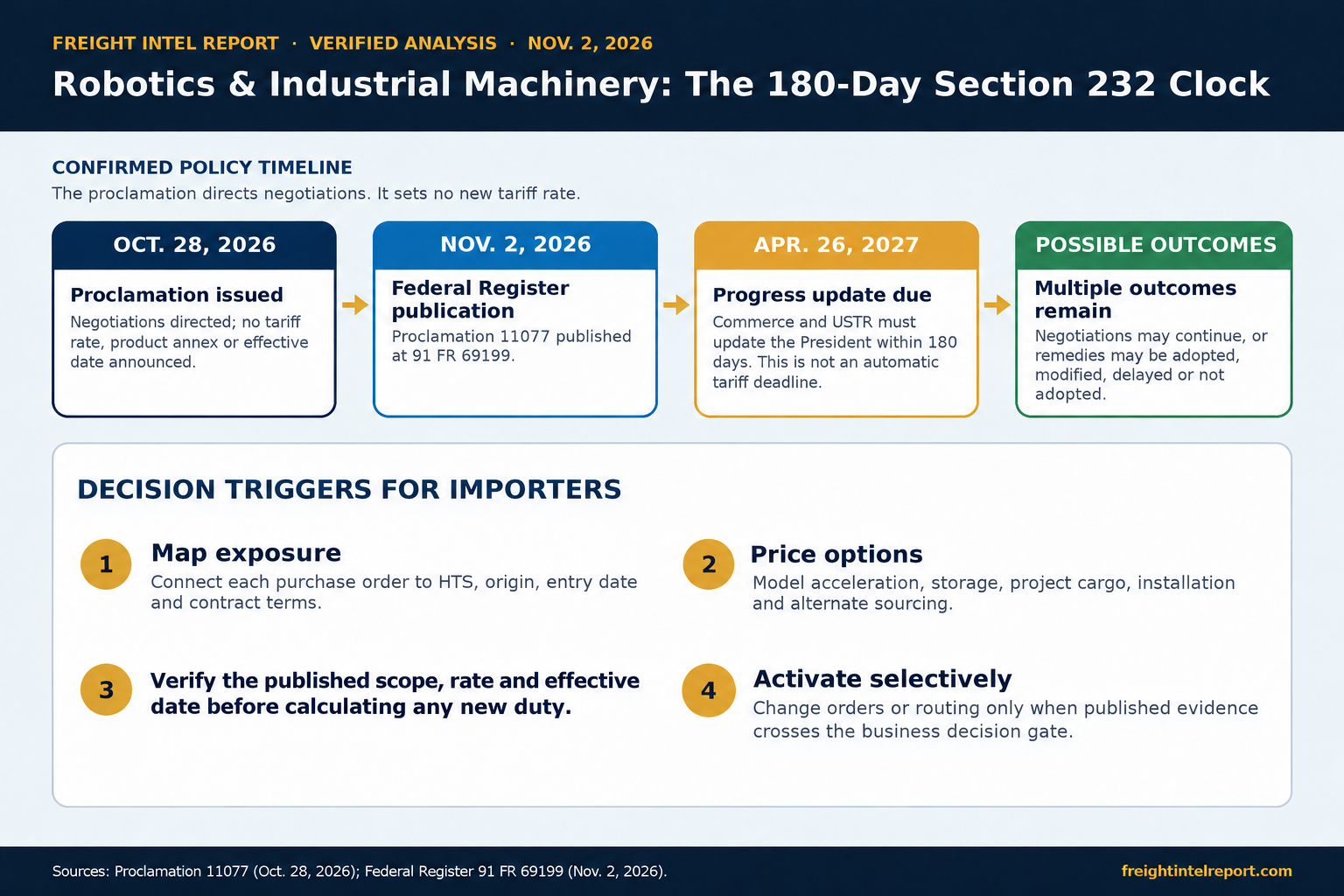
The United States has opened a new trade-policy clock for robotics and industrial machinery. It has not imposed a new tariff rate.
That distinction is the starting point for importers after the October 28 presidential proclamation on robotics, industrial machinery, and their parts and components. The proclamation accepts the Commerce Department’s finding that these imports threaten to impair national security, directs the Commerce Secretary and the U.S. Trade Representative to pursue negotiations with trading partners, and requires a progress update within 180 days.
The 180th day is April 26, 2027.
The proclamation also preserves a broad set of possible later remedies, including tariffs, duties, quotas, fees and incentives for domestic production. But it does not publish a new duty rate, an effective date for a new charge, a country list, a covered-product annex, a transition rule or a set of Chapter 99 filing instructions.
For shippers, manufacturers and importers, the immediate task is therefore not to add a hypothetical percentage to every machine purchase. It is to identify which purchase orders, capital projects, replacement parts and freight commitments would become exposed if negotiations produce a new restriction.
What the proclamation establishes
The policy finding is broad. The proclamation says robotics and industrial machinery are important to defense production and all 16 critical-infrastructure sectors. It cites their use in automotive, electrical and electronics manufacturing, metal and machinery production, plastics and chemicals, food and beverage, construction equipment, medical devices and aircraft.
It also says the United States relies on foreign imports for most types of robotics and industrial machinery and their components, and that domestic production does not meet current national-security needs.
The action taken now is negotiation. Commerce and USTR may negotiate with any trading partner they consider appropriate and must update the president within 180 days. Depending on those negotiations, the president may consider other remedies.
This is a live policy process, not a completed tariff schedule.
What importers still do not know
The proclamation uses a wide product description, but it does not provide the entry-level detail needed to calculate a shipment’s liability.
The earlier Commerce investigation described the category as including robots and programmable, computer-controlled mechanical systems. The investigation notice referenced equipment such as CNC machining centers, turning and milling machines, and grinding and deburring equipment. That helps define the policy’s reach, but it is not a substitute for a final HTS annex or Customs instructions.
Importers still need answers to five questions:
- Which HTS classifications and components will be covered?
- Will treatment vary by country, supplier, end use or negotiated agreement?
- Will a future remedy be a tariff, quota, fee, minimum price, investment arrangement or combination?
- What entry date, in-transit exception or bonded-inventory rule will control application?
- How will a new remedy interact with existing duties, exclusions, trade programs and other Section 232 measures?
Until those details are published, an importer cannot determine any additional duty liability under a future robotics or industrial-machinery measure.
FIR’s finding: the first cost risk is logistical, not just customs
The most expensive mistake may be treating this as a spreadsheet-only tariff problem.
Industrial machinery often requires long production lead times, special crating, project cargo or out-of-gauge capacity, rigging, permits, plant-access planning, installation crews and a scheduled production shutdown. Replacement parts can have the opposite profile: small physical size but an immediate effect on uptime.
If companies rush to pull every shipment forward before policy details exist, they may create premium freight, storage, demurrage, detention, financing and installation costs that exceed the duty they hoped to avoid. If they wait for a final proclamation before mapping exposure, they may discover that a machine cannot be accelerated, substituted or rerouted inside the remaining window.
The correct response is a staged decision process: identify exposure now, price alternatives, and activate them only when evidence crosses a defined threshold.
Build the exposure file before assigning a rate
The useful control file should be organized at the purchase-order and line-item level, not only by supplier.
For every open or planned purchase, record:
- Product description, model and function.
- Current HTS classification and the basis for that classification.
- Country of origin, export country, manufacturer and seller.
- Capital equipment, component, tooling, consumable or replacement-part status.
- Purchase price, Incoterm and party responsible for duties.
- Production-completion estimate, booking date, expected departure and expected U.S. entry date.
- Mode, equipment type, dimensions, weight, port or airport, inland route and installation deadline.
- Existing duty, Section 232, antidumping or countervailing-duty exposure and claimed trade-program treatment.
- Substitution options, domestic alternatives and the operational cost of delay.
The current 2026 Harmonized Tariff Schedule remains the authoritative published schedule. USITC published Revision 22 on October 30, after the original research cutoff. That revision addresses specified Canadian goods and does not add robotics or industrial-machinery tariff instructions. A future remedy would require importers and brokers to apply the final legal instructions, not a press-release category or an internal product nickname.
Model three policy outcomes
1. Negotiated agreement
A trading partner may reach an agreement that changes or limits the eventual remedy. Importers should not assume that an agreement protects every product from that country. The final terms may depend on origin, volume, end use, investment commitments or product exclusions.
Decision trigger: compare the agreement’s exact scope with the HTS, origin and manufacturer fields in the exposure file before changing orders or budgets.
2. Negotiations continue or the decision is delayed
The 180-day requirement is a progress-update deadline, not an automatic tariff effective date. Negotiations could continue, and the administration could request more work or defer a final remedy.
Decision trigger: keep scenario reserves and contract protections active until an operative legal document supplies a rate, scope and effective date. Do not turn a delay into a zero-risk assumption.
3. Tariffs, quotas or fees are imposed
A final action could raise entry costs directly or limit volume. It could also create a rush for production slots, project-cargo capacity, warehouse space and installation windows before an effective date.
Decision trigger: activate only the purchase-order changes supported by the final HTS scope, country treatment, entry rules and business-loss calculation.
What procurement and logistics teams should do now
Separate critical spares from discretionary capital projects
A replacement control module that prevents a production stoppage should not be managed like a new line scheduled for next year’s expansion. Rank purchases by operational consequence and the time needed to replace the source.
Put tariff-change language next to delivery language
Review who bears a new duty under the purchase order and Incoterm, but also review cancellation, delay, storage, force-majeure and delivery-window provisions. A supplier’s willingness to split an invoice does not establish the correct customs treatment, and a contract clause does not override entry law.
Price an acceleration before approving it
For heavy or oversized machinery, include special equipment, port handling, escorts, permits, transload, storage, rigging, financing and plant-disruption cost. For urgent parts, include premium air freight and the value of avoided downtime.
Require a broker-ready classification packet
Maintain technical specifications, drawings, bills of material, principal-use information, origin support and prior rulings. A broker needs product facts—not only a supplier description—to evaluate classification and future remedy instructions.
Establish an evidence gate
Do not accelerate freight solely because the proclamation exists. A workable gate could require a published product scope plus one of the following: a stated rate, a defined effective date, a credible supplier cutoff, or a business-loss calculation showing that waiting is more expensive than acting.
A 180-day management cadence
The clock should create checkpoints, not daily speculation.
- First 30 days: complete the SKU, machinery and open-order exposure inventory.
- By 60 days: obtain classification support, origin documentation and contract positions for the highest-value items.
- By 90 days: price acceleration, alternate sourcing and inventory scenarios; identify capacity or installation constraints.
- By 120 days: refresh supplier lead times, booking windows and customer commitments.
- By 150 days: prepare broker instructions and executive decision memos that can be activated when final details appear.
- At the 180-day update: compare the actual government action with the exposure file before releasing purchase-order, routing or budget changes.
These are internal planning gates, not government deadlines other than the proclamation’s 180-day update requirement.
The decision now
No importer should claim a new robotics or industrial-machinery tariff from this proclamation alone. No shipper should assume the risk is remote merely because a rate was not announced on October 28.
The policy process has moved from investigation to negotiation. That makes the next 180 days valuable preparation time.
The companies best positioned for the outcome will not be those that guess the eventual rate most confidently. They will be those that can connect a final legal scope to the correct product, origin, entry date, contract, freight plan and business consequence before they act.
We will continue to follow this story as it develops. FIR will update this analysis when the government publishes a product annex, country terms, Customs instructions or another operative decision.
Editorial note: This article provides general trade, transportation and operational information. It is not legal, customs, tax or investment advice. Importers should confirm classification, origin, entry treatment and any future trade-remedy instructions with qualified customs counsel and their licensed customs broker using the controlling legal documents.
Primary sources
- The White House, presidential proclamation, October 28, 2026.
- Federal Register, Proclamation 11077, published November 2, 2026.
- The White House, fact sheet, October 28, 2026.
- U.S. Department of Commerce, Bureau of Industry and Security, original investigation notice, September 26, 2025.
- U.S. International Trade Commission, 2026 HTS Revision 22.
- U.S. Customs and Border Protection, Harmonized Tariff Schedule information.


Leave a Reply