
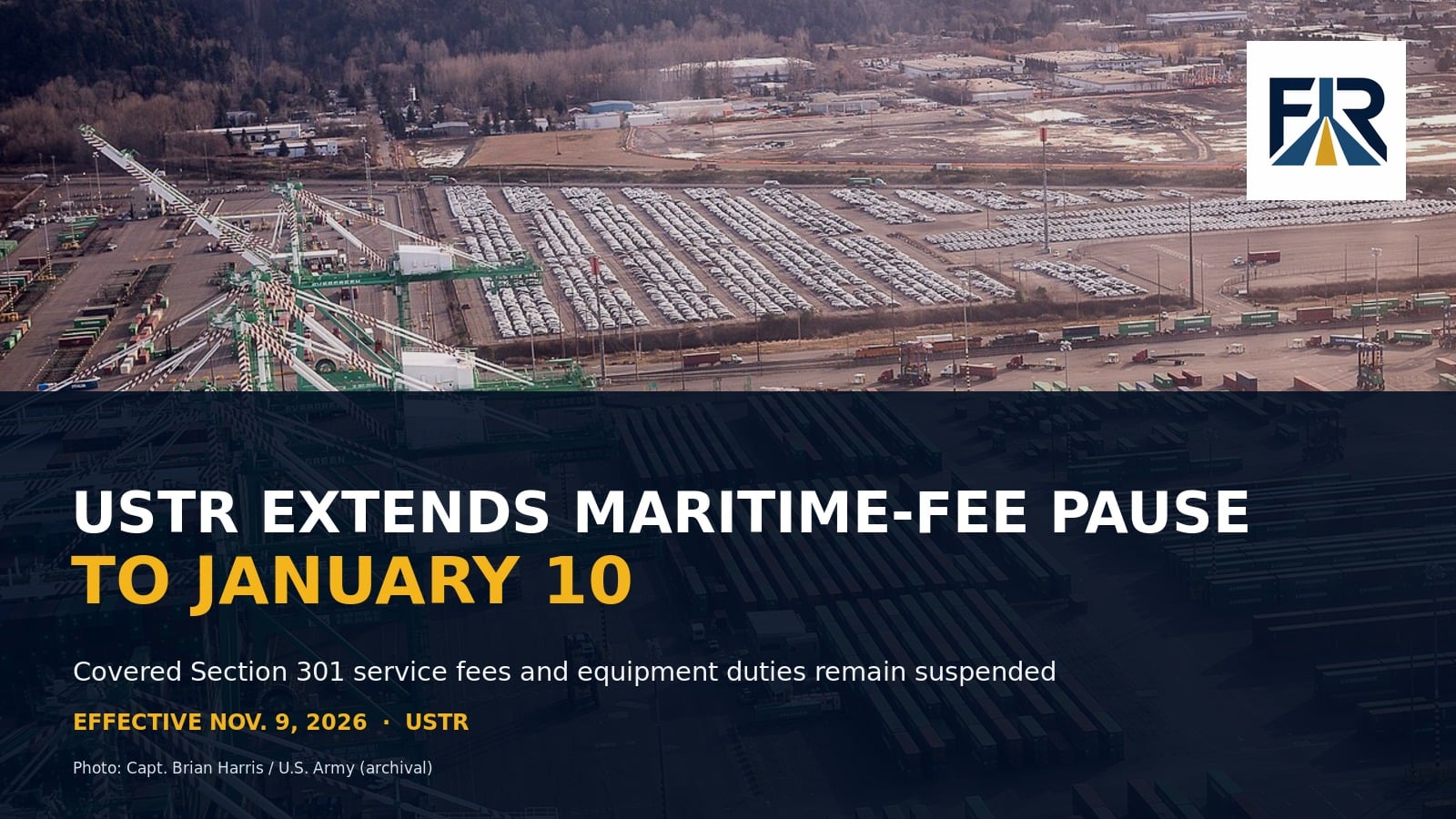
The Office of the United States Trade Representative has extended the suspension of a Section 301 action covering fees on certain maritime transport services and duties on Chinese ship-to-shore cranes and other cargo-handling equipment.
The extension is effective November 9, 2026. It runs through 11:59 p.m. Eastern on January 9, 2027, with January 10 now serving as the next potential restart date.
For shippers, the immediate consequence is straightforward: USTR's final notice says no party will accrue liability for or be required to pay the covered maritime-service fees under Annexes I, II or III during the suspension. It also says no party will accrue liability for or be required to pay the duties provided in Annex V.A during the same period.
The harder question is what happens to freight and equipment commitments that extend beyond January 9.
The pause is final, but the policy is not settled
USTR originally proposed the two-month extension in October. The agency has now made that extension final after receiving approximately 60 unique comments.
Some commenters supported the pause because it could avoid higher shipping costs and commercial disruption. Others opposed it, arguing that the action was needed to support investment in U.S. shipbuilding and related industries. USTR said the circumstances supporting the earlier suspension remain in place while discussions with China continue.
The agency also changed the relevant Harmonized Tariff Schedule dates for headings 9903.91.12 through 9903.91.16 from November 10, 2026, to January 10, 2027.
This is not a permanent repeal. USTR said it will continue monitoring the investigation and may decide before January 10 whether to continue the suspension or take further action.
That uncertainty matters because a rate quote, service contract, equipment order or port project can begin during the pause and still carry cost exposure after it ends.
What shippers should do now
1. Challenge any invoice that treats the covered Section 301 charge as currently payable
For the suspension period, the final notice is explicit: liability does not accrue for the covered Annex I–III maritime-service fees or Annex V.A duties.
Ask carriers, forwarders, customs brokers and equipment suppliers to identify any charge described as a USTR, Section 301, Chinese-vessel, maritime-service or crane-related fee. Require the provider to state the legal basis and the applicable annex or tariff heading.
Do not assume every new ocean or port charge is part of this action. The notice does not suspend ordinary carrier surcharges, terminal charges, port fees or unrelated tariffs. A clean invoice should distinguish the covered federal action from every other line item.
2. Put a January 10 trigger into contracts that cross the deadline
Any ocean agreement, spot quote, project budget or equipment purchase covering activity on or after January 10 should answer four questions in writing:
- Which party bears a restarted or modified Section 301 fee or duty?
- What event triggers the charge: booking, vessel call, service performance, customs entry or another defined milestone?
- What documentation must accompany a pass-through charge?
- Can either party reopen the price, reroute the shipment or cancel without penalty if USTR changes the action?
A generic “government charges may apply” clause gives the supplier maximum flexibility and the shipper minimum visibility. The better clause ties any pass-through to the final government action, the specific movement or entry and proof that the charge was actually incurred.
3. Preserve the classification record behind each covered or potentially covered move
The action has multiple annexes and has already been modified more than once. Do not rely on a spreadsheet labeled simply “China fee.”
Ask the carrier, forwarder or broker to preserve the facts and written classification used to determine whether a service or equipment entry falls within the covered annexes and tariff headings. Keep that record with the quote, booking, entry packet and invoice.
If the action resumes in a revised form, a documented classification trail will be more useful than trying to reconstruct the provider's assumptions after the charge appears.
4. Separate ocean-service exposure from equipment-import exposure
The pause covers two different cost channels: maritime-service fees and duties on specified ship-to-shore cranes and other cargo-handling equipment.
Cargo owners should focus on transportation contracts and invoice controls. Ports, terminal operators, equipment buyers and project sponsors should also review the customs timing and tariff classification of equipment expected to enter near January 10.
Moving an order date is not necessarily the same as moving the customs event that controls duty treatment. The broker and buyer should identify the relevant entry milestone and document the contingency rather than assuming the suspension follows the purchase order.
5. Build three scenarios instead of betting on one outcome
The next USTR decision could extend the suspension, allow the action to restart, or modify the action again.
- If the pause is extended: remove temporary reserves only after the final notice and effective dates are verified.
- If the action restarts: activate the agreed cost-allocation, documentation and routing provisions.
- If the action is modified: rebuild the exposure matrix from the new annexes and tariff language; do not reuse a 2025 or 2026 fee table without checking it.
The wrong planning assumption is that a two-month pause makes the issue disappear. It converts an immediate charge into a dated contingency.
The decision point
Before accepting a quote or contract that extends beyond January 9, require the provider to show how the price changes under each USTR outcome and who carries the cost. For existing shipments and entries during the suspension, verify that the covered federal fee or duty has not been added as if it were payable now.
The next milestone is January 10, 2027, but USTR may act sooner. FIR will watch for a new Federal Register notice, revised annexes, tariff changes and implementation guidance that alters the cost or timing analysis.
We will continue to follow this story as it develops.
Primary sources
- USTR / Federal Register public-inspection notice, filed November 9, 2026; scheduled for publication November 10
- USTR Section 301 investigation docket and notice history
Leave a Reply