
Decision watch · November 11, 2026
One railroad at the plant gate can leave a shipper negotiating without a credible rail alternative. A pending Surface Transportation Board decision could change how businesses seek access to a competing carrier—but it has not opened that access yet.
The STB’s current case-status page lists EP 788, Eliminating Regulatory Barriers to Competition: Review of Part 1144, under Board Review, with November 2026 as the expected month for its next action. That is a timing estimate, not a guaranteed final ruling or an effective date. FIR’s November 11 review of the official docket found no final rule.
For shippers, the useful question is whether a potential change could produce an alternative that works at their own facility. A second carrier’s name on a map does not answer that question. Route access, switching arrangements, total cost and delivery performance all need to be tested.
What the Board is considering
The January proposal would repeal Part 1144, the regulations governing certain requests for reciprocal switching, through routes and through rates. It would let the Board evaluate those requests case by case under the applicable statutory standards. It would not repeal the underlying statutes.
In a reciprocal-switching arrangement, the railroad serving a facility transfers cars within the originating or destination terminal area to another railroad that performs the line haul. Through routes involve longer-distance movements handled by multiple carriers. The proposal covers both; it is broader than a rule about the final switch into a plant.
The STB’s explanation of the proposal says the existing regulations have been interpreted to require proof of anticompetitive conduct and have narrowed the agency’s discretion. Removing that framework could change the path to relief. It would not automatically grant every single-served facility a second carrier, prescribe a switching price, or guarantee lower freight rates.
Why the outcome matters beyond one industry
The issue reaches businesses whose production and customer commitments depend on rail access: manufacturers, agricultural shippers, utilities and other rail users. For procurement and operations teams, a workable alternative could change which carriers they can ask to quote, where freight is interchanged, and how much flexibility they have in future negotiations.
Those are potential consequences, not measured benefits already delivered by EP 788. The USDA’s March comments support repeal while identifying unresolved practical questions, including eligibility, switching fees and distance. USDA also warns that case-by-case proceedings can leave shippers with uncertainty and litigation costs. Its recommendations are a stakeholder position, not rules adopted by the Board.
What shippers should prepare now
Build a facility-specific access file. Record the serving railroad, actual interchange points, track ownership or operating restrictions, commodities, equipment needs and shipment volumes. Ask a prospective connecting carrier to confirm physical and operational feasibility. A nearby line alone is not proof that the carrier can handle the traffic.
Compare the complete move. Request written indications covering line haul, switching, fuel, accessorials, equipment supply and any additional handling. Examine interchange frequency, transit-time variability and responsibility for exceptions. An attractive line-haul indication may lose its advantage once the entire movement is priced.
Preserve evidence and commercial flexibility. Keep service records, dated quotations, communications about access and the operational consequences of missed service. Before renewing long commitments, have transportation and legal teams review volume obligations, routing provisions and any practical ability to revisit terms. Do not assume a pending rulemaking changes an existing contract.
If the Board adopts the proposed approach
Read the actual order before making a commitment. Confirm its scope, effective date, any transition provisions and whether a stay affects implementation. For a facility with a credible alternative, seek rail counsel’s assessment of eligibility, evidence, cost and timing under the final framework.
Continue commercial discussions with both carriers. Move freight only after access, pricing, equipment and operating responsibilities are confirmed; use a controlled trial where practicable before shifting critical deliveries. Do not place projected savings into a committed budget before the alternative has been priced and validated.
If the decision is delayed, narrowed or leaves the framework unchanged
Keep procurement and service planning grounded in arrangements available today. Continue voluntary access discussions, assess feasible transload or other transportation alternatives, and preserve the documentation needed to evaluate existing remedies. Do not let a November timing estimate hold up a necessary renewal or a customer delivery.
FIR’s recommendation is to prepare the evidence and operating plan now, while keeping any decision to change carriers conditional on a legally available, commercially sound and operationally reliable option.
We will follow this story as it develops and update this article when the STB acts or changes the timetable. The next update should distinguish what the Board actually adopted from what shippers still need to establish for their own facilities.
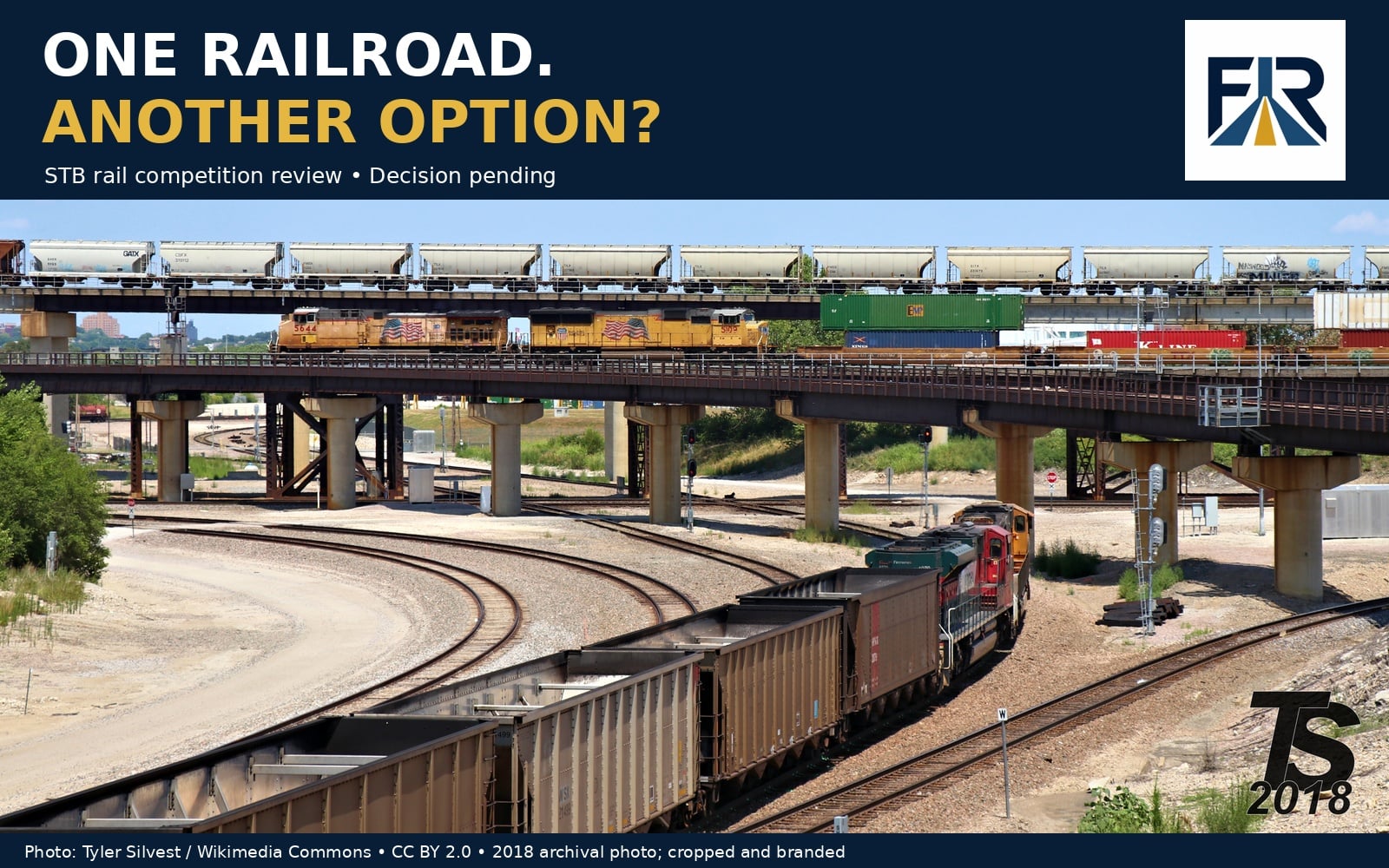
Photo: Tyler Silvest / Wikimedia Commons · CC BY 2.0. Santa Fe Junction, Kansas City, Missouri, July 15, 2018. Archival photograph; cropped and FIR branding added. Photo source.

Leave a Reply