
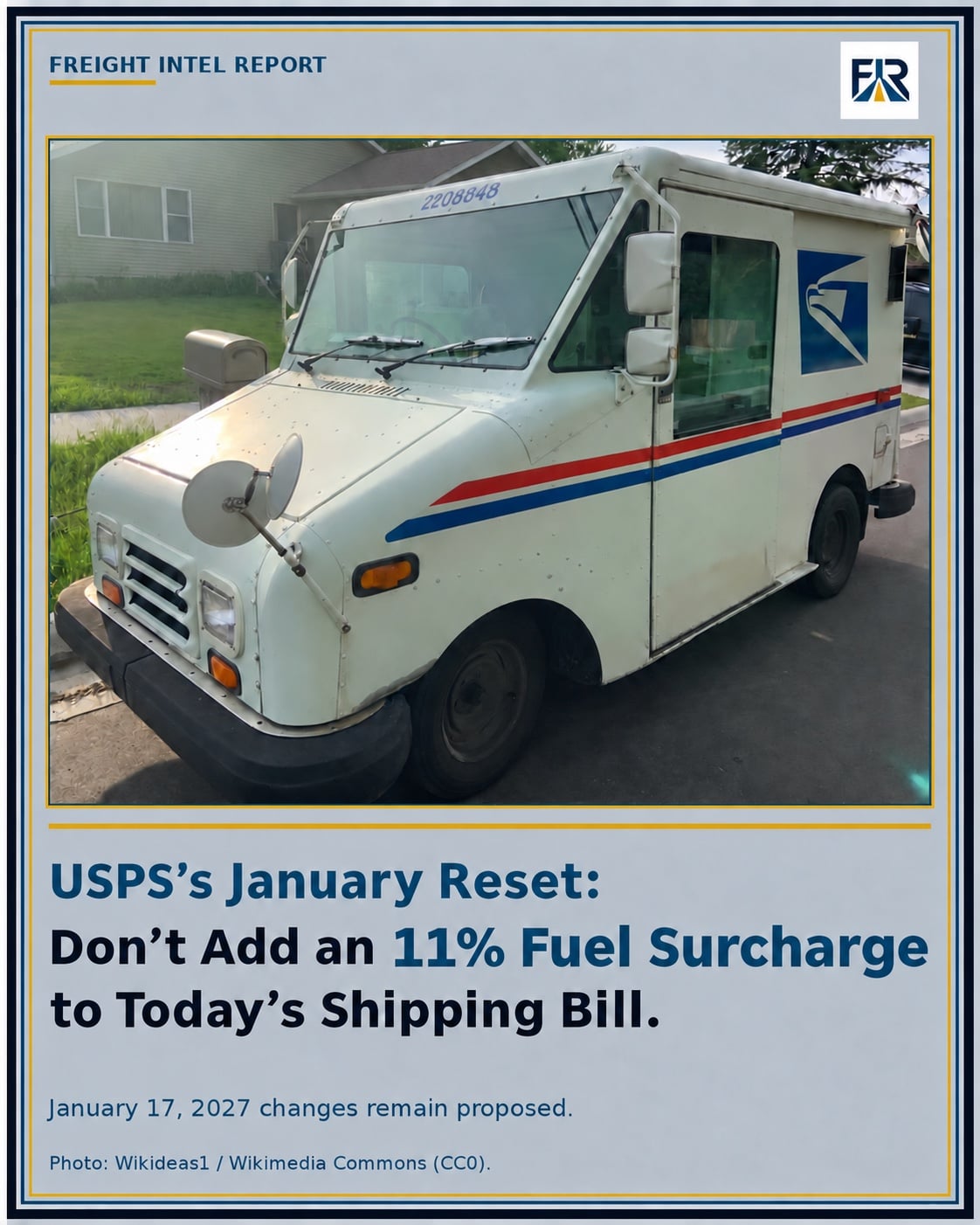
For a manufacturer shipping replacement parts or an online seller absorbing delivery costs, USPS’s proposed January changes require a shipment-level repricing—not an 11% blanket increase to today’s labels. An existing transportation adjustment would be replaced, holiday pricing would end, and new postage rates would begin around the same transition.
The immediate decision: do not change customer shipping charges or free-shipping thresholds until your postage provider shows how each component appears in a complete January quote.
What changed—and what has not taken effect
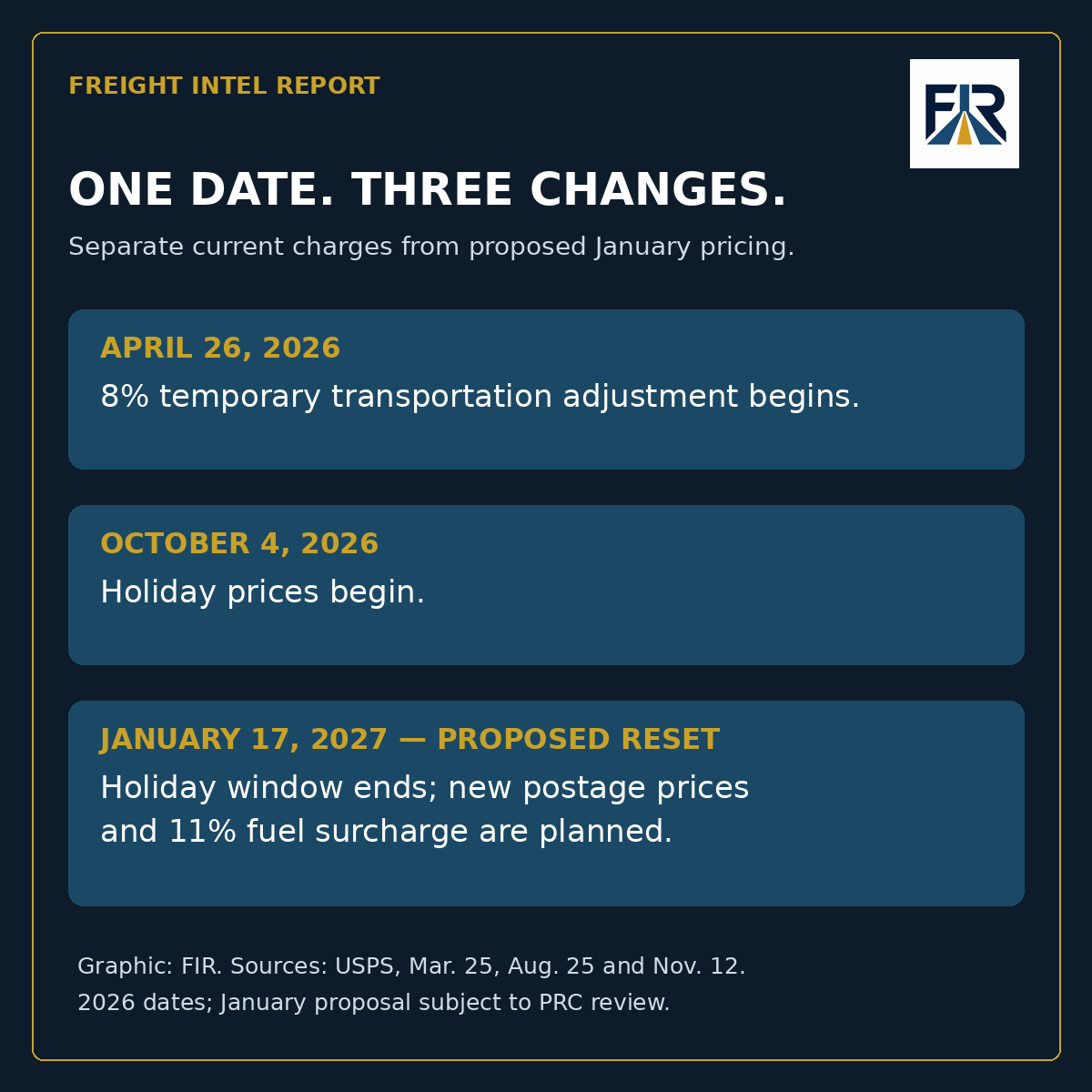
USPS announced November 12 that it had filed proposed shipping-price changes for January 17, 2027. The domestic announcement covers Priority Mail Express, Priority Mail, USPS Ground Advantage and Parcel Select, with an average postage-price increase of 5.9%.
USPS would convert the 8% temporary transportation-related adjustment introduced in April into a permanent fuel surcharge totaling 11%. It says international products would not face that surcharge at this time, and that the surcharge will be reevaluated in July 2027. These are announced terms, not a measurement of any reader’s future shipping bill.
The January price files remained marked “Proposed” when checked for this report. The USPS employee announcement explicitly makes implementation subject to favorable Postal Regulatory Commission review. FIR did not verify a final PRC order authorizing this package; treat it as proposed rather than an already effective charge.
The overlooked comparison: January is not just another increase
The holiday price window began October 4 and ends January 17. That matters because an invoice paid during peak season is not a clean starting point for measuring the next underlying price change. USPS’s August announcement identifies different holiday adjustments by service, zone and weight.
FIR analysis: the operational problem is a baseline reset. Adding 11% and 5.9% to today’s total cannot establish your January increase. It risks treating a replacement fuel mechanism as wholly additional, retaining a seasonal component that is ending, and treating an average postage change as an individual parcel’s rate.
There is no defensible universal net increase in this report. A shipment’s result depends on its applicable price cell and account terms. A provider may display fuel separately or include it in the returned quote; obtain written confirmation before adding anything manually.
A second exposure: inaccurate package data
The November 12 filing also proposes a repricing fee for inaccurate dimensions or weight: 20% of the shortpaid amount would be added to the postage owed; for overpayments, 20% would be deducted from the overpaid amount, subject to refund rules. That is not a 20% charge on every shipping bill. The filing separately proposes a $5 charge for specified barcode noncompliance.
The draft fuel schedules calculate the surcharge on base postage. USPS describes a static January surcharge and a possible later move to weekly adjustment—not weekly fluctuation already scheduled to begin in January. A lower fuel price therefore should not be assumed to produce an immediate automatic reduction.
What the shipping manager should do now
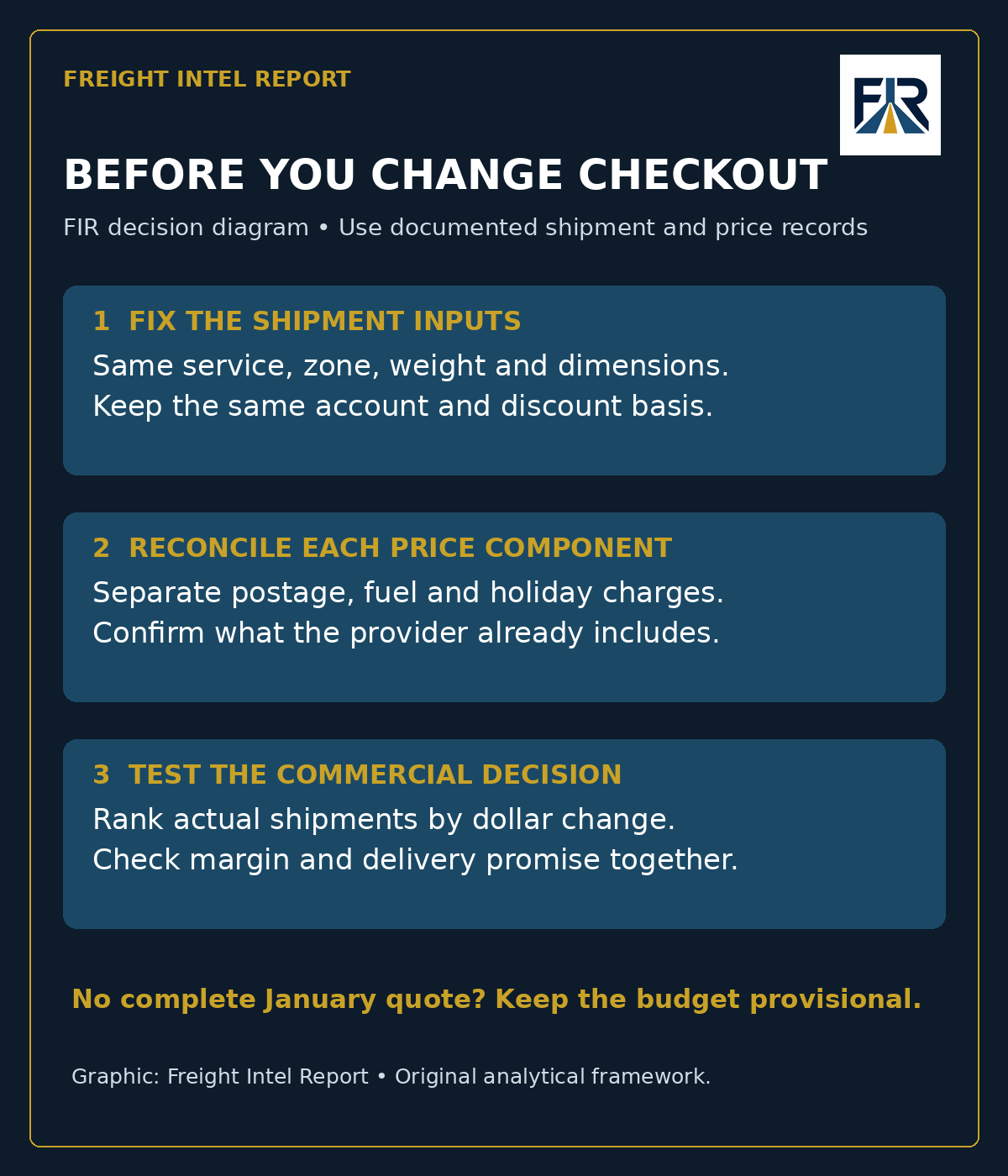
Build a comparable shipment file. Use actual recent manifests, including the services and destinations that matter to your customers. Retain actual billed weight, dimensions, zone, account pricing, postage corrections and delivery results. Separate returns from outbound shipments if their commercial terms differ.
Ask your provider for a transparent rerate. Request current all-in charges and proposed January all-in charges for those same shipment records. Have the provider identify seasonal charges removed, replacement fuel treatment, changed postage and applicable fees. Keep the written quote, version and proposed effective date together. Do not add a surcharge twice.
Rank dollar exposure, not just percentage changes. Look first at lanes and products with the largest documented aggregate increase, then at orders whose contribution after shipping becomes unacceptable. Revisit free-shipping thresholds only after that analysis. No new threshold or savings claim can be justified without the seller’s actual order economics.
Test alternatives against the delivery promise. A cheaper label is not a usable substitute if it cannot support the required service. Compare actual available services, charges and delivery commitments before changing routing. For urgent replacement parts, involve the service or maintenance owner before trading transit performance for price.
What FIR will follow next
The next decision points are PRC action in Docket CP2027-1, changes to the proposed price files, and provider confirmation of January implementation. If the package changes, rerate the same shipment file so the difference reflects pricing rather than a different shipment mix.
If review or implementation is delayed, keep the existing effective price set in production and retain the January version as a planning case. Do not promise customers a change until its actual terms and effective date are confirmed.
Bottom line: January’s risk is not captured by a single headline percentage. The useful work now is to reconcile the transition on real parcels and correct shipment data before either creates a margin problem.
Sources and reporting basis
External addresses below are plain text, not live links. Source check: November 17, 2026. No invented shipment prices, savings or financial scenarios are used.
S1 • USPS newsroom • November 12, 2026
https://about.usps.com/newsroom/national-releases/2026/1112-usps-recommends-shipping-price-adjustments-for-2027.htm
Primary: 5.9% average, 8% to 11% replacement, scope and July reevaluation.
S2 • USPS employee news • November 12, 2026
https://news.usps.com/2026/11/12/usps-recommends-shipping-price-changes/
Primary: favorable PRC review condition.
S3 • USPS filing CP2027-1 • filed November 12, 2026
https://prc.arkcase.com/api/prc-dockets/filing/downloadFile?fileId=258184&inline=true
Primary: filing ID 141208; fuel framework, repricing and barcode provisions. See opening notice and Governors’ Decision 26-8; base-postage schedules in sections 2105.6, 2110.6, 2115.6, 2125.6.
S4 • USPS Postal Explorer • checked November 17, 2026
https://pe.usps.com/PriceChange/Index
Primary: January files marked Proposed, revised November 12; holiday files marked Final. No procedural government link is offered.
S5 • USPS holiday announcement • August 25, 2026
https://about.usps.com/newsroom/national-releases/2026/0825-usps-announces-temporary-price-change-for-2026-holiday-shipping-season.htm
Primary: October 4–January 17 holiday window; product/zone/weight differentiation.
S6 • USPS transportation announcement • March 25, 2026
https://about.usps.com/newsroom/national-releases/2026/0325-usps-announces-transportation-related-time-limited-price-change.htm
Primary: April 26 implementation of temporary transportation adjustment.
S7 • FreightWaves • November 13, 2026
https://www.freightwaves.com/news/usps-to-add-11-permanent-fuel-surcharge-along-with-parcel-rate-hike
Independent corroboration of surcharge and pricing package. Opening “total shipping bill” wording is not adopted; the filing specifies base postage.
S8 • Reuters • November 12, 2026
https://www.reuters.com/world/us/usps-plans-11-fuel-surcharge-package-deliveries-2026-11-12/
Independent corroboration of proposal and review status. No financial-loss figures imported.
Leave a Reply