
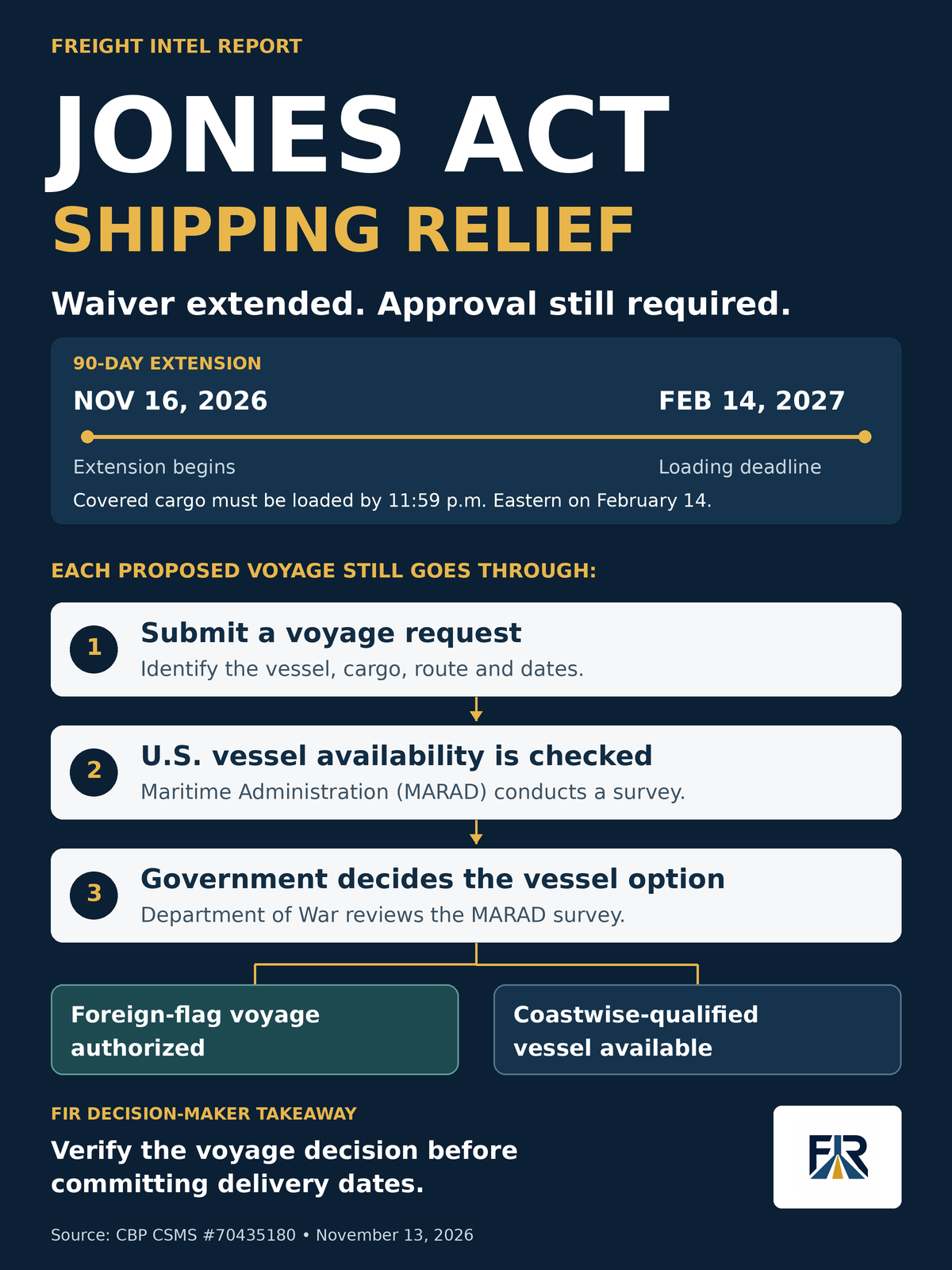
The Jones Act waiver extension gives buyers of covered commodities more time to seek domestic shipping options. The commercial risk sits in the next step: promising a delivery before the proposed foreign-flag voyage has been authorized.
U.S. Customs and Border Protection’s November 13 guidance confirms an extension beginning November 16, 2026, at 12:00 a.m. Eastern. It specifies that covered products must be loaded aboard the relevant vessel before 11:59 p.m. Eastern on February 14, 2027. CBP describes the action as a 90-day extension. [1]
For scheduling, use the bulletin’s express dates and obtain confirmation for a time-sensitive movement. The stated cutoff concerns loading covered cargo; it should not be presented as a universal delivery deadline.
The extension is approved. Voyage authorization remains conditional.
The Jones Act generally reserves domestic waterborne cargo transportation between U.S. points for vessels meeting coastwise requirements. This waiver concerns qualifying domestic movements; it is not a general authorization for every commodity or foreign-flag vessel. [2]
CBP requires a written vessel-availability request before a proposed voyage. MARAD surveys coastwise-qualified vessel availability and passes its findings to the Department of War, which determines the authorized vessel option for that individual movement. The bulletin also supplies a list of potentially covered products. [1]
The voyage-review process was already part of CBP’s August guidance. The new development is the extension taking effect November 16, rather than the introduction of an entirely new approval system. [3]
The timing trap for procurement teams
FIR analysis: A supplier’s statement that shipping relief is available does not establish that its proposed vessel, cargo and loading schedule have cleared the required review. Buyers should distinguish a proposed movement, a submitted request and an authorized voyage in their planning records.
CBP normally gives coastwise-qualified vessels 24 hours to respond to MARAD’s market survey, unless MARAD specifies otherwise. That is a vessel-response window, not a promised end-to-end approval time. [1]
Do not build an inventory commitment around an assumed one-day clearance. Ask who owns the request, what remains unresolved and when the transportation plan will be escalated if authorization is still pending.
What shippers should protect now
Confirm eligibility before treating a quote as executable. Have the responsible shipping and compliance teams check the cargo against CBP’s current product list and confirm how the proposed movement fits the waiver. A potentially covered product is a starting point for verification, not proof that a particular voyage is authorized.
Tie delivery promises to confirmed operating arrangements. Request the voyage decision, vessel identity and agreed loading window before making an unconditional customer commitment. Separately confirm terminal availability, storage, receiving capacity and any onward transportation. Authorization alone does not complete those commercial arrangements.
Allocate the cost of a failed plan. Review charter cancellation, storage, handling and substitute-transport terms before committing funds. Specify who approves an alternative and which party bears the resulting costs. Use actual quotes and contract terms to compare options; there is no defensible universal savings figure in the announcement.
Prepare for approval, delay or a different vessel
If the foreign-flag voyage is authorized: reconcile the decision with the movement being booked and confirm the cargo, vessel and dates. Keep the approval record with the shipment documents and assign responsibility for required CBP notification and post-voyage reporting. MARAD’s guidance identifies reporting obligations after a voyage conducted under a waiver. [2]
If review remains pending: maintain a qualified alternative and establish a commercial decision deadline before a missed loading window threatens supply. Tell receiving sites which dates are conditional. Avoid paying for overlapping arrangements without an agreed cancellation plan.
If a coastwise-qualified vessel is available or the proposed foreign-flag option is not authorized: reassess the permitted transportation plan, timing and delivered cost. The extension should not be used as a reason to proceed without the necessary authorization.
What this means for other freight buyers
The direct operational relevance is to parties arranging covered domestic maritime movements. For general truckload, LTL and intermodal buyers, any benefit through fuel availability or prices remains uncertain. The extension itself does not establish a lower diesel price or rewrite a freight contract’s fuel-surcharge mechanism.
Keep fuel budgets tied to verified market data and the index, lag and formula in the actual agreement. Do not book anticipated savings from this announcement alone.
FIR will continue to follow this story as it develops and update this article when authoritative guidance changes the scope, timing or voyage-review process.
Sources and reporting notes
[2] MARAD: domestic shipping, Jones Act framework and waiver reporting.
Primary guidance checked November 16, 2026. CBP’s “90-day” description and its express start and cutoff dates are reproduced as published; FIR has not substituted a recalculated deadline. Operational recommendations are FIR analysis. No shipment-specific authorization, guaranteed savings or nationwide capacity effect is asserted.


Leave a Reply