
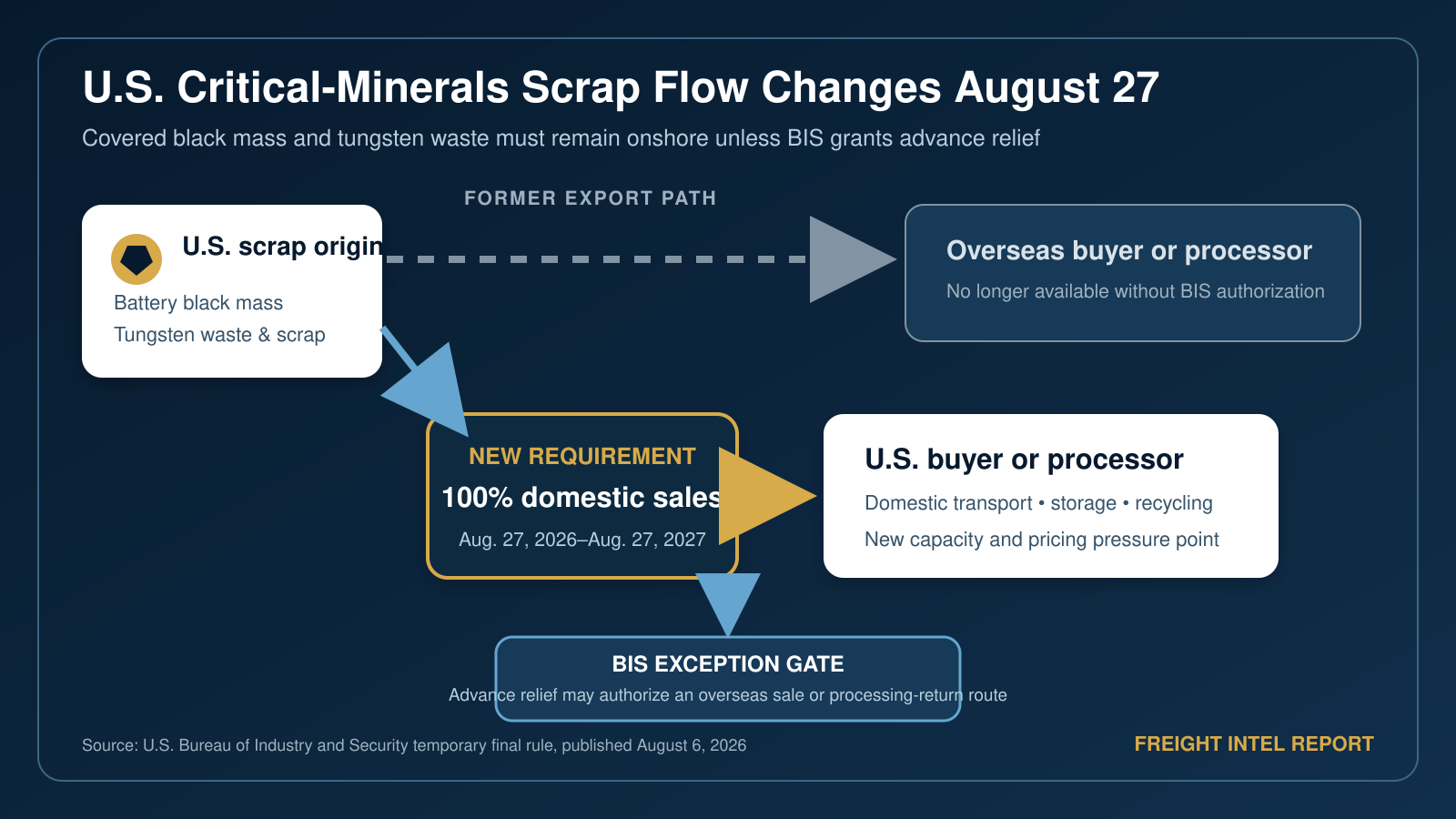
Beginning August 27, a category of U.S. critical-minerals freight will be forced to reverse direction.
The Commerce Department’s Bureau of Industry and Security has ordered U.S. sellers of covered lithium-ion battery “black mass” and tungsten waste and scrap to allocate 100% of monthly sales to U.S. persons. Unless BIS grants advance relief, the material must remain physically inside the United States through August 27, 2027.
For exporters, scrap dealers, battery recyclers, freight forwarders, hazardous-material carriers and overseas processors, this is not simply an industrial-policy announcement. It is a near-term routing, capacity, classification and contract event.
What the rule requires
The temporary final rule published August 6 creates a domestic-sales requirement under the Defense Priorities and Allocations System.
- Effective period: August 27, 2026, through August 27, 2027.
- Black-mass codes: Schedule B 8549.13.00.00, 8549.14.00.00 and 8549.19.00.00, but only when material meets the rule’s definition of black mass.
- Tungsten code: Schedule B 8101.97.00.00.
- Physical-location requirement: covered material must remain in the United States unless BIS authorizes otherwise.
- Border enforcement: Customs and Border Protection may detain intended export shipments while BIS conducts a review.
Black mass is defined as shredded lithium-ion battery scrap containing cathode material, anode material or other residual battery-cell materials. The rule does not automatically capture every shipment declared under the three electronic-waste codes; the material must also satisfy that definition.
The immediate freight consequence
Outbound flows that previously moved to Asian or other overseas processors may need to be redirected toward U.S. recyclers, storage facilities or intermediate handlers. Existing export bookings and supply contracts covering late-August departures should be reviewed now rather than at the terminal gate.
The likely effects divide in two directions:
- Ocean and forwarding demand: covered export moves should decline unless an exception is secured.
- Domestic reverse logistics: demand could rise for compliant collection, drayage, truckload, specialized storage and processing moves.
That redirection does not guarantee a smooth domestic market. Reuters reported August 6 that the United States does not have enough capacity to recycle all of the scrap it produces. If material accumulates faster than processors can absorb it, the first visible consequences may be storage pressure, weaker scrap values and longer dwell times—not an immediate processing boom.
Exceptions are possible, but they are not automatic
BIS began accepting requests for adjustments and exceptions on August 6. The agency says it intends to respond within 14 days and may grant interim relief while a request is pending.
Possible grounds include exceptional hardship, irreparable harm, additional time needed for compliance, or an overseas processing arrangement in which refined material returns to the United States. Filing a request does not suspend the domestic-sales obligation unless BIS grants written interim relief.
What each stakeholder should do before August 27
Scrap sellers and exporters: classify inventory against the Schedule B codes and the rule’s black-mass definition; identify every contract and booking extending beyond the effective date; and determine whether an exception is necessary.
Freight forwarders and customs teams: flag covered commodity descriptions, confirm the shipper’s BIS authorization status and avoid treating an exception request as permission to export.
Carriers and storage providers: verify hazardous-material handling requirements and prepare for possible changes in domestic routing, dwell time and storage demand.
Domestic processors: evaluate inbound capacity, working-capital needs, insurance, pricing and the ability to accept redirected material safely.
Executives and counsel: review termination, force-majeure, change-in-law and price-adjustment provisions in overseas processing and offtake agreements.
What remains uncertain
The rule does not yet answer every shipment-level question. Important unknowns include the treatment of cargo booked, tendered or staged before August 27; the detailed CBP detention-and-release process; the volume domestic processors can absorb; and whether BIS will add more recoverable critical materials to future allocation orders.
Executive takeaway: Any company touching covered black mass or tungsten scrap should treat August 27 as an operational cutoff, not merely a compliance date. Map the material, contracts, bookings and domestic alternatives now—and do not export without clear authority.
Discussion: Will the domestic-sales requirement create enough dependable feedstock to accelerate U.S. recycling, or will processing constraints first produce a storage and pricing bottleneck?
For independent, decision-focused freight intelligence, subscribe free to Freight Intel Report.
Government services: For government services, verification, registrations, forms, reporting, or instructions, always navigate to the official agency website directly. Independently verify its address before entering credentials or business information.
Leave a Reply