
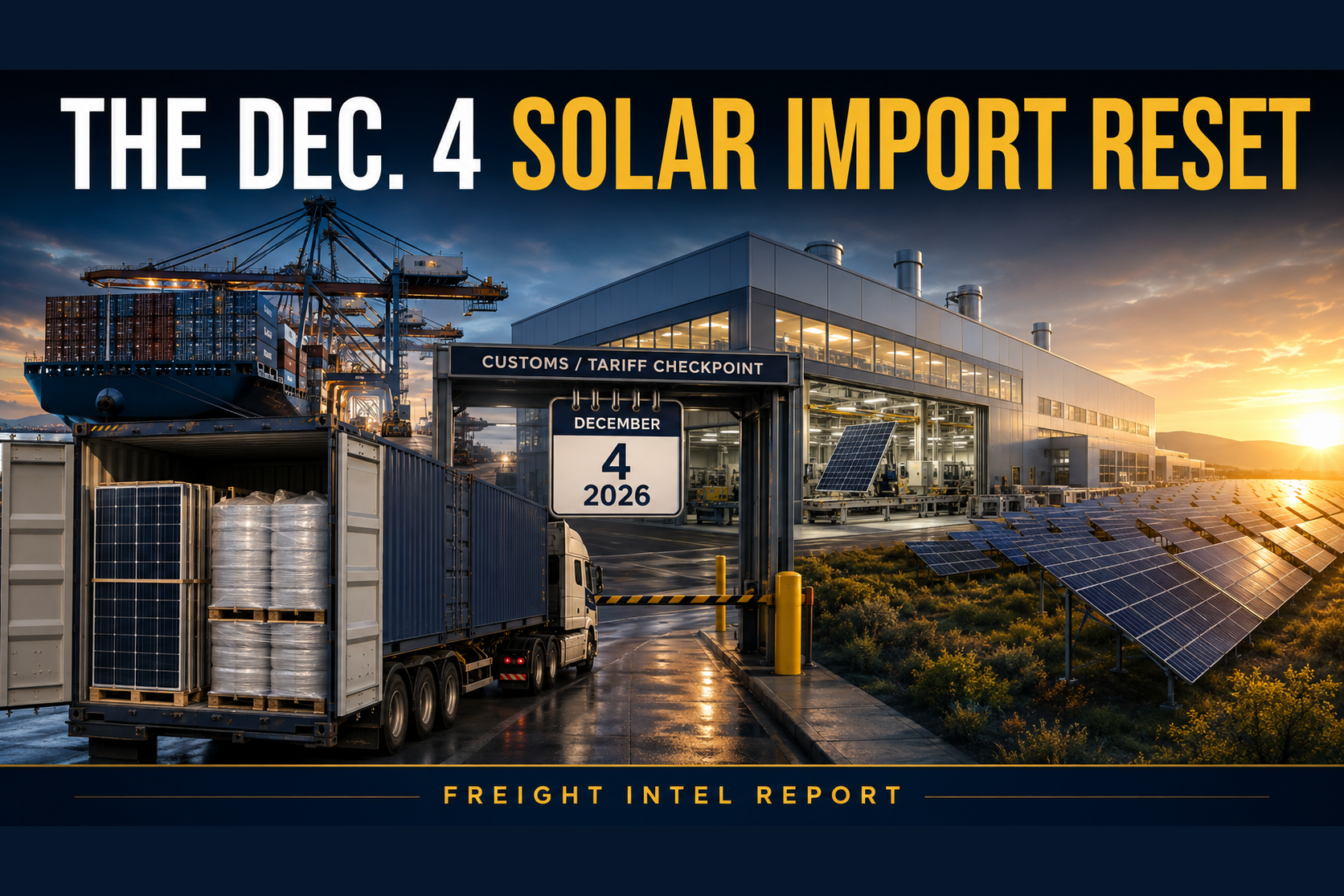
A new U.S. trade regime will change the economics—and the paperwork—of imported polysilicon, wafers, solar cells and modules beginning December 4.
President Donald Trump signed a Section 232 proclamation on August 6 establishing minimum import prices for polysilicon and its derivatives, plus an additional 15% tariff on covered polysilicon ingots and downstream derivatives. For importers, solar developers, customs brokers, ocean carriers, forwarders and domestic manufacturers, the practical issue is no longer whether a policy change is coming. It is whether contracts, entries and inventory plans can withstand the new rules.
The signed White House proclamation sets the operative terms. Reuters and The Wall Street Journal independently reported the action and its supply-chain implications.
What changes on December 4
The minimum import prices are:
- Polysilicon: $21 per kilogram
- Polysilicon ingots and wafers: $100 per kilogram
- Solar cells: $0.22 per watt
- Solar modules: $0.38 per watt
Beginning at 12:01 a.m. Eastern on December 4, 2026, covered imports entered for consumption or withdrawn from warehouse for consumption will be subject to the minimum-import-price program. Covered ingots and polysilicon derivatives identified in the proclamation’s Annex I and Annex II also face an additional 15% ad valorem tariff unless a specified exception or country treatment applies.
This is not simply a China-only duty. The proclamation creates a broader import regime for listed products. Japan, South Korea, Taiwan, Switzerland, Liechtenstein and European Union members receive a combined Section 232 and ordinary duty rate capped at 15%; covered U.K. products receive a 10% Section 232 rate. Commerce may later alter treatment for trading partners that adopt substantially equivalent price floors.
The first freight consequence may be front-loading
The four-month implementation window creates a strong incentive to advance imports. Reuters reported that trade counsel expects a possible surge before December 4, while buyers say the delay is needed to revise supply contracts.
But the proclamation directly addresses stockpiling. If Commerce determines that a company is accumulating covered material before the effective date, it can coordinate with Customs and Border Protection to restrict imports by that company and its affiliates. Importers therefore need a documented commercial reason for accelerated orders rather than a volume strategy built only around tariff avoidance.
For ocean carriers, non-vessel-operating common carriers, customs brokers and ports, the near-term effect could be a compressed booking cycle followed by a post-deadline reset. The magnitude is not yet measurable, and Freight Intel Report is not treating a volume surge as confirmed until booking, import and port data show it.
Contracts signed before August 6 need immediate review
The proclamation allows importers to certify that the first arm’s-length U.S. sale will occur at or above the applicable minimum price. It also recognizes first arm’s-length sales made under fixed terms in contracts entered into before August 6, 2026.
That makes contract language operationally important. Importers should identify which agreements have fixed price and quantity terms, which permit repricing, and whether the contracting entity matches the importer and first U.S. buyer. The pre-existing-contract provision relates to the minimum-price documentation; companies should not assume it automatically removes the separate 15% tariff.
Customs compliance carries unusually high stakes
If the importer does not provide qualifying documentation, the merchandise faces a specific tariff equal to the applicable minimum import price. If the entered value is below the floor, the specific tariff equals the difference between the entered value and the minimum price.
CBP will monitor the certifications. A materially inaccurate filing or material failure to comply can permanently bar the importer and its affiliates from importing covered products, in addition to other penalties. That consequence elevates the decision above routine tariff classification: procurement, legal, finance and customs teams need a single auditable record of the transaction chain.
Foreign-trade-zone users also face a change. Covered foreign merchandise admitted on or after the effective date generally must enter in privileged foreign status unless it qualifies for domestic status. Manufacturing drawback remains available only under conditions specified in the proclamation, including limits tied to trade-agreement partners and polysilicon origin.
Who should act now
- Solar and semiconductor importers: map covered products to the annexes, validate country treatment, and decide which entries require minimum-price certification.
- Procurement and legal teams: isolate pre-August 6 fixed-term contracts and review change-in-law, tariff pass-through, cancellation and delivery clauses.
- Customs brokers and forwarders: build document controls for the first arm’s-length sale, entered value, affiliate relationships and foreign-trade-zone status.
- Ocean carriers and ports: watch for legitimate front-loading in wafers, cells and modules, but also for a sharper demand drop after the deadline.
- Developers and project financiers: recalculate landed equipment cost and confirm whether delivery schedules, power-purchase economics and construction milestones remain viable.
- Domestic manufacturers: evaluate Commerce’s forthcoming onshoring program, which can provide duty-free import benefits tied to qualifying U.S. investment commitments.
What remains unknown
Commerce and CBP still must issue implementation guidance. Open questions include the exact certification format, treatment of related-party sales, how aggressively stockpiling will be defined, review procedures for import restrictions, and whether trading-partner arrangements will change coverage before December 4. The tariff also layers onto other applicable duties and trade remedies, so landed-cost effects will vary by product and origin.
Executive takeaway: December 4 is a customs-and-contract deadline, not just a tariff date. Companies moving polysilicon, wafers, cells or modules should validate scope, pricing evidence, contract eligibility and inventory timing now—before front-loaded cargo reaches the water.
Discussion: Will the four-month runway stabilize contracting, or produce a front-loading wave that leaves solar importers and ports with a sharper post-deadline correction?
For independent, decision-focused freight intelligence, subscribe free to Freight Intel Report.
Government services: For government services, verification, registrations, forms, reporting, or instructions, always navigate to the official agency website directly. Independently verify its address before entering credentials or business information.
Leave a Reply