
The newest U.S.–China tariff announcement sounds like a cost event. It is not one yet.
On September 25, the White House said the two countries had reached consensus on recommendations for more favorable tariff treatment for roughly $30 billion of nonsensitive goods in each direction. The U.S. import list includes consumer products such as toys, small appliances, holiday decorations and children’s car seats. China’s list includes U.S. agricultural goods, seafood, wood products, cosmetics and medical devices.
Two days later, the Office of the U.S. Trade Representative described those products as goods that could receive more favorable treatment in the future. The Board of Trade’s working procedures are equally cautious: officials will develop proposals “with a view toward” reduced tariffs, subject to each country’s domestic laws and processes.
That distinction is the first shipper decision point: a recommended product list is not a new duty rate.
As of September 29, the public documents do not specify the size of any reduction or an effective date. Reuters likewise reported that neither side had disclosed the depth or timing of the prospective cuts.
For importers, exporters and transportation buyers, the correct question is not “Did China tariffs go down?” It is: What portion of our customs value, landed cost, margin and freight network would change if—and only if—the recommendation becomes enforceable?
Facts, uncertainty and FIR analysis
What is verified
- The United States and China recommended about $30 billion of goods on each side for possible more favorable tariff treatment.
- The U.S. list is concentrated in selected consumer products, including toys, household items, small appliances, holiday decorations and children’s car seats.
- China’s list includes selected U.S. agricultural products, seafood, logs and wood products, cosmetics and medical devices.
- USTR says the U.S. list would cover approximately 30% of U.S. exports to China. That does not mean 30% of U.S. imports from China—or 30% of an individual importer’s portfolio—would receive relief.
- U.S. goods imports from China totaled $308.7 billion in 2025, according to USTR. The headline $30 billion figure is therefore meaningful at a national level, but it cannot be translated directly into a company savings percentage.
What is not yet known
- The amount of the tariff reduction for each product.
- The effective date.
- Whether all recommended tariff lines will survive the domestic implementation process.
- How origin, entry date, exclusions, quotas or other Chapter 99 provisions may affect eligibility.
- How much of any duty reduction suppliers or customers will capture through repricing.
FIR analysis
The announcement is commercially relevant, but its value will be uneven. A toy importer whose covered classifications account for a large share of customs value could see a material change.
A diversified importer with only a small amount of listed merchandise may see almost no bottom-line effect, even if both companies import the same total value from China.
That is why national trade totals make poor budgeting tools. Materiality is company-specific and product-line-specific.
The six-line China tariff materiality test
1. Build the exposure file at entry-line level
Start with the last 12 months of China-origin entries. At minimum, capture:
- 10-digit HTS classification;
- country of origin;
- entered customs value;
- ordinary duty rate;
- every applicable Chapter 99 or trade-remedy duty;
- duty paid;
- port and date of entry;
- supplier, SKU, business unit and customer program;
- container count, weight or shipment units.
Do not begin with total company revenue or total spend with Chinese suppliers. Tariffs are assessed on qualifying customs value and classification, not the size of the company.
2. Match exact classifications—not product descriptions
“Toys,” “appliances” and “decorations” are reporting categories, not sufficient customs determinations. A tariff change applies through enumerated classifications and implementation language. One product can sit next to another in a catalog and receive different treatment because its composition, function or HTS code differs.
For operational classification and entry questions, shippers should navigate directly to the official U.S. government websites, independently verify the addresses, and review the current Harmonized Tariff Schedule and applicable customs guidance. A broker’s spreadsheet or a news summary is not the controlling source.
3. Establish the current stacked-duty baseline
Before estimating relief, calculate the duty stack that applies today:
Current duty dollars = customs value × (ordinary duty rate + applicable additional tariff rates)
Keep antidumping, countervailing, excise and product-specific charges separate. They may not move with a bilateral tariff decision.
4. Model scenarios, not savings promises
Because the announced framework does not disclose a final rate reduction, use scenarios such as 5, 10 and 15 percentage points. These are planning assumptions, not forecasts.
Illustrative gross relief = covered customs value × assumed tariff-rate reduction
Do not book a savings target until an enforceable notice supplies the tariff lines, rates, dates and qualification rules.
Same headline, radically different bottom-line impact
The chart below compares two hypothetical importers. Each has $50 million in annual revenue, $5 million in EBITDA and $12 million in annual customs value from China. The only difference is how much of that China-origin value falls on a future eligible list.
- Importer A: $3 million covered, or 25% of China customs value. Under an illustrative 10-percentage-point reduction, gross annual relief would be $300,000—equal to 6% of baseline EBITDA.
- Importer B: $300,000 covered, or 2.5% of China customs value. The same assumed reduction produces $30,000—just 0.6% of EBITDA.
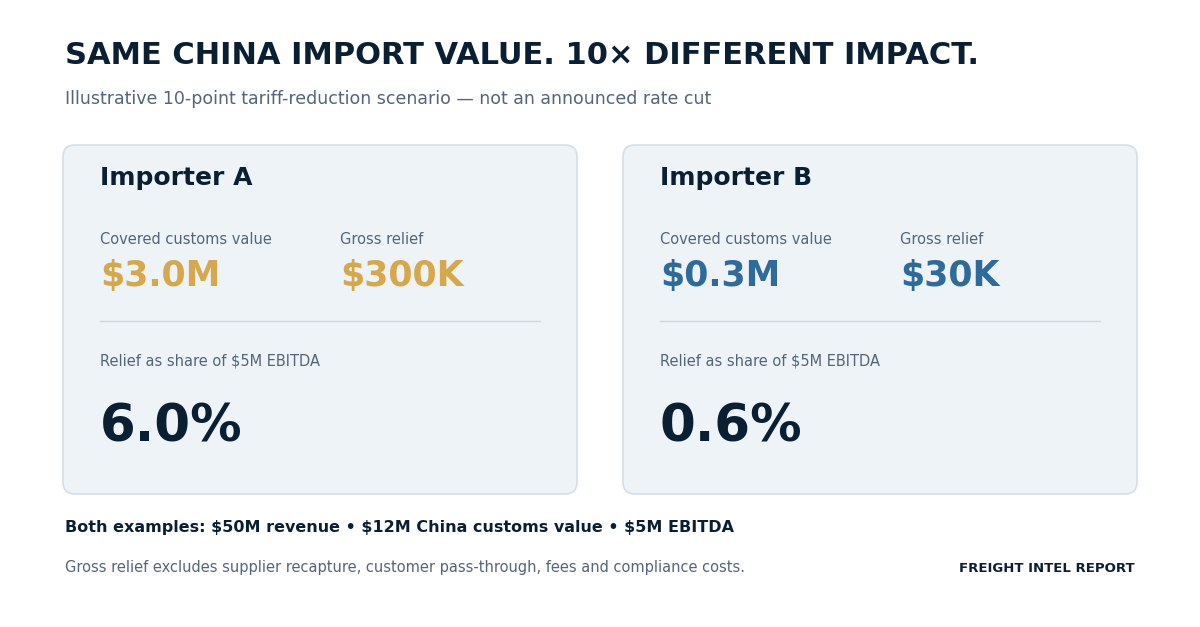
Illustrative scenario only. No 10-percentage-point reduction has been announced. Gross relief excludes supplier repricing, customer pass-through, fees, compliance costs and other taxes.
5. Convert gross relief into retained economics
Gross duty relief is not the same as profit.
Net retained benefit = gross tariff relief − supplier recapture − customer price reductions − implementation and switching costs
Then measure the business consequence:
EBITDA impact = net retained benefit ÷ baseline EBITDA
FIR’s recommended screening bands—not accounting standards—are:
- Below 1% of EBITDA: monitor; avoid disruptive sourcing changes.
- 1% to 5%: meaningful; prepare contract and pricing actions.
- Above 5%: material; elevate to finance, procurement, customs and operations leadership.
Run the same calculation against product gross margin and cash requirements. Duties can be painful even when recoverable if they create a working-capital gap between entry and customer collection.
6. Measure freight exposure separately
A low-dollar tariff change can still matter operationally if covered goods consume a high share of containers, cube, peak-season capacity or time-sensitive purchase orders.
Calculate:
Freight exposure share = covered China-origin containers, weight or units ÷ total relevant freight volume
This reveals whether relief could change order cadence, consolidation strategy, port selection or inventory timing. It also prevents a customs-value analysis from understating the transportation effect of bulky, lower-value products.
What shippers should do now
- Do not change customs accruals yet. No enforceable reduction or effective date has been published.
- Tag potentially covered entry lines and purchase orders. Create a watchlist by HTS code, supplier and business unit.
- Run 5-, 10- and 15-point scenarios. Show gross relief, cash timing, EBITDA effect and sensitivity to supplier repricing.
- Review commercial clauses. Determine whether lower duties flow to customers, remain with the importer or reopen supplier pricing.
- Create an implementation trigger. Act only when final tariff lines, rates and effective dates appear in controlling U.S. and Chinese measures.
- Keep freight and customs decisions connected. If the economics become material, rerun order quantities, mode choices, inventory targets and routing—not just the landed-cost spreadsheet.
The Freight Intel view
The $30 billion announcement is not meaningless, but it is not a universal cost reduction and it is not yet cash savings.
The disciplined shipper response is to separate three layers:
- Policy: a reciprocal recommendation exists.
- Implementation: product lines, rates and effective dates are still required.
- Enterprise materiality: only a company’s own entry data can show whether the eventual change reaches its bottom line or freight plan.
That framework avoids the mistake that weakened many tariff stories: leading with the largest national number while leaving readers unable to determine whether their own exposure is large, small or zero.
Sources
- Office of the U.S. Trade Representative, statement on U.S.–China Board of Trade recommendations, September 27, 2026
- White House fact sheet on the U.S.–China state visit and recommended product groups, September 25, 2026
- U.S.–China Board of Trade working procedures, September 27, 2026
- USTR China trade summary, including 2025 bilateral goods trade
- Reuters, “China, US pledge tariff cuts on $60 billion of goods,” September 28, 2026
Tariff headlines do not manage landed cost. Freight Intel Report turns policy, market and operating signals into decision-ready analysis for shippers. Subscribe free to the Freight Intel Briefing →
Leave a Reply