
A transportation buyer deciding whether to lower a fourth-quarter
fuel budget should not do it because the G7 announced 100 million
barrels.
The first defensible checkpoint is the next 20 days.
G7 leaders agreed October 2 to a coordinated release of 100 million
barrels of oil and petroleum products over four months. The plan
includes a “frontloaded substantial diesel release” in the first 20
days. The same statement asks the International Energy Agency to report
on implementation before that window closes.
That timetable gives freight buyers a specific review date. It does
not give them a guaranteed price reduction.
The missing information is commercially decisive: how much of the 100
million barrels will be finished diesel, which countries and regions
will receive it, when the product will enter distribution, and whether
the relevant price benchmark will move enough to change a transportation
invoice.
An overnight development makes that execution test more important. On
October 4, seven OPEC+ countries decided to keep September’s required
production levels in place for November. The decision does not establish
a new crude-production increase that a freight planner can count as
additional near-term relief.
The result is a clearer operating conclusion: the announcement
reduces the risk of new G7 export restrictions and creates a path for
supply relief, but the freight effect now depends on delivery, refining
and regional distribution—not on the headline barrel count.
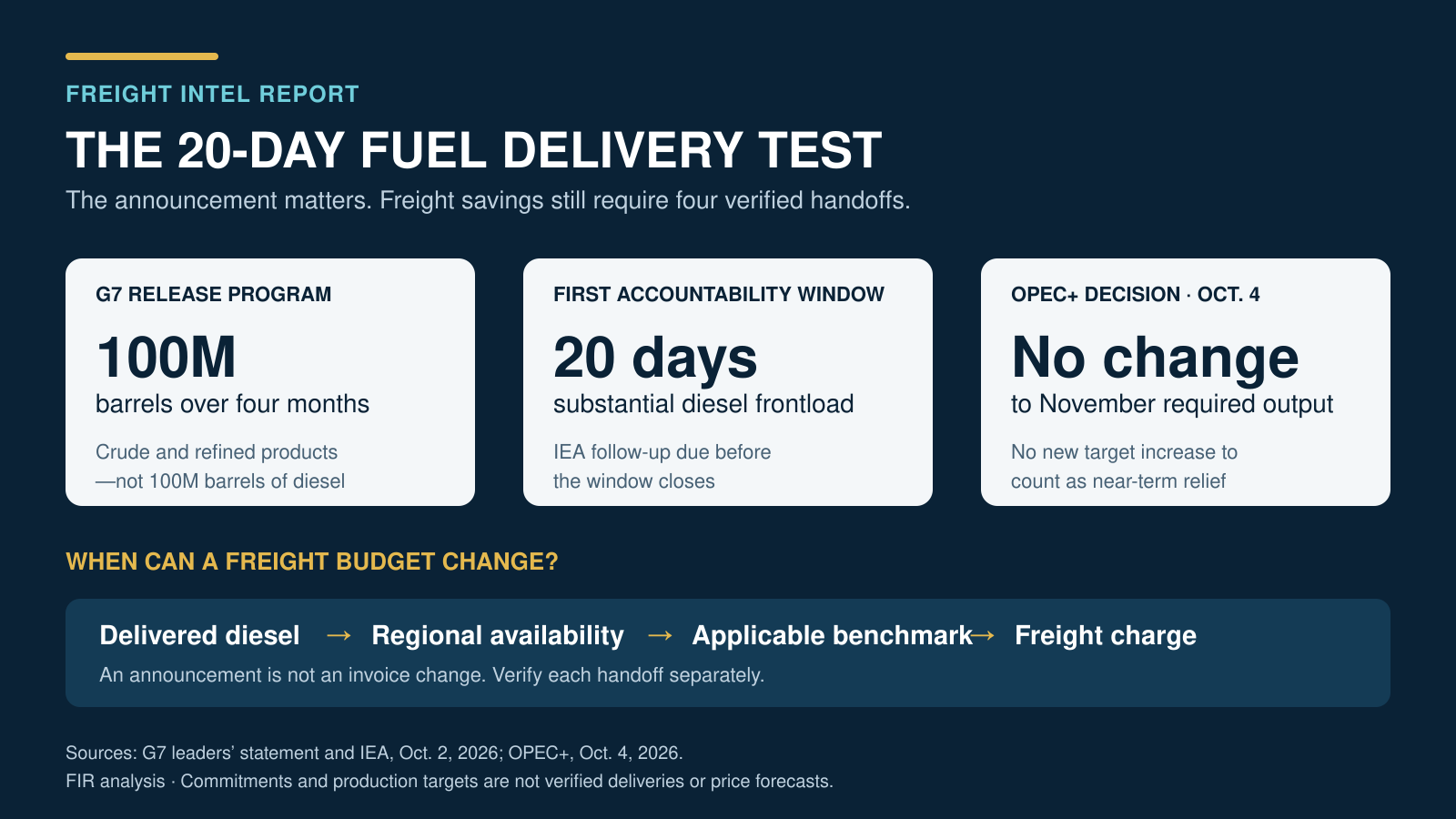
The 100-million-barrel total includes crude and refined products;
the official statement does not specify a diesel volume or country
allocation. OPEC+ production requirements are targets, not verified
output. The visual does not forecast a fuel-price or freight-rate
decline.
The
first analytical distinction: announced supply is not additive by
default
The G7 statement connects the new release timetable to implementation
of commitments made in March and says releases already fulfilled must be
taken into account.
The IEA reported October 2 that about 325 million barrels—more than
80% of the 400 million barrels announced in the March collective
action—had already been released. Those figures make the accounting
question unavoidable.
Freight planners should not automatically add the new
100-million-barrel headline to every barrel announced in March and treat
the sum as a new supply forecast. The official language describes
implementation of prior commitments after accounting for completed
releases. Country contributions, product composition and delivery status
still need to be reconciled.
That does not make the October agreement irrelevant. Timing can
matter as much as the cumulative number. Moving finished diesel into
constrained markets earlier can reduce shortage risk even when the
barrels are connected to an earlier pledge.
But the correct planning variable is delivered product—not
announcements accumulated in a spreadsheet.
The
second distinction: not every barrel becomes truck fuel on the same
clock
The 100-million-barrel total covers crude oil and refined products. A
substantial share of diesel will be frontloaded, but the official
statement does not disclose the diesel volume.
Crude oil still needs a refinery with compatible capacity. Finished
diesel still needs the correct specification, storage access and a route
into the market where a fleet buys fuel. A barrel released from a
reserve can support supply without immediately changing the retail
diesel series or a carrier’s fuel cost.
Two releases with the same headline volume can therefore have
different freight effects.
- Finished diesel delivered near a constrained distribution market can
affect availability quickly. - Crude delivered into a refining system with maintenance, feedstock
or transport constraints can take longer to reach road users. - Product placed in one region can ease a global balance without
resolving a shortage on the lane a shipper is buying.
This is why the article’s 20-day checkpoint is a delivery test, not a
countdown to cheaper freight.
OPEC+ kept November
requirements unchanged
The October 4 OPEC+ announcement provides a useful boundary around
the G7 decision.
Saudi Arabia, Russia, Iraq, Kuwait, Kazakhstan, Algeria and Oman
agreed to maintain September 2026 required production for November. The
countries said they would continue reviewing market conditions and meet
again November 1.
The decision does not mean crude supply will fall. It also does not
prove that every country will produce exactly its required level.
Required production and actual output are different measurements.
For freight planning, the narrower point is enough: OPEC+ did not
announce a fresh November target increase that should be layered on top
of the G7 release as certain additional supply.
Near-term relief therefore rests on three execution paths already
identified in the official record:
- release of emergency stocks;
- higher refinery utilization where feasible; and
- restoration of more reliable energy flows, including through the
Strait of Hormuz.
Each path has different timing and failure points. A budget should
not merge them into one assumption.
What changed for
cross-border fuel risk
The G7 also reaffirmed that members would avoid restrictions on
energy trade between one another and called on other producers to
refrain from export bans.
That is meaningful for freight networks that depend on cross-border
fuel flows. Avoiding a new restriction reduces the risk that one market
tries to solve a domestic shortage by transferring the problem to an
importing market.
It does not guarantee that product will be available everywhere. Nor
does it resolve restrictions or disruptions outside the G7.
FIR’s October
1 analysis examined the possible U.S. export-ban path before the G7
agreement. The new statement changes that policy scenario: the focus has
moved from whether G7 members will restrict trade to whether the
coordinated release and refinery measures will be executed quickly
enough.
That is a substantive improvement in planning visibility. It is still
not a rate quote.
The
four handoffs between the announcement and a freight invoice
Freight buyers can test the agreement through four separate
handoffs.
| Handoff | Evidence to verify | Why it matters |
|---|---|---|
| Released supply | Product type, volume, country contribution and release date | Establishes what left a reserve—not what reached a fleet |
| Regional availability | Inventory, terminal supply, allocation status and distribution constraints |
Shows whether the relevant market can obtain the product |
| Applicable benchmark | The exact index, geography and observation period written into the contract |
Determines whether the shipper’s fuel mechanism can move |
| Freight charge | Formula, base price, trigger, lag, mileage and accessorial treatment |
Establishes the actual invoice consequence |
The sequence prevents two common errors.
First, it stops a procurement team from turning an aggregate global
release into an assumed lane-level saving.
Second, it stops a provider from treating the shortage explanation as
permanent after the applicable benchmark and supply conditions
improve.
Both sides need the same discipline: identify the condition, the
measurement and the date on which the commercial term changes.
What to ask during the
20-day window
A shipper does not need to predict the oil market to make a sound
freight decision. It needs a short, dated evidence review.
For truckload and private
fleets
Confirm whether the contract uses a national or regional diesel
series, how many weeks of lag apply, and whether emergency or temporary
fuel charges have their own end conditions. Do not assume that a lower
futures price changes a retail index on the same day.
For rail and intermodal
Separate any fuel-adjustment mechanism from linehaul, equipment
premiums and terminal charges. A change in diesel supply may alter truck
competitiveness or drayage costs without producing the same change in a
rail invoice.
For parcel and LTL
Check the carrier’s published fuel table, measurement source and
application lag. A carrier-specific surcharge can move differently from
the fuel price visible at a local station.
For ocean and air freight
Distinguish bunker fuel or jet-fuel exposure from inland diesel. The
G7 statement emphasizes diesel but covers a broader mix of products. Do
not apply a road-fuel assumption to another mode without evidence from
that mode’s benchmark and contract.
Three scenarios for
the next freight review
The 20-day window supports three conditional cases.
Delivered diesel improves the relevant market.
Recheck temporary premiums, spot quotes and exceptional fuel charges
against current conditions. Preserve service contingency until the
supply improvement is durable enough for the shipment requirement.
The release proceeds, but the relevant region stays
tight. Keep the shipment-specific capacity and fuel plan.
Global supply relief is not proof of local availability.
Benchmarks fall, but linehaul remains firm. Separate
the fuel adjustment from the underlying transportation price. Capacity,
labor, insurance and service requirements can keep linehaul elevated
even when fuel eases.
These are planning cases, not forecasts. The purpose is to make the
next decision contingent on observable evidence.
The decision date
is built into the agreement
The G7 gave the IEA an implementation-monitoring role and requested a
follow-up report before the first 20 days are complete. That makes the
report a natural freight-review trigger.
By then, a transportation buyer should be able to ask four concrete
questions:
- How much finished diesel was released?
- Which markets received it?
- Did the benchmark in our contract move?
- Did the invoice mechanism apply that movement correctly?
If the answers remain incomplete, the 100-million-barrel headline is
not yet a defensible freight-budget reduction.
If the answers are clear, procurement can pursue genuine relief
without treating a finite stock release as a permanent repair to
refining, production or trade flows.
The agreement matters because it creates supply action and a deadline
for evidence. The next useful freight headline is not another promise.
It is proof that diesel arrived where the network needed it—and changed
the charge a shipper actually pays.
Sources
External addresses are presented as plain text under FIR’s source
policy.
- G7, “G7 Leaders’ Statement on global energy security and market
stability,” October 2, 2026. Address:
elysee.fr/en/emmanuel-macron/2026/10/02/g7-leaders-statement-on-global-energy-security-and-market-stability - International Energy Agency, “Executive Director participates in G7
Leaders’ meeting on energy security and markets,” October 2, 2026.
Address:
iea.org/news/executive-director-participates-in-g7-leaders-meeting-on-energy-security-and-markets - OPEC, “Saudi Arabia, Russia, Iraq, Kuwait, Kazakhstan, Algeria, and
Oman reaffirm commitment to market stability,” October 4, 2026. Address:
opec.org/pr-detail/1891616-4-october-2026.html
Leave a Reply