
An expected tariff refund can influence an importer’s next inventory order, transportation commitment or financing decision. But a claim that has entered a government processing system is not the same thing as money available to pay a carrier. The latest customs filing shows why freight budgets need that distinction.
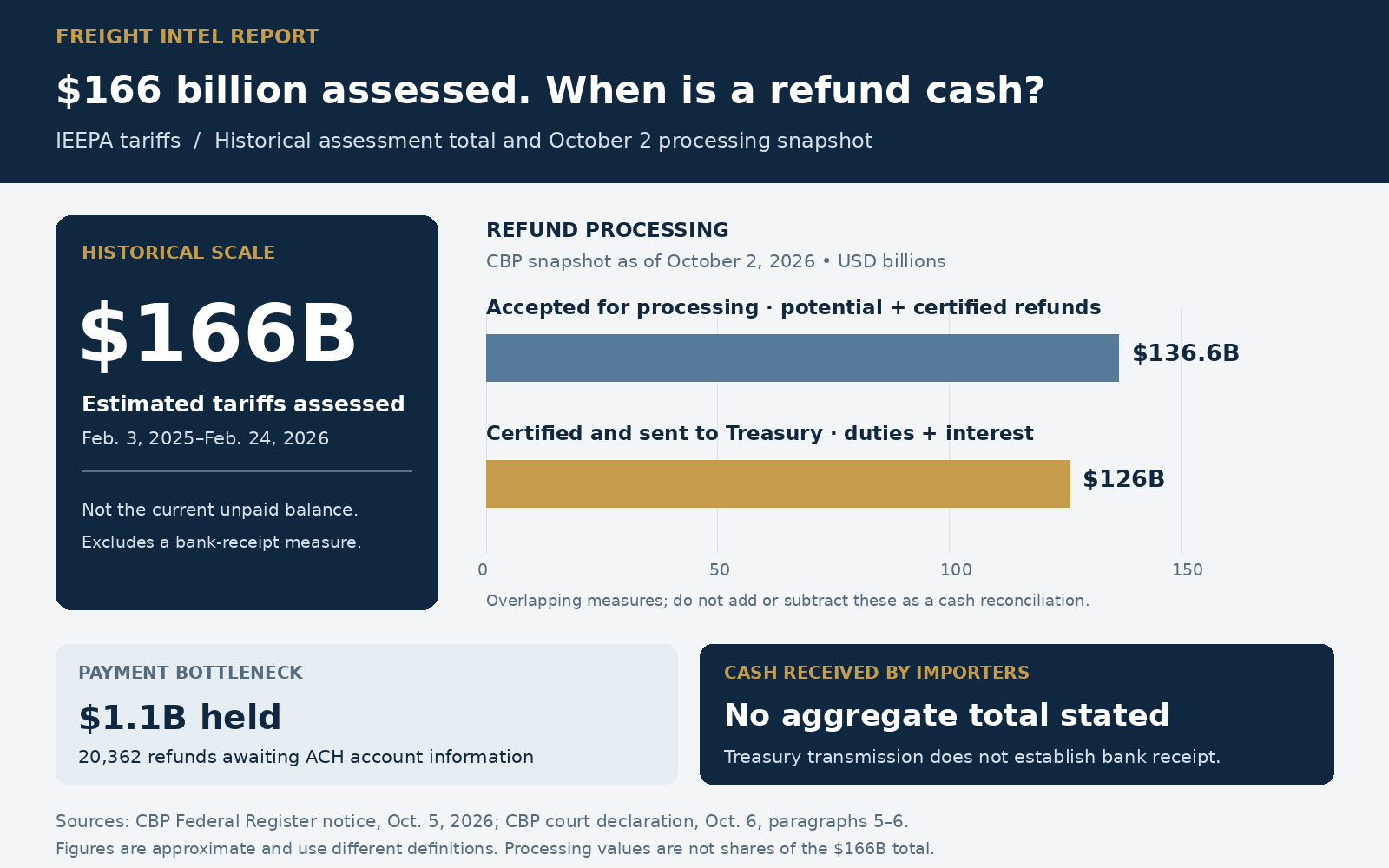
In an October 6 court declaration, U.S. Customs and Border Protection reported approximately $136.6 billion in potential and certified refunds accepted for CAPE processing as of October 2. About $126 billion, including interest, had been certified and sent to Treasury for disbursement. Those figures do not establish how much had reached importers’ bank accounts. [1]
Phase 3 expanded the path, not universal access
The same declaration confirms CAPE Phase 3 launched October 6 for finally liquidated entries belonging to plaintiffs whose entries the court ordered reliquidated. This is a defined court-covered population, not an opening for every importer. The filing also distinguishes declaration-file validation from entry-specific validation. Passing one does not establish that every entry passes the other. [1]
FIR’s interpretation: a company-wide recovery estimate can hide materially different claim positions. Procurement needs to know which funds are still contingent before incorporating them into a freight spending decision. A customs broker’s processing update and a finance team’s confirmed cash balance answer different questions.
What the $166 billion figure actually measures
CBP’s October 5 Federal Register notice estimates $166 billion in IEEPA tariffs assessed from February 3, 2025 through February 24, 2026, involving more than 53 million entry summaries. That historical assessment total is not today’s unpaid refund balance. The notice also explains that other applicable duties, taxes and fees remain payable. [2]
The distinction matters when an importer estimates its own recovery. A total customs payment cannot automatically become a refund forecast. FIR has omitted the earlier proposed per-entry average: dividing rounded national figures would add apparent precision without helping a reader establish an individual entitlement.
A payment bottleneck with an operational consequence
As of October 2, CBP reported 20,362 refunds totaling approximately $1.1 billion that had not been transmitted to Treasury because the importer or authorized designee had not supplied ACH account information. This is a dated snapshot, not a forecast of future delays. [1]
The Federal Register notice describes ACE account and profile requirements for importers or designated licensed customs brokers, electronic refund delivery, and screening that can require rejected submissions to be corrected. [2]
For freight buyers, the practical risk is a mismatch between a funding assumption and a payment obligation. If a refund is expected to support inventory replenishment, reserve warehouse space or pay ocean, drayage, rail or truck invoices, the commitment should have an identified funding source if the receipt slips. The evidence does not support predicting a freight-rate decline, a particular payment date or a capacity increase from the refund program.
FIR analysis: keep four cash-planning states separate
FIR recommends an internal distinction between identified duty, confirmed eligibility, accepted processing and reconciled payment receipt. These are management categories, not official CAPE status codes, a guaranteed sequence or accounting recognition rules. The accompanying chart uses only sourced figures and keeps their measurement definitions separate.
For each material recovery, link the customs entry evidence to the applicable refund path, filing responsibility, latest documented processing status and authorized payee. Finance should reconcile receipts before treating them as cash available for transportation. Customs counsel or the licensed customs broker should resolve eligibility and deadline questions using current official instructions.
The next developments to watch are changes in court-covered eligibility, updated CBP processing instructions and the importer’s own payment evidence. National progress can provide context; it cannot replace entry-level confirmation. The useful procurement question is therefore concrete: which transportation commitments depend on funds that have not arrived?
Sources and reporting limits
[1] CBP: Brandon Lord declaration, filed October 6, 2026, paragraphs 3–8. Processing and payment figures are explicitly dated October 2. [2] CBP Federal Register notice, October 5, 2026, FR document 2026-20228. Its historical background is not used here as a live court-status update. Reporting checked October 13; current official guidance should be checked before release. No importer-specific recovery or payment forecast is made.
Leave a Reply