
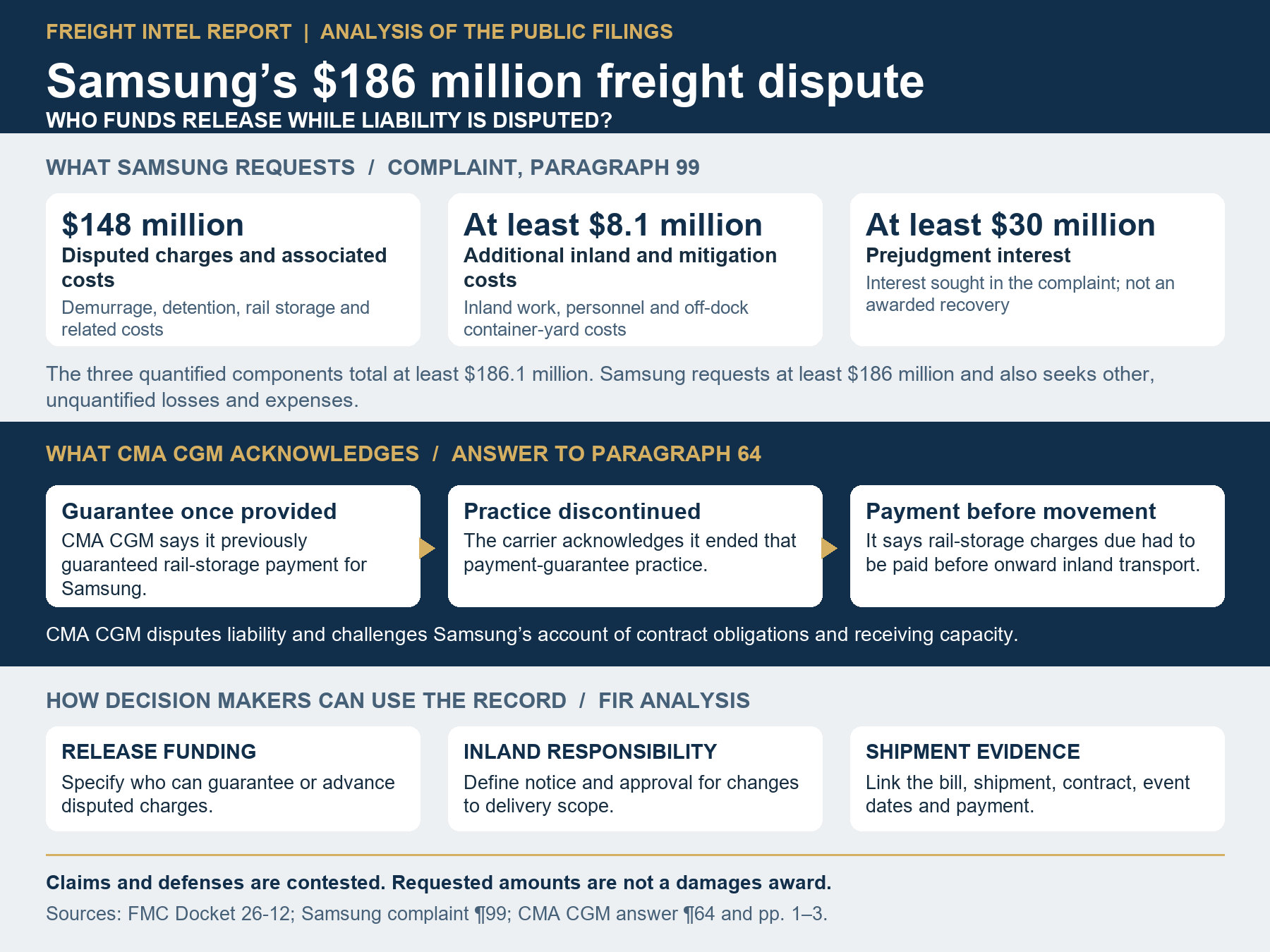
Samsung Electronics America is seeking at least $186 million from CMA CGM in a Federal Maritime Commission proceeding over demurrage, detention, rail storage and inland transportation. Samsung alleges it paid charges and performed work that should have been the carrier’s responsibility. CMA CGM denies liability, disputes that account of the contracts and operations, and asks for dismissal. [1] [2]
The financial demand is substantial. The carrier’s answer also documents a narrower operating fact with direct procurement consequences: CMA CGM says it once guaranteed rail-storage payment for Samsung, discontinued that practice, and that onward inland transport could not occur before payment of rail-storage charges due. [2, response to paragraph 64]
FIR’s analysis: release funding and ultimate liability are separate contract decisions. CMA CGM’s acknowledgement identifies a payment mechanism affecting inland movement. It does not establish which party caused the charges or legally owed them. Procurement, operations and finance leaders should specify that mechanism and the evidence supporting responsibility in their ocean-to-door awards.
A contested claim, with a long decision timetable
Samsung’s complaint was received August 24 and served September 1. CMA CGM filed its verified answer September 28. The public docket checked October 12 contains no merits decision. The published schedule calls for an initial decision by September 1, 2027, and a final Commission decision by March 15, 2028; those dates can change. This is an active dispute, not a damages award or a finding of misconduct. [3]
| Requested component | Amount stated in complaint | What the number represents |
|---|---|---|
| Disputed charges and associated costs | $148 million | Demurrage, detention, rail storage and related costs |
| Additional inland and mitigation costs | At least $8.1 million | Costs of performing inland work and mitigating disruption |
| Prejudgment interest | At least $30 million | Requested interest; not money already awarded |
The three quantified components total at least $186.1 million. Samsung describes its demand as at least $186 million and also seeks unquantified revenue losses, time and legal expenses. Adding those items to a precise grand total would manufacture certainty. [1, paragraph 99]
The inland obligation is where the parties disagree
Samsung alleges repeated failures in store-door delivery, changes to container-yard arrangements and cargo holds linked to disputed balances. It cites one 2021 Busan–Long Beach–The Colony, Texas shipment that allegedly accumulated $162,799.38 in rail storage. The complaint describes more than 121,000 charges; that is a charge count, not a count of unique containers. [1]
CMA CGM argues that the service contracts and other arrangements qualify Samsung’s description of store-door responsibility. It attributes alleged losses to Samsung’s ability to handle and receive increased imports, disputes the identification of affected shipments and asserts that a 2023 settlement bars part of the claim. Its answer also challenges FMC jurisdiction over third-party rail charges. Those are defenses, not established conclusions. [2]
One response deserves procurement’s attention: CMA CGM acknowledges that it once guaranteed rail-storage payment on Samsung’s behalf and later discontinued that practice. It says onward movement then required payment of charges due on the containers. The admission does not settle who caused the charges or ultimately owed them. It identifies a payment arrangement that can determine whether freight moves while responsibility remains contested. [2, response to paragraph 64]
That is the commercial issue a door-to-door rate alone cannot answer. A party may undertake the inland movement yet dispute a particular storage charge. The terminal may still require payment before release. The consignee’s inventory need and the contracting parties’ liability arguments then run on different clocks.
The financial claim extends beyond the disputed charges
Samsung’s requested damages distinguish the disputed charges and associated costs from additional inland work, mitigation and interest. The complaint identifies personnel hired to manage increased transportation costs and leased off-dock container-yard space within its additional-cost demand. It also seeks revenue losses, employee and attorney time, and legal expenses that are not fully quantified in paragraph 99. [1, paragraph 99]
The requested prejudgment interest is at least $30 million. That figure belongs to Samsung’s actual claim. The public filings reviewed do not supply the complete payment-by-payment record needed to independently reproduce the interest calculation, and no merits award appears in the docket checked October 12. It would be incorrect to treat the requested interest as recovered cash or to infer a financing rate from the demand. [1] [3]
CMA CGM denies paragraph 99 and challenges the propriety of categories of damages. Its introductory statement disputes Samsung’s claim for off-dock storage, linking the alleged need for that space to Samsung’s receiving capability. Recovery of the additional costs therefore remains part of the contested case. [2, introduction and response to paragraph 99]
For finance, the useful distinction is between paid disputed amounts, separately incurred operating costs, interest requested, and recoveries actually received. The complaint’s categories provide a concrete basis for that separation. They do not establish the recoverable amount or the Commission’s eventual award.
The 2026 rule makes the evidence file more consequential
A separate FMC rule effective September 1 clarifies that qualifying charge complaints can use traditional formal or small-claims procedures as well as the interim process. For covered demurrage and detention charge complaints, the common carrier bears the burden of establishing reasonableness. The submission must identify the applicable bills of lading and invoices and allege the relevant statutory violations. [4]
The date of the underlying conduct still matters: the rule says OSRA 2022 is not retroactive, and its charge-complaint framework applies to covered violations from June 16, 2022 onward. It therefore cannot be applied indiscriminately to the pandemic examples in Samsung’s complaint. Nor does burden shifting eliminate a claimant’s need to establish the shipment, charge, applicable procedure and claimed injury. [4]
For current covered invoices, Part 541 requires identification, charge dates, free time, rates, dispute information and certifications addressing the billing party’s contribution to the charge. Invoice issuance generally has a 30-calendar-day limit; NVOCCs have a separate clock starting with issuance of the upstream invoice. Billed parties must have at least 30 calendar days from invoice issuance to seek mitigation, refund or waiver. These rules do not govern every standalone rail-storage bill. [5]
The court set aside the provision specifying permitted invoice recipients, section 541.4; the remaining billing rules continue. That distinction prevents an outdated shortcut in a present-day invoice audit. It also does not make the 2024 billing rules retroactive to every earlier charge in this case. [6]
Reasonableness is a separate inquiry. The FMC’s incentive principle asks whether charges promote freight fluidity; its application depends on the circumstances. The appeals court’s port-closure decision upheld relief on a particular factual record. Neither that decision nor this unresolved complaint makes every congestion charge invalid. [7] [8]
Buy control of the exception, not just a broader service description
For 2027 awards, an integrated provider should be able to explain what happens when its inland subcontractor requires payment, receiving capacity is constrained or the delivery scope changes. The answer belongs beside the rate and service commitment in the evaluation.
| Commercial issue | What the buyer should obtain |
|---|---|
| Release funding | Who may guarantee or advance disputed charges, the amount and duration of that authority, and the reconciliation deadline |
| Change to inland scope | Conditions permitting a change, required notice and approval, and allocation of substitute transport and storage costs |
| Receiving constraints | Agreed forecasts, appointment capacity, unloading windows and evidence separating shipper-caused delay from provider failure |
| Dispute containment | How one contested balance affects other shipments, escalation authority, and any agreed security or release mechanism |
| Claim support | Shipment-specific records linking the invoice, bill of lading, container, event dates, contract version and payment |
The case also makes the shipper’s operating record consequential. CMA CGM’s defense points to import growth, receiving capability, contract terms and shipment identification. A procurement review should therefore reconcile the promised delivery scope with the shipper’s forecasts, appointment capacity, unloading requirements and event records. Those records bear on the responsibility the parties dispute. [2]
A broader carrier network does not, by itself, resolve those disagreements. The public complaint and answer present competing accounts of the same movement obligations. The bid evaluation should identify which party controls the relevant action, which document assigns responsibility, and which record demonstrates performance.
Give finance a disputed-cash report, not only a freight variance
Procurement, operations, treasury and counsel should review the same exposure by lane and provider. Show paid disputed principal; unresolved billed amounts separately; incremental mitigation expense; elapsed time since each payment; the evidence supporting responsibility; and recoveries received. Keep pending claims separate from realized savings.
The unit of analysis is the shipment event. A container number alone is inadequate when equipment is reused: retain its bill of lading, voyage or movement identifier and dates. Pair those records with cargo availability, chassis access, appointments, release instructions, receiving readiness and empty-return attempts. That gives both sides a way to distinguish an operating failure from a customer constraint.
Samsung’s allegations about cargo holds and direct payments to railroad subcontractors, together with CMA CGM’s acknowledgement about the guarantee, put escalation authority and payment documentation at the center of the operating review. Operations, treasury and counsel should identify the release instructions, amounts paid, party authorizing payment and responsibility being disputed. Counsel should review release and payment terms that affect a claim. [1] [2]
What would change the assessment
The case’s legal significance will depend on decisions addressing jurisdiction, the contracts and settlement, shipment-level responsibility and recoverable damages. FIR has not reviewed the complete underlying contract record or confidential evidence and cannot determine which party will prevail. A settlement or revised schedule could also change the financial timetable.
The filings make release funding an explicit procurement issue. Samsung seeks recovery for charges and inland work; CMA CGM disputes liability and acknowledges ending a rail-storage payment guarantee. Decision makers can use that record to require clear inland scope, release-payment authority and shipment evidence in their awards. The Commission’s eventual findings will determine the legal consequences of this case.
Sources and reporting notes
Primary filings, current rules and docket checked October 12, 2026. FIR reviewed both parties’ public pleadings. Allegations and defenses remain contested. Commercial conclusions are FIR analysis; no original interviews are represented.
- Samsung Electronics America verified complaint, FMC Docket 26-12. Received August 24, 2026; served September 1, 2026. Paragraphs 29, 43-51, 64-77, 84 and 99; PDF pp. 7-19, 22, 25.
https://www2.fmc.gov/readingroom/documents/141820 - CMA CGM verified answer, FMC Docket 26-12. September 28, 2026. Introduction pp. 1-3; answers to paragraphs 14, 51 and 64; affirmative defenses pp. 11-12.
https://www2.fmc.gov/readingroom/documents/145927 - FMC public docket and Federal Register notice, Samsung v. CMA CGM. Docket reviewed October 12, 2026; latest listed filing September 28, 2026. Docket entries 1, 6, 7 and 12; notice decision schedule.
https://www2.fmc.gov/readingroom/proceeding/26-12/
https://www.federalregister.gov/documents/2026/09/04/2026-18122/samsung-electronics-america-inc-complainant-v-cma-cgm-sa-respondent-notice-of-filing-of-complaint - FMC final rule: Charge Complaint Procedures, 91 FR 56053. Effective September 1, 2026. Background and Discussion of Rule; amendments to 46 CFR 502.62 and 502.301-302.
https://www.federalregister.gov/documents/2026/09/01/2026-17876/charge-complaint-procedures - 46 CFR Part 541: Demurrage and Detention. eCFR displayed current through October 8, 2026. Sections 541.2, 541.5-541.8.
https://www.ecfr.gov/current/title-46/chapter-IV/subchapter-B/part-541 - FMC: Court decision in demurrage and detention billing practices. November 20, 2025. Section 541.4 set aside; remainder of Part 541 continues.
https://www.fmc.gov/articles/u-s-court-of-appeals-issues-decision-in-case-on-demurrage-and-detention-billing-practices/ - 46 CFR 545.5: Demurrage and detention incentive principle. eCFR displayed current through October 8, 2026. Paragraphs (b)-(f).
https://www.ecfr.gov/current/title-46/chapter-IV/subchapter-B/part-545/section-545.5 - FMC: Appeals court upholds freight-fluidity decision. July 8, 2026. Fact-specific port-closure decision and compensatory-cost evidence.
https://www.fmc.gov/articles/u-s-court-of-appeals-upholds-fmc-decision-that-detention-fees-must-promote-freight-fluidity/ - FreightWaves: Samsung seeks $186M from CMA CGM in container charges dispute. October 8, 2026; updated with CMA CGM comment. CMA CGM spokesperson response; independent corroboration.
https://www.freightwaves.com/news/samsung-seeks-186m-from-cma-cgm-in-container-charges-dispute - FMC: Detention and Demurrage data. Latest period displayed on page: Q1 2025; reviewed October 12, 2026. Nine-carrier coverage and Q1 2025 limitations.
https://www.fmc.gov/detention-and-demurrage/
Related FIR analysis: Port Closed? A Federal Ruling Clarifies the Detention-Fee Playbook; FedEx Supply Chain Has a New Owner.
Leave a Reply