
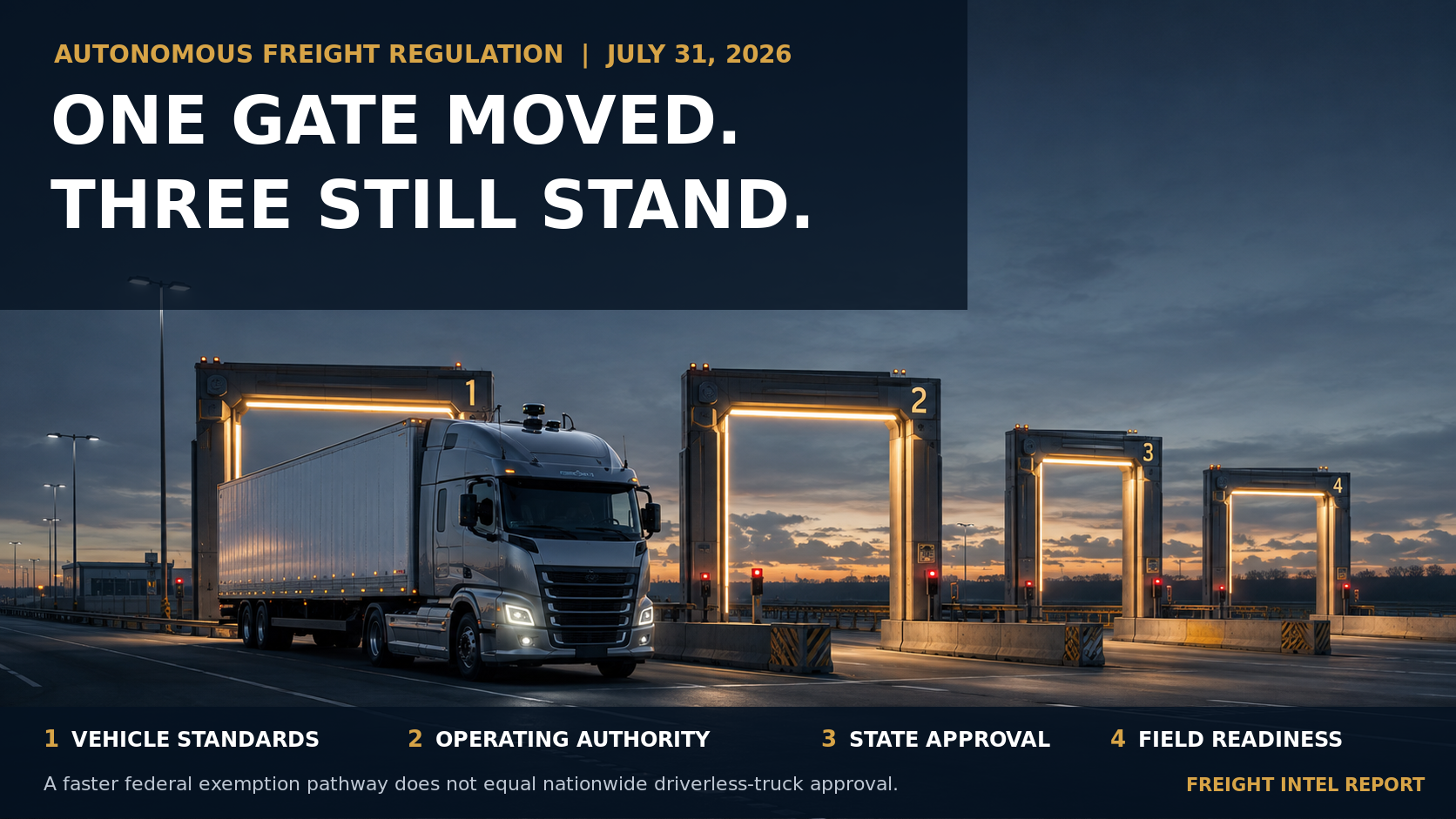
September 3, 2026 — Material update: The U.S. Department of Transportation’s new 2026–2030 automated-vehicle strategy explicitly targets commercial freight deployment, federal operating rules for automated commercial vehicles, cross-state corridor interoperability and the first federal competency standards for automated driving systems. It advances every gate in FIR’s autonomous-freight framework—but it does not authorize nationwide driverless-truck operations.
What DOT’s national strategy changes
The strategy converts several long-discussed barriers into named federal workstreams. NHTSA is developing an advance notice of proposed rulemaking for objective ADS competency standards. FMCSA is modernizing Federal Motor Carrier Safety Regulations for ADS-equipped commercial vehicles. FHWA is working on machine-readable traffic rules and interstate data sharing, while FMCSA is developing a standardized emergency-response framework for automated trucks. PHMSA is separately considering how hazardous-materials rules should apply to highly automated transportation.
- Vehicle-safety gate: NHTSA plans minimum ADS competency standards and updated voluntary guidance covering remote assistance, software updates, first-responder interaction and safety-management systems.
- Commercial-operating gate: FMCSA identifies an active rulemaking for ADS-equipped commercial vehicles, but the strategy does not publish final operating requirements.
- State and corridor gate: DOT will pursue interoperable interstate data and traffic-rule systems. State and local traffic enforcement authority remains in place.
- Field-readiness gate: The plan elevates emergency response, remote operations and safety-management systems, but leaves insurance, cargo recovery, maintenance and shipper acceptance to be resolved operationally.
What the strategy does not authorize
The strategy is a federal roadmap, not a final rule or operating permit. DOT states that automated vehicles must comply with existing federal standards unless an exemption is granted. It provides no blanket authority for driverless trucks to operate nationwide, no uniform state deployment approval and no firm completion date for the major rulemakings beyond the strategy’s fiscal-year 2026–2030 horizon.
For shippers and carriers, the practical conclusion is disciplined caution: prepare for faster regulatory development, but do not treat the strategy as proof that a proposed lane, vehicle or operator is commercially authorized or field-ready.
The July 31 rule that began this analysis
July 31, 2026 — Breaking analysis: A new NHTSA rule removes a timing barrier that could otherwise force automated-vehicle developers to rebuild or discard test vehicles before seeking commercial deployment. The freight implication is meaningful, but narrow: the federal vehicle-compliance gate became more flexible. Driverless trucks did not receive nationwide operating authority.
The National Highway Traffic Safety Administration made an interim final rule effective July 31 that allows temporary safety-standard exemptions to cover vehicles manufactured before an exemption takes effect, when the agency approves that scope case by case.
The change sounds technical. Operationally, it can matter a great deal. Previously manufactured automated test vehicles may contain designs that do not comply with Federal Motor Vehicle Safety Standards written around human controls. Under the revised rule, a manufacturer can ask NHTSA to include those vehicles in a Part 555 exemption rather than assume it must build an entirely new compliant fleet for the next stage of use.
The rule does not make approval automatic. NHTSA must still make the required safety and public-interest findings, and the agency said it will decide whether to include earlier-built vehicles individually. The change also does not excuse a vehicle’s prior noncompliant manufacture or operation.
Zoox shows what the pathway can unlock
The commercial significance came into focus one day earlier. NHTSA granted Amazon-owned Zoox the first U.S. approval for paid service using a purpose-built robotaxi without a steering wheel or conventional driver controls, according to Reuters. The authorization permits up to 2,500 vehicles in each of the next two years, subject to conditions and reporting requirements. Zoox may not sell the vehicles to the public, and the planned Las Vegas service remains subject to state and local authority.
Zoox is a passenger-vehicle case—not a trucking authorization. It nevertheless demonstrates that the Part 555 process can move a purpose-built automated vehicle from testing toward revenue service when NHTSA finds an equivalent overall level of safety and imposes operating and reporting conditions.
The four gates for autonomous freight
1. Federal vehicle design and safety standards. NHTSA controls compliance with federal vehicle standards. The July 31 rule makes this gate more adaptable for previously manufactured vehicles, while the September 3 strategy adds a planned federal competency-standard process for automated driving systems.
2. Federal commercial operating requirements. FMCSA now identifies an active rulemaking to modernize operational requirements for ADS-equipped commercial vehicles. Until a final rule or applicable exemption exists, a driverless truck still must fit within the current federal operating, inspection and safety-oversight framework.
3. State and local deployment authority. DOT’s interoperable-corridor initiative may reduce cross-state friction through consistent data standards, but it does not create blanket permission to operate on every road. State laws, corridor restrictions, permits and local conditions remain decisive.
4. Field readiness. FMCSA’s planned emergency-response framework and NHTSA’s updated guidance acknowledge a critical operational gap. Insurance, disabled-vehicle recovery, maintenance, cybersecurity, remote assistance and shipper acceptance can still be as consequential as formal approval.
What freight stakeholders should do now
- Autonomous-truck developers: map each deployment plan to the NHTSA competency-standard process, FMCSA operating-rule docket, applicable Part 555 exemptions and state corridor requirements. Treat remote assistance and first-responder procedures as evidence requirements, not afterthoughts.
- Carriers and shippers: continue evaluating deployments corridor by corridor. Require evidence of vehicle authorization, commercial operating authority, state permission, insurance, operational-design-domain limits, remote-assistance coverage, recovery plans and first-responder coordination.
- Brokers and 3PLs: do not treat the strategy as an immediate change to carrier qualification. Monitor actual operating approvals and define contractual responsibility for incidents, cargo recovery, remote intervention and service interruption.
- Investors and equipment suppliers: separate announced policy direction from completed regulation. Federal work is accelerating, but operating, state and field-readiness gates still determine commercialization speed.
What remains unknown
DOT has not published completion dates for the ADS competency standards, FMCSA’s automated-CMV operating rule, the emergency-response framework or the interstate interoperability initiatives. It is also unknown which autonomous-truck developers will seek Part 555 coverage for previously built vehicles, what conditions NHTSA would impose or whether states will align their deployment requirements.
Freight Intel Report analysis: The September 3 strategy is consequential because it addresses all four deployment gates within one federal plan. The direction is clearer and the regulatory work is more concrete, but the highway is not open nationally. Commercial readiness must still be proven vehicle by vehicle, operator by operator and corridor by corridor.
Primary and corroborating sources
- USDOT: National Automated Vehicle Strategy announcement — September 3, 2026.
- USDOT: America Leads—National Strategy for Automated Vehicles, FY 2026–2030 — full strategy and agency workstreams.
- NHTSA interim final rule: Temporary Exemption From Motor Vehicle Safety and Bumper Standards — effective July 31, 2026; comments due August 31, 2026.
- NHTSA notice on Zoox’s Part 555 petition — the underlying application and requested exemptions.
- Reuters: Zoox wins first U.S. approval for paid robotaxis without human controls — July 30, 2026.
- NHTSA: Part 555 exemption process and safety findings — June 13, 2025.
- NHTSA: first demonstration exemption for American-built automated vehicles — August 6, 2025.
- NHTSA: first-responder interaction warning to AV developers — July 8, 2026.
Government services: For government services, verification, registrations, forms, reporting, or instructions, always navigate to the official agency website directly. Independently verify its address before entering credentials or business information.

Leave a Reply