
A shipper can now tender a load to a Level 4 autonomous truck that does not carry a person who can set warning triangles. If that truck stops on a highway shoulder, a new federal exemption allows cab-mounted warning beacons to replace the triangles—but it does not say who retrieves the cargo, sends replacement equipment, protects a refrigerated load or pays for a missed delivery.
Those responsibilities still belong in the operating agreement.
The Federal Motor Carrier Safety Administration granted a limited five-year exemption effective October 7, 2026. It applies to Aurora Operations and to other motor carriers using Level 4 automated-driving-system commercial vehicles after they give FMCSA prior written notice and agree to the conditions. The exemption runs through October 7, 2031.
The decision is nationally significant because it creates a reusable compliance path for more than one company. It is also narrower than a broad authorization for driverless freight. The exemption changes three roadside-warning requirements; it does not approve every vehicle, route, cargo or operating model.
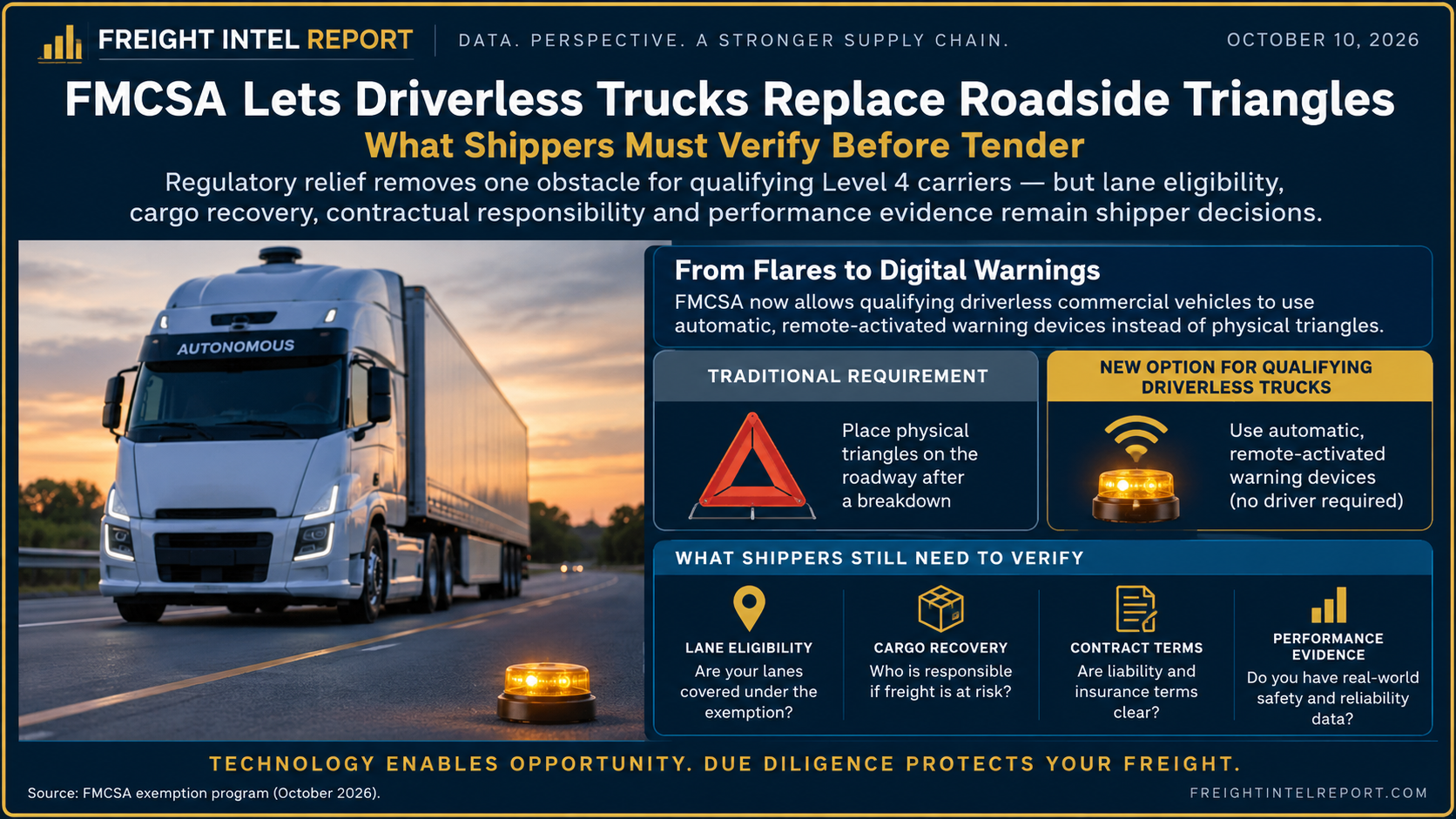
What changed on the roadside
The normal federal rule requires a driver to activate hazard flashers and place specified warning devices around a commercial vehicle stopped on the traveled portion or shoulder of a highway. The devices generally must be placed as soon as possible and within ten minutes, with special positioning around curves, hills and other visibility constraints.
Under the new exemption, a qualifying Level 4 truck may use forward- and rearward-facing amber beacons mounted on the cab instead. The beacons must meet specified photometric, location, flash-pattern and redundant-power requirements. They must activate as soon as possible and no later than five minutes after the stop, remain active for the entire event, and operate with the truck’s normal hazard flashers.
That is a real operational change. It removes a regulation that presumed a human would exit the vehicle and place equipment on the roadway. It also establishes a five-minute warning deadline that is shorter than the ten-minute outside limit for traditional roadside devices.
But it is only a warning-system decision. FMCSA did not find that all autonomous freight is ready for unrestricted commercial use.
The exemption broadens eligibility while narrowing operations
The most important detail for freight buyers is that the exemption is not Aurora-only. Other Level 4 motor carriers may use it after notifying FMCSA and certifying that they have compliant beacons and will follow every condition.
That makes the decision scalable. A carrier does not need a separate exemption proceeding simply to replace triangles with the specified beacon system.
The scope is bounded in four important ways:
- Operating domain: use is limited to roads and conditions inside the automated vehicle’s validated operational design domain. FMCSA explicitly says the exemption does not authorize unrestricted nationwide deployment.
- Cargo and passengers: operations that would require H, X, P or S commercial-driver endorsements are excluded. Passenger transportation and hazardous materials are prohibited under the exemption.
- Vehicle combinations: longer-combination use is limited to doubles with two 28-foot trailers; triples are excluded.
- Oversight: carriers must report qualifying crashes within five calendar days, submit annual operating and beacon-performance information, and notify FMCSA if they determine the system no longer maintains an equivalent level of safety.
For interstate operations, states may not enforce conflicting requirements against carriers using the exemption. States may adopt the same approach for intrastate commerce, but are not required to do so. A procurement team therefore still needs to distinguish interstate movements covered by the federal preemption from intrastate moves subject to state treatment.
What the evidence establishes—and what it does not
FMCSA said Aurora operated 34 vehicles under a temporary waiver for more than 500,000 miles between October 10, 2025 and January 9, 2026. The beacons were active for nearly ten hours. Aurora reported no faults, malfunctions or power issues, and no roadway collisions involving the vehicles while stopped and using the beacons.
The agency combined that experience with two earlier visibility studies and concluded that the beacons would likely provide safety equivalent to or greater than the existing requirement when paired with the exemption’s guardrails.
The evidence deserves careful interpretation. More than 500,000 operating miles is meaningful for a targeted waiver, but only about ten hours involved actual beacon activation. The absence of a collision during that limited activation period does not establish a long-run crash rate. FMCSA also notes that Aurora submitted some operating reports as confidential business information.
That does not invalidate the decision. It means the exemption is a monitored authorization, not a universal performance guarantee. The five-year term includes annual reporting, crash reporting and revocation authority precisely because real-world evidence must continue to accumulate.
The shipper’s decision moves from legality to execution
For a freight buyer, the exemption answers one narrow question: a qualifying Level 4 carrier may use compliant cab-mounted beacons instead of roadside triangles. It leaves four commercial questions open.
1. Is the exact lane inside the validated operating domain?
A carrier’s general statement that it operates autonomously is not enough. The origin, destination, connecting roads, weather limits, construction conditions and planned operating hours must fit the validated domain for the specific truck and system.
A tendering workflow should therefore capture the autonomous segment, any human-driven transfer segment, prohibited conditions and the point at which the carrier must substitute equipment or a driver.
2. What happens after the beacons activate?
Warning approaching motorists is not the same as recovering a shipment. The operating plan should identify the remote-assistance desk, roadside-response provider, towing authority, cargo-security procedure and replacement-equipment clock.
Temperature-controlled, high-value and appointment-critical freight need additional thresholds: when a trailer is moved, when a transload begins, who can break a seal, how temperature data are preserved and when the consignee receives a revised arrival commitment.
3. Who owns the cost and the claim?
The exemption does not amend a shipper’s transportation agreement, insurance policy or cargo-claim process. Contract language should allocate responsibility for roadside recovery, replacement transportation, storage, transload, redelivery, missed appointments, cargo inspection and evidence preservation.
It should also say what event data the shipper, broker and insurer can receive after a service failure. A regulatory report to FMCSA is not automatically the same information a customer needs to investigate a loss or manage a downstream customer claim.
4. Which performance measures will decide expansion?
Shippers should not judge an autonomous lane only by whether the truck completes a run without a crash. The more useful measures are tender acceptance, on-time pickup and delivery, intervention frequency, roadside stops, recovery time, cargo exceptions, visibility latency and the number of loads that require substitution outside the planned operating domain.
A controlled lane launch can establish a baseline before volume expands. The decision to add lanes should depend on demonstrated service and recovery performance, not on the existence of the federal exemption alone.
What carriers and brokers should change
Autonomous carriers using the exemption should be able to show that each truck’s beacon configuration, power redundancy, activation logic and operating domain match the federal conditions. They also need a customer-facing recovery plan that starts after the warning system does its job.
Brokers and 3PLs should avoid treating the exemption as a blanket change to carrier qualification. Their contracts and routing guides should identify when autonomous equipment may be used, who validates the lane, what must be disclosed to the shipper and how a disabled vehicle is escalated.
Traditional carriers also have a reason to watch the decision. FMCSA has shown that a human-centered operating rule can be replaced when an applicant supplies specific equipment standards, monitored field experience and reporting controls. Other automated-freight rules may follow the same pattern: narrow relief first, broader adoption only after evidence accumulates.
What would change FIR’s assessment
The exemption becomes more commercially important if additional carriers notify FMCSA, validated operating domains expand, roadside events produce reliable recovery data and shipper service measures hold up across more corridors and conditions.
The assessment would weaken if beacon malfunctions, crash reports, poor recovery performance or inconsistent state treatment expose a gap between regulatory compliance and field execution. FMCSA can revoke the exemption if safety deteriorates.
The immediate conclusion is narrower: a federal obstacle to Level 4 freight operations has been removed for qualifying carriers. That makes autonomous tendering easier to consider. It does not make the load self-rescuing.
Related FIR analysis: DOT’s New AV Strategy Targets Freight Deployment—But Autonomous Trucks Still Face Four Gates.
Sources and reporting notes
Sources rechecked October 9, 2026. Government links below are provided for published decisions and source documents, not for registrations, forms or procedural services.
- Federal Motor Carrier Safety Administration, final disposition granting the limited five-year exemption, effective October 7, 2026: https://www.federalregister.gov/d/2026-20734
- FMCSA, December 2024 denial of the earlier Waymo–Aurora exemption request: https://www.fmcsa.dot.gov/regulations/federal-register-documents/2024-30860
- FMCSA, April 2026 notice of Aurora’s revised application: https://www.fmcsa.dot.gov/regulations/federal-register-documents/2026-07288
- Reuters, October 8, 2026, corroborating report on the exemption and Aurora’s current deployment: https://www.reuters.com/business/us-grants-aurora-exemption-self-driving-trucks-safety-feature-2026-10-08/
FIR’s distinction between regulatory eligibility and commercial readiness is analysis. The decision does not set freight rates, promise shipper savings or authorize every route, vehicle or cargo. Any party using a government service, registration, form or reporting process should navigate directly to the official agency website and independently verify its address before entering credentials or business information.
Leave a Reply