
Carrier surveys reveal practical interest in automation alongside real barriers. Brokers and shippers need to measure what happens on both sides of the transaction.
A broker automates a status call. The office saves a few minutes. The carrier’s dispatcher answers, repeats an update already provided and calls back when the system cannot resolve a discrepancy.
That is an illustrative scenario, not a measured industry average. It exposes a question freight’s AI discussion needs to answer: has the work disappeared, or has someone else inherited it?
The same question applies to rate negotiation. Faster offers can help both parties. Repetitive counteroffers, incomplete load details and inaccessible human support can consume the time automation was supposed to return.
For shippers evaluating their transportation providers, the meaningful result is a shipment booked correctly, executed reliably and settled accurately. A broker’s reduction in calls handled by employees captures only part of that result.
What carrier surveys actually establish
Trimble’s Transportation Pulse Report 2026 reports that 42% of carrier and logistics-service-provider respondents used AI for pricing and lane optimization, and 39% for real-time tracking. The report’s adoption barriers are equally revealing: 57% identified data quality and system gaps, 36% integration with shipper or broker platforms, and 29% high cost or unclear return on investment. These are different applications and challenges, not mutually exclusive groups. [1]
The dates and population matter. Despite its 2026 title, the survey was conducted in August–September 2025. It gathered more than 230 responses across shipper executives and carrier/LSP leaders in the United States and Europe. It is not a representative poll of American truck drivers, and it does not measure September 2026 sentiment. [2]
Randall Reilly’s fleet research, discussed publicly in August 2026, supplies a newer observation: its summary says 30% of surveyed fleets used no AI anywhere and 58% identified their own team as the biggest obstacle. The public summary does not provide the sample size or full methodology; the accompanying discussion says the research surveyed fleet clients. These results should remain descriptions of that respondent group. [3][4]
Taken together, the findings justify examining usefulness, implementation and trust. They do not establish that carriers as a whole are increasingly hostile to broker negotiation bots or automated check calls. FIR did not find a representative, repeated survey that measures that specific trend.
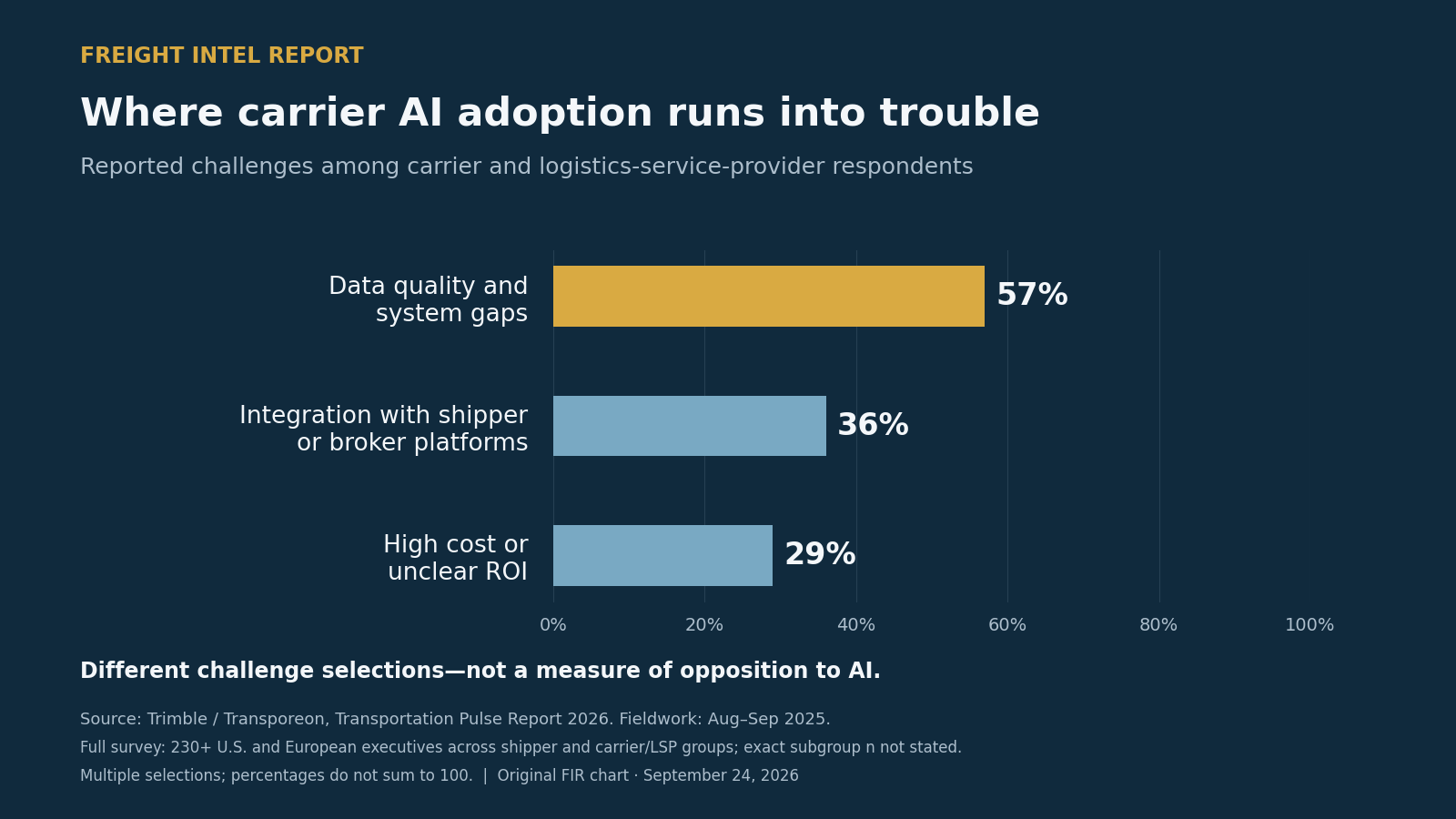
Original FIR chart using Trimble/Transporeon’s Transportation Pulse Report 2026. Percentages are separate challenge selections within the carrier/LSP respondent group; they are not an anti-AI sentiment score. The full survey included 230+ executives across shipper and carrier/LSP groups.
A negotiation agent has a commercial objective
Trimble markets autonomous procurement that estimates a price a carrier may accept and automates offers. It also sells quotation tools for carriers and brokers. These product descriptions establish the intended function of the technology; they do not independently prove its advertised savings or its effect on market rates. [5]
A carrier can reasonably evaluate those two tools differently. One helps it price its own work. The other negotiates on behalf of a customer or intermediary with a different commercial objective.
FIR’s assessment is that acceptance will depend partly on whether the conversation remains useful. Can the carrier obtain the actual appointment, equipment and handling requirements before quoting? Can it explain a cost the agent missed? Can it reach someone authorized to settle the issue? Does the written confirmation preserve the terms agreed?
The quality problem becomes visible when a system can keep negotiating a dollar amount but cannot resolve a material shipment condition. A cheap booking with an unresolved delivery restriction can create more work later for the dispatcher, driver, receiver and broker.
That is a reason to measure booking accuracy and completion alongside negotiated price. It is also a reason to distinguish a carrier declining one provider’s process from a carrier rejecting AI altogether.
Check calls: count the interruption as well as the answer
Vendors offer different approaches to status collection. Claire markets AI agents that conduct check calls and collect updates. Trimble markets predictive visibility as a way to reduce the need for check calls. Neither product description establishes industry-wide carrier satisfaction. [5][6]
The operational question comes before the choice of voice: what information is missing, and who is best placed to supply it?
If a recent, reliable tracking update already answers the location question, asking again needs a purpose. If the missing fact is whether unloading has begun, location alone may be insufficient. If a driver reports a breakdown, capturing the answer does not resolve the shipment.
FIR would judge the workflow by whether it uses existing information, directs questions to the appropriate person, supports safe response timing and moves exceptions to someone who can act. An escalation button is useful only if an accountable person responds.
This matters especially when several systems contact the same carrier. A broker may count one automated call while the dispatcher experiences repeated requests across phone, text and tracking platforms. The shipment is the appropriate unit of measurement.
The savings calculation needs both sides
Consider a deliberately simple illustration. Before automation, a booking takes 12 minutes of broker labor and four minutes of carrier labor: 16 minutes altogether. After deployment, the broker uses four minutes while the carrier spends 15 minutes navigating the process and resolving errors: 19 minutes altogether.
The broker’s labor time falls by about 67%. Combined labor time rises by about 19%.
These are hypothetical inputs, not survey results or measured vendor performance. Different wage rates, service outcomes and software costs would change the financial calculation. The example shows why one organization’s dashboard cannot establish the total productivity gain.
A useful pilot records active handling time separately from elapsed time, includes unsuccessful bookings, and captures rework after a load is awarded. Otherwise, a fast initial transaction can conceal a slow correction process.
Driverless trucks raise a different employment question
AI used to answer a phone and technology used to perform highway driving affect different work. Combining them into one approval rating obscures what drivers are being asked to accept.
Aurora’s July 29 results announcement reported deployment of a second fleet operating without a person behind the wheel. Its stated target of 200 driverless trucks at year-end was forward-looking guidance, not a completed fleet count. These are company disclosures, not an independent finding of readiness across every route or operating condition. [7]
James Year’s June reporting for the Economic Hardship Reporting Project documents concerns about wages, independence and displacement. Recounting a 2022 ride, he quotes trucker Will Cook: “Sometimes when I get bored, I count the lost wages of every truck I see if it became autonomous.” This is one driver’s perspective, not a national opposition percentage. [8]
The interests involved can diverge. A fleet owner may value higher equipment utilization. An employed driver may be concerned about the number and quality of paid assignments. Promised jobs in terminals, maintenance or local delivery do not by themselves establish equivalent wages, accessible locations or suitable transitions for affected drivers.
For FIR, a credible evaluation identifies who benefits, who bears the adjustment and what evidence supports each claimed outcome. A lower transportation cost and a secure driver livelihood are separate results that both deserve scrutiny.
Selective adoption is a business discipline
There is a useful operating example in Randall Reilly’s August discussion with Werner director of product Kate Daly. She described starting with a defined after-hours receptionist use case, monitoring performance, adjusting the process and turning some agents off when results disappointed. This is one company’s account of its experience. [4]
Carriers can apply that discipline to their own tools. Select a recurring problem, record its current cost, test a limited workflow and define the conditions for expanding or stopping it. Include the people who must use the result.
Refusing to test any useful technology can carry an opportunity cost. But the reviewed surveys do not prove that carriers declining AI will fail, and willingness to negotiate with a particular broker’s bot is a poor proxy for technological sophistication.
The relevant competitive question is whether a carrier can identify and retain improvements that work for its freight, staff and customers.
The scorecard shippers should request
FIR proposes the following measures for a controlled comparison of similar freight before and after deployment. These are evaluation suggestions, not industry benchmarks.
| Measure | What to examine |
|---|---|
| Correctly completed bookings | Accepted loads that reach an accurate written agreement; include failures and abandoned attempts in the review. |
| Broker and carrier handling time | Active minutes spent on the same transaction, including repeated contacts and corrections. |
| Duplicate status requests | Questions repeated despite a current, usable answer already being available. |
| Exception response | Time from a problem being reported to an accountable person taking a meaningful action. |
| Execution and settlement quality | Missed appointments, confirmation corrections, accessorial disputes and invoice rework. |
| Carrier willingness to return | Repeat acceptance and structured feedback, interpreted alongside rates and market conditions. |
A shipper should also ask who owns the data and what happens when an agent encounters something it cannot resolve. Those answers should be understandable before the provider presents a savings percentage.
The FIR view
Carrier skepticism is useful when it exposes a bad process, challenges an unsupported claim or protects a workable relationship. It becomes limiting when it prevents a fair test of a tool that could reduce real work.
The strongest freight AI will earn trust through observable results: clearer offers, fewer unnecessary interruptions, accurate commitments and faster resolution when something goes wrong.
The commercial advantage belongs to the operation that makes the entire transaction easier to complete. Measuring the carrier’s time is part of proving it.
Sources and research boundaries
Sources reviewed September 24, 2026. This is an original synthesis and operational analysis; no original interviews were conducted. Survey populations, observation dates, vendor statements and FIR’s illustrative scenario are distinguished. Vendor-sponsored research is not an independent audit. Different surveys are not combined into an industry-wide sentiment percentage.
- Trimble/Transporeon, Transportation Pulse Report 2026: Current state. Carrier/LSP application and challenge percentages; chart source.
- Trimble, December 17, 2025 research announcement. Survey fieldwork dates, geography and overall respondent count.
- Randall Reilly, Fleet AI Report public summary. Fleet adoption and team-barrier results; full methodology not disclosed on this page.
- Randall Reilly, August 26, 2026 discussion and transcript. Survey-client context and Werner’s implementation experience.
- Trimble, AI product descriptions. Commercial descriptions of procurement, quotation and visibility tools; performance claims are not independently validated here.
- Claire, AI check-call automation. Commercial description of automated status calls.
- Aurora, second-quarter 2026 results, July 29. Company-reported deployment and explicitly forward-looking fleet guidance.
- James Year / Economic Hardship Reporting Project, June 24, 2026. Original qualitative driver reporting.
Related FIR coverage: Technology & Operations · Shipper Strategy.
Leave a Reply