
Published August 3, 2026
U.S. factories just delivered the clearest demand-side freight signal of 2026.
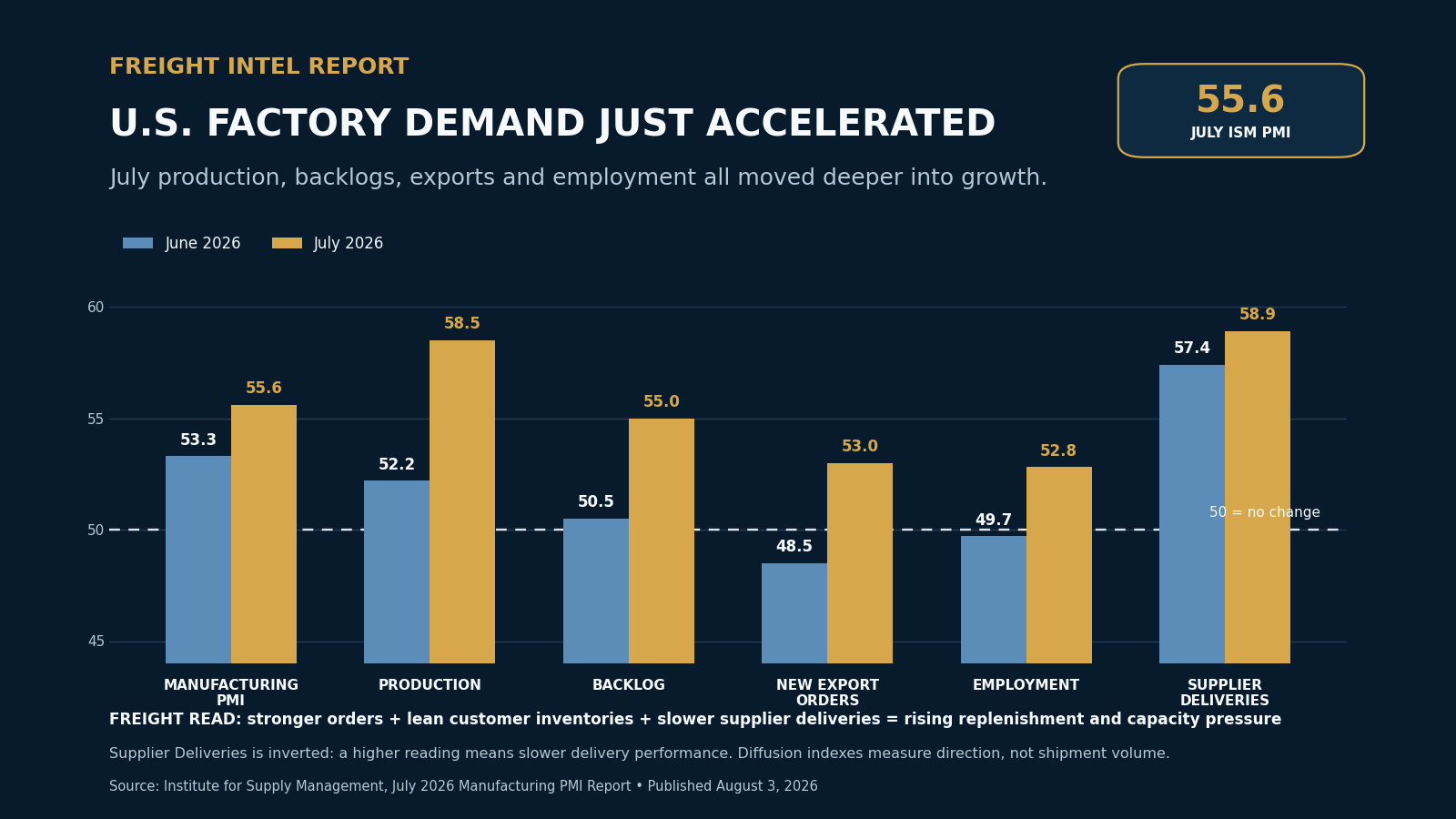
The Institute for Supply Management’s Manufacturing PMI rose to 55.6 in July, up 2.3 points from June and its highest reading since May 2022. Production jumped 6.3 points to 58.5, the strongest reading since November 2021. Order backlogs, exports and factory employment also moved decisively into expansion.
For transportation buyers and providers, the message is not that freight volumes have already entered a broad boom. It is that the manufacturing pipeline is tightening quickly enough to change late-third-quarter capacity, inventory and pricing decisions.
What changed in July
- Manufacturing PMI: 55.6, up from 53.3.
- Production: 58.5, up from 52.2 and at a nearly five-year high.
- New orders: 56.7, the seventh consecutive month of expansion.
- Order backlogs: 55.0, up 4.5 points.
- New export orders: 53.0, returning to growth from 48.5.
- Employment: 52.8, the first expansion reading in 33 months.
- Supplier deliveries: 58.9, indicating slower delivery performance.
- Customers’ inventories: 40.7, falling further into ISM’s “too low” category.
The combination matters more than any single index. Production is accelerating while customers report lean inventories, backlogs are growing and suppliers are taking longer to deliver. That is the pattern most likely to create replenishment freight, premium service requirements and tighter equipment availability if it persists.
The Freight Intel view
This report moves the freight outlook closer to a genuine industrial reacceleration—but it does not yet prove a broad transportation-volume recovery.
ISM indexes are diffusion measures: they show how many respondents report improvement or deterioration compared with the prior month. They do not measure truckloads, ton-miles, containers or revenue shipments. The latest hard freight data still show uneven demand, including the year-over-year decline in June Cass shipments documented in the August Freight Intel Outlook.
The July survey nevertheless changes the leading signal. Four of the six largest manufacturing industries—transportation equipment, machinery, computer and electronic products, and food, beverage and tobacco products—expanded. Twelve industries reported higher production, and none reported a production decline.
The expansion is not uniform. ISM said 62% of respondent comments were negative, with pricing volatility, the Iran conflict, longer lead times and tariffs repeatedly cited. AI infrastructure, defense and advanced electronics remain unusually powerful demand centers, while some consumer-oriented businesses are still weaker.
What shippers should do now
- Refresh lane forecasts by commodity and plant. Do not apply the national PMI reading evenly across the network. Prioritize transportation equipment, machinery, electronics, food and fabricated-material lanes.
- Protect capacity before broad freight indexes turn. Secure service on lanes tied to low customer inventories, expanding backlogs and long-lead components—without locking the entire portfolio at surge pricing.
- Recheck intermodal conversion opportunities. Stronger imports and production can improve density on long-haul lanes just as trucking capacity becomes more expensive.
- Separate demand delays from disruption delays. Supplier deliveries can slow because factories are busier, but tariffs, component shortages and geopolitical rerouting are also extending lead times.
Implications for carriers and brokers
Carriers should protect flexible capacity around industrial, data-center, defense, transportation-equipment and food corridors while resisting the temptation to interpret one survey as a nationwide volume surge. Brokers should prospect into the expanding sectors, monitor plant-level changes and price the risk of late tenders and component-driven schedule volatility.
The most important confirmation signals over the next six to eight weeks will be actual truckload spot volume and rates, tender rejections, LTL tonnage, rail intermodal volume, industrial production and Cass shipment activity. If those measures begin rising together, the market will have moved from a cost-and-scarcity cycle toward a broader demand recovery.
What remains uncertain
It is not yet clear how much of July’s improvement reflects durable end-market demand versus AI and defense concentration, inventory timing or tariff-related purchasing. Raw-material prices continued rising, the ISM Prices Index remained elevated at 71.1, and shortages were reported in electronics, memory, semiconductors, rare-earth components, steel and tungsten products.
The signal is strong enough to change planning. It is not strong enough to justify indiscriminate rate increases, fleet expansion or inventory accumulation.
Sources
- Institute for Supply Management: July 2026 Manufacturing PMI Report, published August 3, 2026.
- Reuters: U.S. manufacturing activity jumps to more than four-year high, published August 3, 2026.
- Freight Intel Report: August 2026 Freight Outlook.
Free Freight Intel Briefing: Subscribe for sourced breaking analysis, decision dashboards and monthly freight scenarios built for shippers, carriers, brokers and executives.
Leave a Reply