
Peak parcel pricing is no longer a late-quarter event.
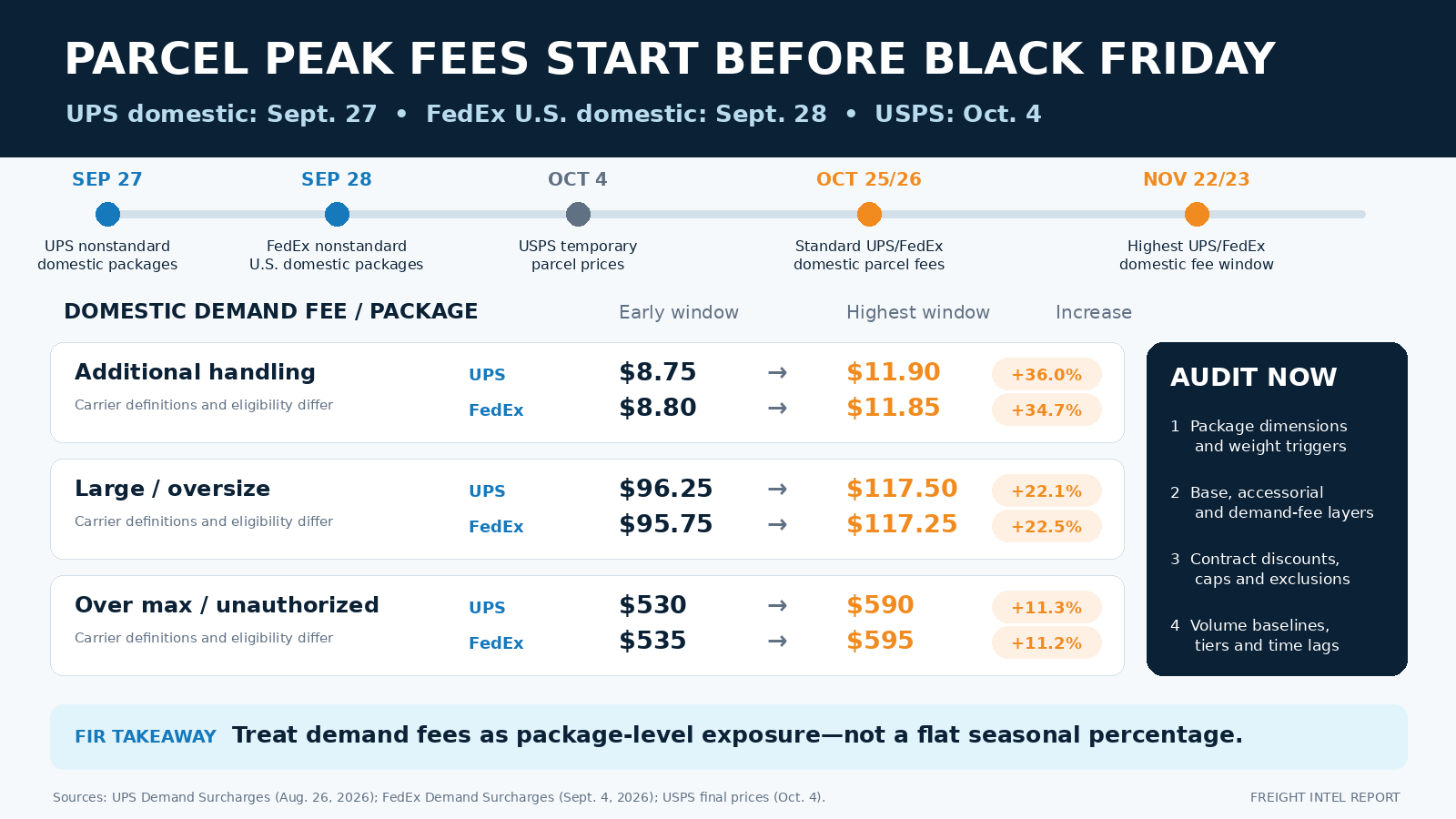
UPS demand surcharges for packages requiring additional handling, large-package treatment or over-maximum treatment begin September 27. FedEx begins comparable U.S. domestic demand fees for additional handling, oversize and unauthorized packages on September 28. Its international demand program has a separate calendar; some international fees began September 21. USPS time-limited prices follow on October 4.
That calendar creates an immediate procurement problem: a shipper can incur peak-related cost weeks before standard residential demand fees begin—and before many organizations activate their holiday control rooms.
The right response is not to add one seasonal percentage to the parcel budget. The exposure depends on package dimensions and weight, service selection, customer-specific volume baselines, weekly volume timing, contract language and whether demand charges stack with other fees.
The earliest fees attach to nonstandard packages
UPS says its first demand window runs September 27 through November 21. During that period, the demand fee is $8.75 per package for additional handling, $96.25 for a large package and $530 for an over-maximum package. The highest window begins November 22, when those amounts rise to $11.90, $117.50 and $590.
FedEx’s first domestic window runs September 28 through November 22. Its demand fee is $8.80 for additional handling, $95.75 for oversize and $535 for an unauthorized package. Beginning November 23, those amounts rise to $11.85, $117.25 and $595.
| Demand fee per affected package | Early UPS window | Highest UPS window | Early FedEx window | Highest FedEx window |
|---|---|---|---|---|
| Additional handling | $8.75 | $11.90 | $8.80 | $11.85 |
| Large / oversize | $96.25 | $117.50 | $95.75 | $117.25 |
| Over maximum / unauthorized | $530 | $590 | $535 | $595 |
The early-to-highest increase is 36.0% for UPS additional handling and 34.7% for FedEx additional handling. Large-package or oversize demand fees rise about 22%, while over-maximum or unauthorized demand fees rise about 11%.
Those percentages do not make the carrier programs interchangeable. UPS and FedEx use different definitions, service rules, contracts and billing systems. A package must be tested against the applicable carrier’s rules before the figure can be treated as an exposure.
A packaging error can become a triple-cost event
The demand fee is only one layer.
UPS states that its demand surcharges apply in addition to all other applicable charges. FedEx says its volume-based residential demand charge is assessed in addition to the residential delivery charge, and that a contracted discount or cap on the ordinary residential charge does not apply to the demand charge.
That means a package that crosses a dimension, weight or handling threshold can create more than one cost event: the underlying transportation charge, the ordinary accessorial and the seasonal demand charge. Fuel and delivery-area charges may add further layers depending on the shipment and contract.
The operational control therefore belongs upstream of invoice audit. Shippers should identify which SKUs, cartons and fulfillment locations generate the affected characteristics, then compare the manifest dimensions with carrier measurements. A downstream dispute process cannot recover the margin lost when packaging design repeatedly pushes the same item across a published threshold.
This is distinct from FIR’s August analysis of parcel fuel surcharges. Fuel programs generally move with published fuel tables and lags. Demand fees are tied to a seasonal calendar, package attributes and—in some programs—customer-specific volume behavior. Both may appear on the same invoice, but they should be modeled as separate cost drivers.
September 26 can change the UPS baseline
For high-volume shippers, the less visible exposure is the baseline used to calculate the weekly demand tier.
UPS says the higher-volume table applies to customers whose combined qualifying volume exceeded 20,000 packages in any week after October 2025. The normal baseline is average weekly volume for the applicable service level from May 31 through June 27, 2026.
But the carrier also specifies a second test: if average weekly volume from August 30 through September 26 is less than 80% of the June average, the lower August–September period becomes the baseline.
That matters now because the alternative measurement period just ended. A business that temporarily reduced volume in September and then restores it during peak can generate a higher peaking factor than it would against the June baseline. The result can move every qualifying package in a service level into a higher demand tier for the applicable invoice week.
A simple hypothetical shows the effect. If a qualifying shipper averaged 25,000 weekly packages in June but 18,000 during the later period, the later average would be 72% of June and could become the baseline under the published rule. A 27,000-package week would then equal 150% of the lower baseline, rather than 108% of the June baseline. The invoice consequence depends on service level, contract and the carrier’s determination, but the procurement implication is clear: the baseline must be validated before the forecast is approved.
FedEx uses a different clock—and a two-week lag
FedEx’s volume-based residential demand program also applies to enterprise customers above a 20,000-package weekly threshold, but its calculation mechanics differ.
FedEx compares each calculation week’s qualifying volume with the shipper’s average weekly volume from June 1 through June 28. It then applies the resulting charge during a corresponding application week, with a two-week lag. FedEx also adjusts volume in a calculation week containing a holiday to account for the shorter operating week.
The lag creates a control problem. A volume surge and the resulting demand charge do not necessarily appear in the same operating week. Finance, parcel operations and e-commerce teams need one shared calendar that maps the calculation week, the application week and the expected charge tier. Otherwise, the charge can look like an invoice error even when it reflects a prior week’s volume.
The highest published volume-based tier reaches $8 per package for FedEx ground and home-delivery services and $9.35 for specified express services. UPS’s higher-volume table reaches the same $8 and $9.35 endpoints for corresponding residential ground and air categories. The similar endpoints should not substitute for reading the separate baseline, eligibility and service rules.
USPS starts earlier than standard UPS and FedEx parcel fees
USPS’s final time-limited 2026 price files take effect October 4 and run through January 17. That is three weeks before standard UPS residential demand fees begin October 25 and FedEx’s standard package demand fees begin October 26.
USPS publishes time-limited prices by product, weight, zone and other characteristics rather than one directly comparable demand-fee number. Shippers should therefore run their actual package file through the final October 4 price tables instead of treating the postal change as a flat surcharge or assuming it matches a private-carrier category.
The sequencing matters for carrier-allocation decisions. A routing model built from today’s base rate may be obsolete when the shipment is tendered. The comparison should use the price and fee schedule in effect on the planned ship date, not the date the budget or promotion was approved.
Five controls to put in place now
Build an affected-package file. Identify every SKU and carton that has triggered additional handling, large-package, oversize, over-maximum or unauthorized treatment during the last 13 weeks. Include the ship-from location, service and carrier-measured dimensions.
Separate charge layers. Model the base transportation charge, ordinary accessorial, demand fee, residential fee, delivery-area charge and fuel surcharge as distinct fields. Do not bury them inside a single effective-rate average.
Recalculate volume baselines. Confirm the UPS and FedEx eligibility threshold, carrier-defined baseline, peaking factor and application week. Keep UPS’s possible August 30–September 26 reset separate from FedEx’s June baseline and two-week lag.
Test packaging and fulfillment alternatives. Quantify whether a carton change, split shipment, different fulfillment node or different service avoids a threshold without increasing damage, labor or delivery risk. A lower headline rate does not help if the package still triggers the same fee.
Align pricing promises with the fee calendar. Review free-shipping thresholds, marketplace commitments, customer quotations and promotional dates against the carrier-specific effective dates. The financial trigger is the tender date and shipment characteristics, not the marketing team’s definition of peak.
The decision is package-level, not seasonal
Parcel demand pricing is often budgeted as a temporary percentage. The published 2026 programs show why that shortcut can fail.
The first charges arrive in late September. Nonstandard packages carry far larger dollar exposure than ordinary residential packages. High-volume programs use customer-specific baselines and time lags. USPS begins its temporary pricing before the standard UPS and FedEx parcel demand windows. And the demand fee may sit on top of other accessorial and fuel charges.
The defensible procurement question is not, “What peak percentage should we add?” It is, “Which packages trigger which charge, during which week, under which baseline and contract rule?”
That is the level at which parcel cost can still be controlled.
Sources
- UPS Demand Surcharges, August 26, 2026 update
- FedEx Demand Surcharges, updated September 4, 2026
- USPS Time-Limited 2026 Price Change
- FIR: Fuel Surcharges Are Outrunning Fuel Costs—What Shippers Should Audit Across Rail, Parcel and Ocean
Leave a Reply