
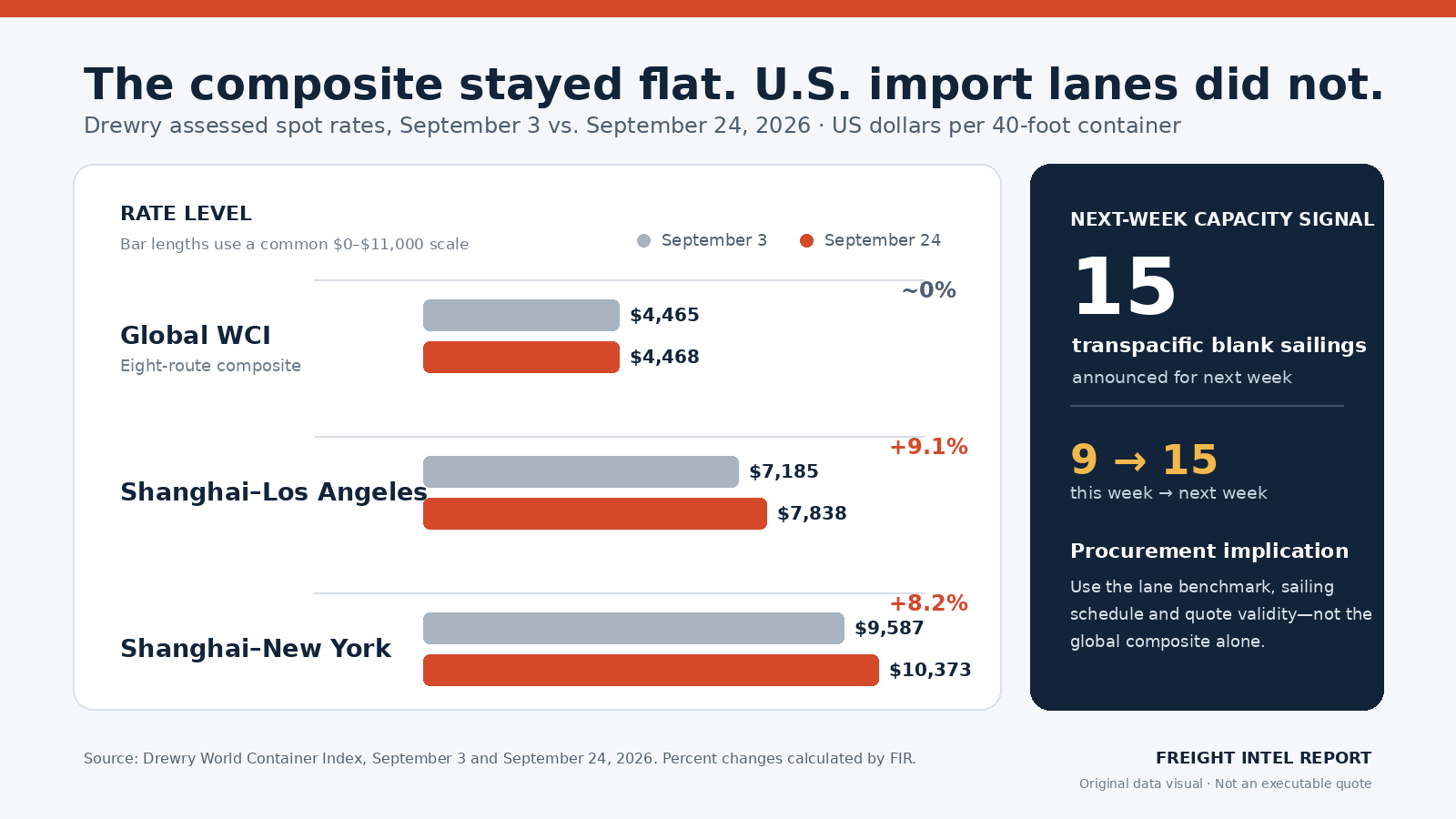
A shipper comparing ocean bids against a global index could see almost no change since early September. A shipper buying space from Shanghai to Los Angeles or New York would see a very different market.
Drewry’s World Container Index (WCI) was $4,468 per 40-foot container on September 24, just $3 above its September 3 reading. Over those same three weeks, Drewry’s Shanghai–Los Angeles assessment rose $653, or 9.1%, and Shanghai–New York rose $786, or 8.2%.
| Drewry assessment, U.S. dollars per 40-foot container | September 3 | September 24 | Change |
|---|---|---|---|
| Eight-route WCI composite | $4,465 | $4,468 | +$3 (+0.07%) |
| Shanghai–Los Angeles | $7,185 | $7,838 | +$653 (+9.1%) |
| Shanghai–New York | $9,587 | $10,373 | +$786 (+8.2%) |
FIR calculations from Drewry’s published assessments. These are market benchmarks, not an individual shipper’s executable quote or a forecast of its invoice.
The immediate buying question is not whether the global index or the U.S. lanes are “right.” It is which measure is written into the contract, which departure can carry the cargo and how long the quoted price remains valid.
The flat composite masks a live contract mismatch
Drewry’s composite tracks eight major east–west trades. Its September 24 reading fell 1% from the previous week as Asia–Europe rates declined: Shanghai–Genoa was down 5% to $3,835, and Shanghai–Rotterdam down 4% to $3,485. Shanghai–Los Angeles, meanwhile, gained 2% for the week to $7,838; Shanghai–New York held at $10,373.
That one-week decline and the three-week U.S. lane increases can both be true. A global average blends routes whose prices are moving in opposite directions. Neither the composite nor a lane assessment automatically equals what a particular importer will pay.
For a simple sensitivity test, multiply the change in the relevant lane assessment by exposed volume. If 100 forty-foot containers were priced directly against the Shanghai–Los Angeles assessment at the two observation dates, the $653 difference would amount to $65,300 of benchmark movement. For Shanghai–New York, $786 times 100 is $78,600.
That arithmetic is a way to size a pricing exposure, not a claim that an importer received a $65,300 or $78,600 bill. Contract discounts, reset dates, quote terms, container specifications, inland moves and surcharges determine the actual charge. If the contract uses a monthly average or a different base value, the two spot observations cannot be inserted directly into its invoice formula.
Three questions before the next rate reset
1. Which benchmark governs? “WCI-linked” is incomplete. Record the publisher, named index, direction, port pair, equipment, currency and covered ocean leg. If the contract uses the eight-route composite for a single U.S. import lane, document the mismatch and whether the adjustment was intentionally designed that way.
2. When does a market observation become an invoice change? Record the assessment date or averaging window, base value, adjustment percentage or dollar formula, reset lag, cap, floor and effective date. A September 24 spot assessment may have no effect on a fixed-rate contract today; it can matter at a future reset.
3. What sits outside the benchmark? Put fuel, peak-season, security, congestion, equipment, origin and destination charges beside the linehaul formula. Confirm whether each charge is fixed, separately indexed or subject to a new notice. Preserve the quote and calculation so a buyer can reproduce the all-in number.
A benchmark mismatch cuts both ways. The composite can understate a rising lane when other routes fall, or overstate one that softens faster than the average. Match the measure to the freight being purchased rather than selecting whichever index favors a particular negotiation.
The sailing count is a prompt to check bookings
In its September 24 release, Drewry said 15 transpacific blank sailings were announced for the following week, versus nine in the current week. That is a two-thirds increase in the count of announced cancellations. It is not a two-thirds reduction in all transpacific slots, vessel capacity or a shipper’s available space.
The next day’s broader cancelled-sailings tracker adds useful scale: Drewry expected 58 cancellations out of 712 scheduled sailings across major east–west trades over Weeks 40–44, an 8% cancellation rate. It said 64% of those announced cancellations were concentrated on the eastbound transpacific. That five-week, multi-trade measure is not the same denominator or time window as the nine-to-15 one-week transpacific count.
A blanked service matters only when it intersects a real shipment. For every cargo lot that must move around China’s Golden Week, ask the forwarder or carrier for:
- the named vessel and service string, origin cutoff, transshipment plan and destination call;
- confirmation that the booking is accepted on that departure rather than merely requested;
- the next usable sailing and the written rollover rule if the booked departure is removed;
- the latest date the cargo can arrive without a stockout, production interruption or missed customer commitment; and
- the price, approval owner and deadline for a viable alternative.
A shipper with inventory cover may be able to wait. One with a production-critical component may have to secure a specific departure even if the spot benchmark later falls.
Golden Week makes timing a decision, not a prediction
Drewry expects rates to decline in the week ahead of Golden Week despite the announced blank sailings. That is a forecast, not an available quote or a guarantee of space.
For confirmed, time-critical cargo, secure a named departure and price the cost of a rollover. For confirmed cargo with buffer, compare a current executable quote with the next available quote and the cost of waiting. For forecast cargo without a firm purchase order, avoid committing volume solely because a cancellation count rose. Annual contracts need their own benchmark and reset review; a one-week sailing change should not dictate a year of pricing.
Write the quote-expiration time, included charges and space commitment into that comparison. If a forwarder offers a lower rate but cannot identify a usable departure before the delivery deadline, it is not the cheaper operational option. If an earlier sailing carries a premium, compare that premium with the actual cost of delay.
The FIR decision
The September 24 global WCI was essentially unchanged from September 3. Drewry’s two Shanghai-to-U.S. assessments were up 8%–9%. Asia–Europe declines helped hide that divergence in the composite, while announced blank sailings added a separate schedule question.
For Q4 bids and immediate bookings, put three records side by side: the contract’s exact rate formula, the current quote for the actual lane and the confirmed sailing with its fallback. That comparison tells a shipper whether the exposure is a benchmark mismatch, a price increase, a capacity risk—or all three.
Sources and related FIR coverage
- Drewry World Container Index, September 24, 2026.
- Drewry Cancelled Sailings Tracker, September 25, 2026.
- FIR September 2026 Freight Outlook, recording Drewry’s September 3 starting assessments.
- FIR’s earlier Maersk pricing analysis.
- FIR Multimodal Rate Monitor.


Leave a Reply