
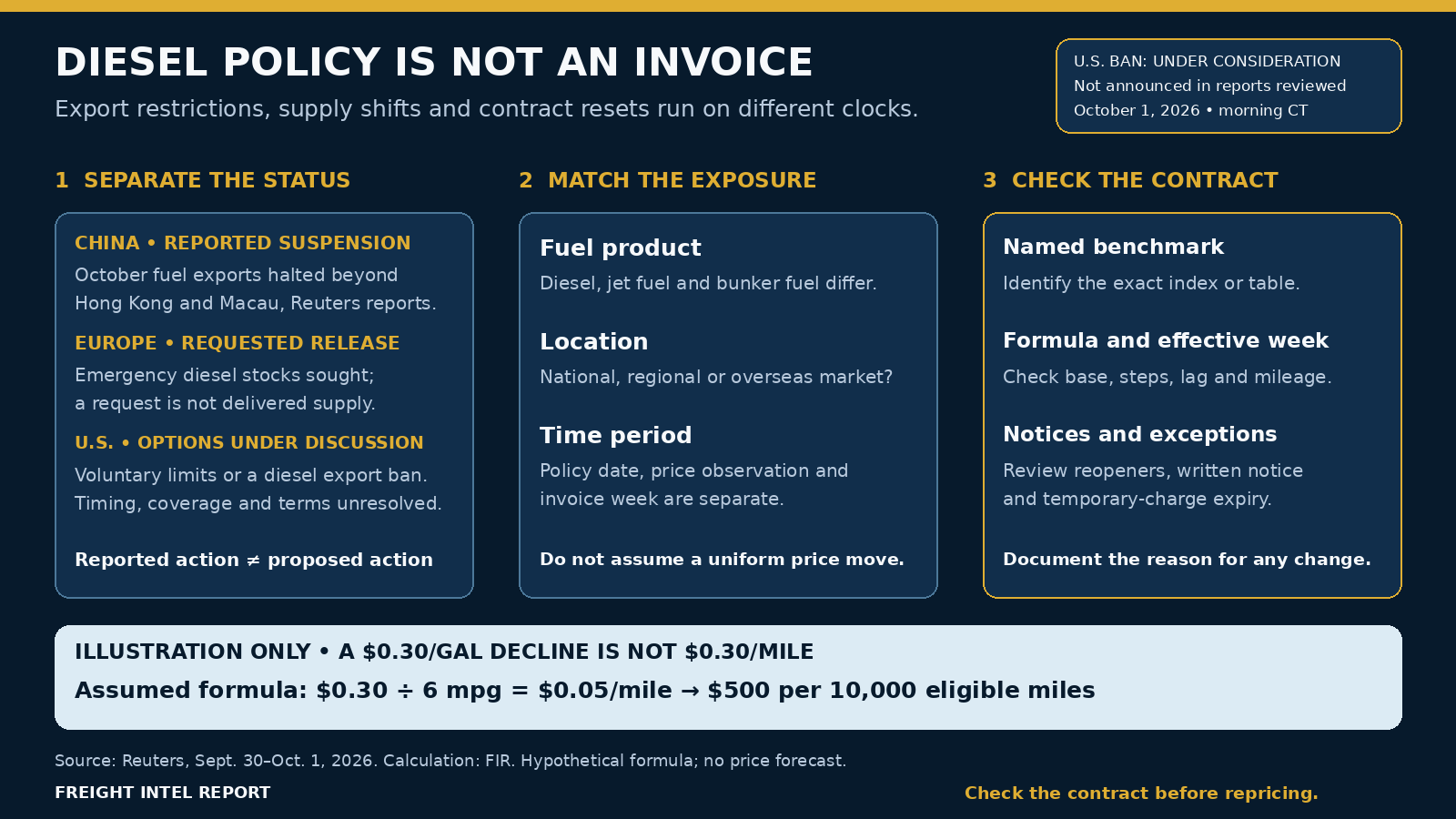
Reported restrictions in China and a U.S. push for European reserves put the supply question ahead of the surcharge question. Freight buyers need separate tests for fuel availability, benchmark movement and contract changes.
Information reviewed October 1, 2026.
A shipper can face two fuel problems at once: a bill that has not come down and an overseas transportation network exposed to tighter supply. Planning for October around the prospect of cheaper U.S. diesel could miss the second problem entirely.
Reuters reported October 1 that Chinese refiners suspended October fuel exports beyond Hong Kong and Macau. Separately, its reporting described U.S. pressure on France and Germany to release emergency diesel stocks, with a possible U.S. export ban raised as leverage. Those are different stages of action, with different implications.
The U.S. ban remained under consideration in the reporting reviewed for this article. That distinction belongs at the center of the freight decision: reported restrictions elsewhere do not establish an enacted U.S. ban, and neither a proposal nor a supply intervention guarantees a particular surcharge outcome.
The new risk is a split between markets
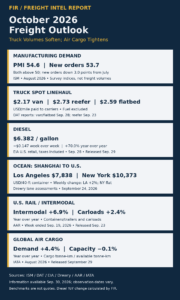
FIR’s October Outlook examined divergence among transportation modes. This development adds a more specific question: could efforts to retain fuel in one country make the international network more expensive or harder to operate?
That is a scenario to test, not a forecast. Fuel retained domestically may help one market while removing supply available to another. The resulting effect depends on replacement sources, inventories, transport access, product specifications and duration. A shipper importing through an Asian gateway and distributing by U.S. truck therefore has at least two exposures to examine.
Track the decisions separately:
- China: the reported suspension concerns shipments beyond Hong Kong and Macau. Treat its duration and affected supply arrangements as matters to verify with transportation providers.
- Europe: a requested reserve release must become an agreed, executable delivery program before buyers can treat it as available supply.
- United States: Reuters’ September 30 reporting described voluntary export limits and a possible ban among the options under discussion. An implementation document would be needed to establish coverage, timing and exemptions.
Do not net these headlines into a single global fuel-saving assumption. Even opposing supply changes may affect different products, places and delivery periods.
The latest price move already shows why geography matters
EIA’s September 28 observations put national retail on-highway diesel at $6.382 per gallon, down 14.7 cents from the previous week. Regional changes differed: Gulf Coast diesel fell 22.2 cents, while Rocky Mountain diesel rose 6.7 cents. These observations predate the October 1 developments and do not measure their effects.
A national-index contract can move differently from the fuel cost a carrier experiences in its operating region. Neither figure is inherently wrong. The mismatch is a reason to understand the agreement—not to substitute whichever index produces the preferred result.
It also explains why a supplier’s fuel-cost claim and a customer’s contractual surcharge entitlement must be checked separately. One concerns operating exposure; the other concerns the agreed billing mechanism.
Thirty cents at the pump is not thirty cents per mile
Consider an illustrative truckload agreement with a continuous fuel formula: the amount above an agreed base price is divided by an assumed six miles per gallon. If its named benchmark falls by $0.30 per gallon, with both values above the base, the calculated surcharge falls by $0.05 per mile.
Across 10,000 eligible billed miles, that is $500 of modeled relief after the applicable reset—not $3,000. The calculation is $0.30 ÷ 6 × 10,000.
This is an arithmetic illustration, not an industry-standard formula or a prediction. Actual agreements may use percentage tables, discrete brackets, different mileage assumptions, minimums or floors. A bracketed table can delay a change until a threshold is crossed. An all-in quote may have no separate indexed adjustment at all.
The useful question for finance is: which input changed, how does the signed formula translate it, and which shipments fall in the effective period?
Keep supply protection separate from invoice adjustment
A transportation team may need to investigate capacity or fuel availability before its billing index changes. Waiting for the next published surcharge table would be the wrong control for an actual service problem. Conversely, a broad policy headline alone does not establish a supplier’s right to impose an additional charge.
| Evidence received | What to examine | Immediate control |
|---|---|---|
| Policy announcement or reported restriction | Product, geography, start date and actual applicability | Identify exposed shipments; keep assumptions provisional. |
| Named benchmark changes | Formula, observation period and contractual lag | Recalculate the applicable charge for eligible shipments. |
| Carrier requests an exceptional charge | Contract clause, notice, scope and supporting evidence | Route for commercial and legal review; record any agreed expiry. |
| Supplier reports a physical shortage or service constraint | Affected terminal, lane, departure and recovery options | Assess continuity measures independently of the surcharge cycle. |
This framework preserves room for negotiation. An indexed formula is one route to a price change; a valid reopener or mutually agreed amendment may be another. Neither should disappear behind an instruction to reprice only when an index moves.
Ask three questions before the next tender
What fuel exposure are we buying? Record the named fuel product and market alongside the lane and service. A diesel indicator does not automatically describe an air carrier’s jet-fuel exposure or an ocean service’s bunker adjustment.
What can change the price? Keep the benchmark, table version, base, reset date and notice requirements in the procurement record. Separate ordinary formula changes from exceptional requests so the same claimed cost is not counted twice.
What can interrupt the service? For potentially exposed lanes, ask providers for shipment-specific evidence and the next workable alternative. Compare recovery time, inventory cover and total delivered cost before buying premium capacity or changing modes.
The October decision is not a bet on whether Washington restricts exports. It is whether the shipper can recognize a supply problem, a benchmark movement and a contractual price change as three distinct events—and respond to each with the appropriate evidence.
Sources and reading
External references are intentionally plain text. Navigate independently to the publisher’s website and search the exact title.
- Reuters, October 1, 2026: “Chinese refiners suspend October fuel exports to bolster stocks, sources say.” Website: reuters.com.
- Reuters, October 1, 2026: “US tells France and Germany to release diesel stocks or face US export ban, sources say.” Website: reuters.com.
- Reuters, September 30, 2026: “Trump says he is still considering diesel export ban.” Website: reuters.com.
- U.S. Energy Information Administration, Gasoline and Diesel Fuel Update; September 28 observations. Address: eia.gov/petroleum/gasdiesel/.
Related FIR analysis
- October Freight Outlook
- FIR Multimodal Rate Monitor
- Fuel-surcharge audit across rail, parcel and ocean
Leave a Reply