
A shipper that assumes every truck moving during a disaster has 30 days of federal hours-of-service relief can price the load, promise the delivery and assign responsibility on the wrong basis. FMCSA has doubled the automatic window for regional emergency declarations from 14 days to 30, effective October 5. But the extra time applies only while a carrier and driver are providing direct assistance to the declared emergency.
The distinction matters before the next hurricane, wildfire, flood, winter storm or fuel shortage. The new number is easy to remember. The legal scope is not. A declaration does not turn all freight in the affected region into emergency freight, suspend every safety rule or guarantee a month of looser capacity.
For a regional emergency declared by a governor, an authorized representative or FMCSA, the rule removes the federal hours-of-service limits in 49 CFR §§395.3 and 395.5 for qualifying direct assistance. The relief lasts for the emergency period or 30 days from the initial declaration, whichever is less. FMCSA can separately extend relief under its existing authority.
The rule changed the calendar, not the scope test
FMCSA’s final rule makes one textual change: it replaces “14” with “30” in the regional-declaration provision of 49 CFR §390.23(b). The agency said the purpose is to reduce extension requests created by the shorter 2023 limit. It estimates that the change will eliminate 25 extension requests a year and save industry and government about $1,429 in combined annual labor.
That small quantified effect is revealing. FMCSA does not describe the rule as a national capacity expansion. It says the only expected impact is fewer extension requests because more emergencies will fit inside the initial window. Freight buyers should therefore avoid converting the change into an assumed rate reduction, guaranteed truck availability or a blanket contract exception.
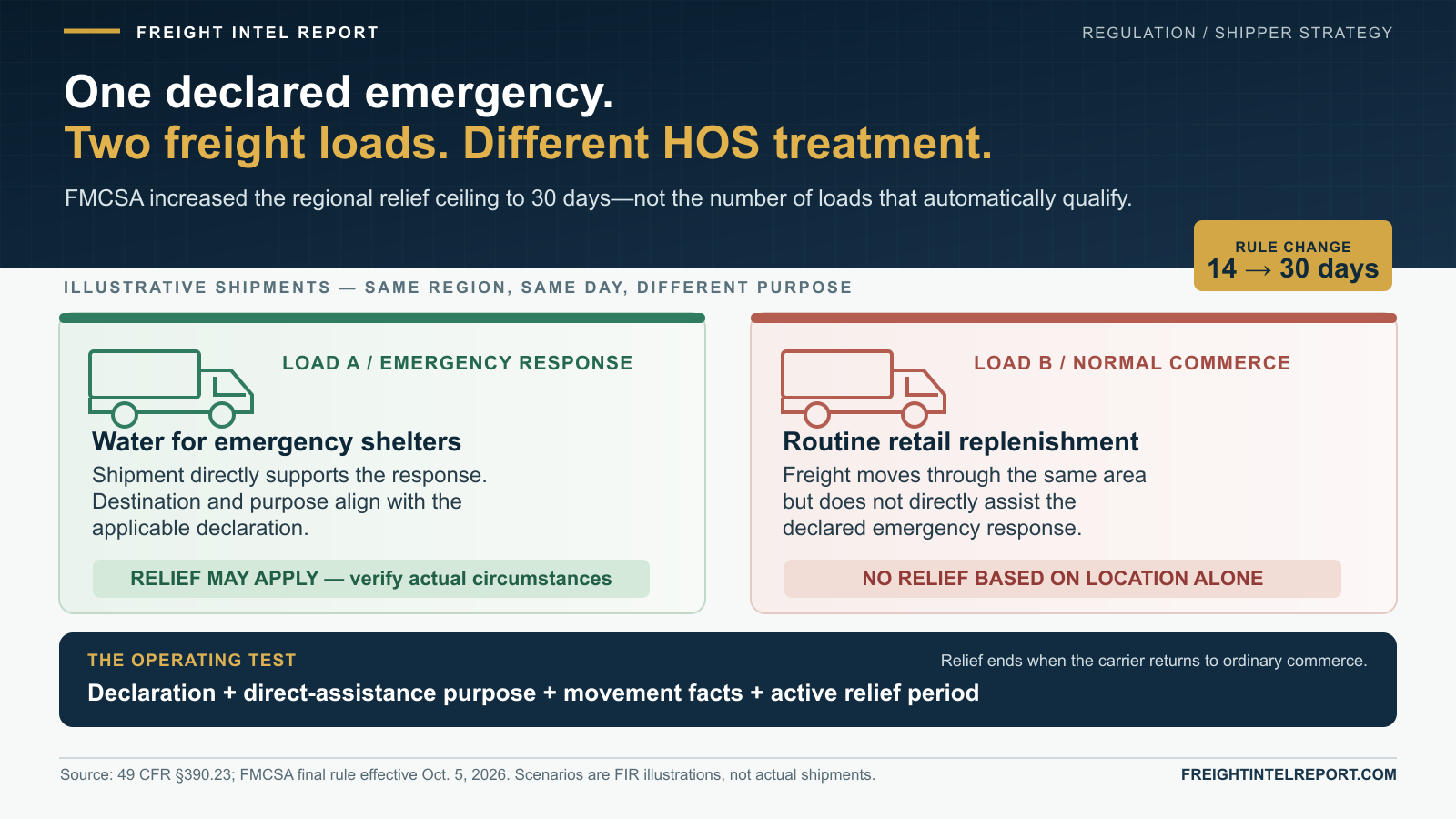
The operational gate remains “direct assistance.” The federal regulation ends the relief when a driver or commercial motor vehicle is used in interstate commerce to transport cargo not destined for the emergency effort, or when the carrier dispatches that driver or vehicle elsewhere to begin normal commercial operations. An empty return to the carrier’s terminal or the driver’s normal reporting location is allowed, subject to the regulation’s rest protections.
That makes qualification load-specific. Two trucks can travel the same highway on the same day inside the same declared area and face different HOS treatment. A shipment of bottled water ordered for emergency shelters may qualify. A routine replenishment load to a retailer in the same county may not. The declaration, consignee, purpose, commodity and timing have to line up.
A 30-day window does not equal a 30-day delivery promise
Shippers often feel the change indirectly. Emergency demand pulls tractors, drivers, fuel, trailers and warehouse labor away from ordinary networks. The longer automatic relief period may help carriers continue qualified response work without pausing after two weeks to await an extension. It does not prevent equipment imbalance, closed facilities, damaged roads, fuel rationing, curfews or receiver congestion.
The planning consequence is to separate regulatory capacity from physical capacity. A carrier can be legally able to run longer and still be unable to meet the shipper’s appointment because the destination is closed or the return network has collapsed. Conversely, a truck may be physically available but ineligible for the exemption because the load is ordinary commerce.
Procurement teams should not ask only, “Is there an emergency declaration?” They should ask, “What fact makes this tender direct assistance under this declaration?” That answer should be available before a dispatcher, broker or carrier relies on the exemption.
Build a six-field qualification record
FIR’s analysis suggests a simple record that can travel with the tender and survive an invoice, service or compliance dispute:
FMCSA’s published guidance says no specific document is required to verify that a driver is operating under an emergency declaration, although ordinary business records such as the bill of lading may be useful later. FIR’s six-field record is therefore a procurement and audit control—not an agency form or an additional legal condition.
- Declaration: identify the issuing authority, effective date, geographic area and stated emergency.
- Emergency need: connect the shipment to restoration of essential services or supplies, rather than relying on proximity alone.
- Cargo: describe the commodity and quantity accurately enough to show why it supports the response.
- Lane and consignee: document the origin, destination and receiving party tied to the emergency effort.
- Time window: confirm that the movement falls inside the emergency period and the applicable federal maximum.
- Carrier basis: require the carrier to state which relief it is using and when direct assistance begins and ends.
This is not a shipper authorization to direct a driver beyond safe limits. The carrier and driver remain responsible for lawful operation, and the regulation’s termination and rest provisions still apply. The record instead prevents a commercial team from building its promise around an exemption that the operating facts do not support.
Contract for the boundary, not only the event
Emergency clauses often focus on whether a force-majeure event occurred. The harder issue is what happens at the boundary between response freight and normal freight. A useful transportation agreement should make five points explicit:
- No automatic rate assumption. Regulatory relief does not itself establish a lower rate, fuel charge or accessorial waiver.
- No unsupported service guarantee. Appointment and transit commitments should reflect road, facility and receiver constraints, not only legal driving time.
- Named evidence owner. Assign responsibility for retaining the declaration, qualification record and dispatch history.
- Normal-commerce handoff. Define when the load or equipment exits emergency work and returns to ordinary contract terms.
- Broker transparency. If a broker is involved, require the qualification basis to reach the actual motor carrier rather than stopping in the customer’s portal.
FIR’s driverless-truck recovery analysis made a related point: a regulatory allowance does not replace a shipper’s execution plan. The same principle applies here. The exemption can expand legal operating flexibility, but the tender still needs a documented purpose, operating owner and exit condition.
What would change the assessment
A future FMCSA declaration can define its own geographic and operating terms, and the agency may extend or modify relief as conditions develop. A presidential declaration also follows a different provision that can suspend a broader set of federal motor carrier rules, while local emergencies have a five-day federal HOS window. Residential heating-fuel shortages have their own treatment.
Those differences are why shippers should read the actual declaration and current regulation for each event rather than reuse a prior storm checklist. The reliable operating conclusion is narrower than the headline: 30 days is the new ceiling for automatic regional relief. The load still qualifies—or does not—one tender at a time.
Sources and reporting notes
Research cutoff: October 13, 2026, 5:15 a.m. Central. External addresses are presented as plain text under FIR’s source policy.
- FMCSA information bulletin, October 5, 2026: fmcsa.dot.gov/newsroom/fmcsa-extends-automatic-relief-period-regional-emergency-declarations
- FMCSA final rule, 91 FR 63156: federalregister.gov/documents/2026/10/05/2026-20325/clarification-to-the-applicability-of-emergency-exemptions-response-to-petitions-for-reconsideration
- Current 49 CFR §390.23: ecfr.gov/current/title-49/subtitle-B/chapter-III/subchapter-B/part-390/subpart-B/section-390.23
- FMCSA emergency-relief documentation guidance: fmcsa.dot.gov/taxonomy/term/4641
By Eric Bratton, Founder and Executive Editor, Freight Intel Report
Leave a Reply