
By Eric Bratton, Founder and Executive Editor, Freight Intel Report
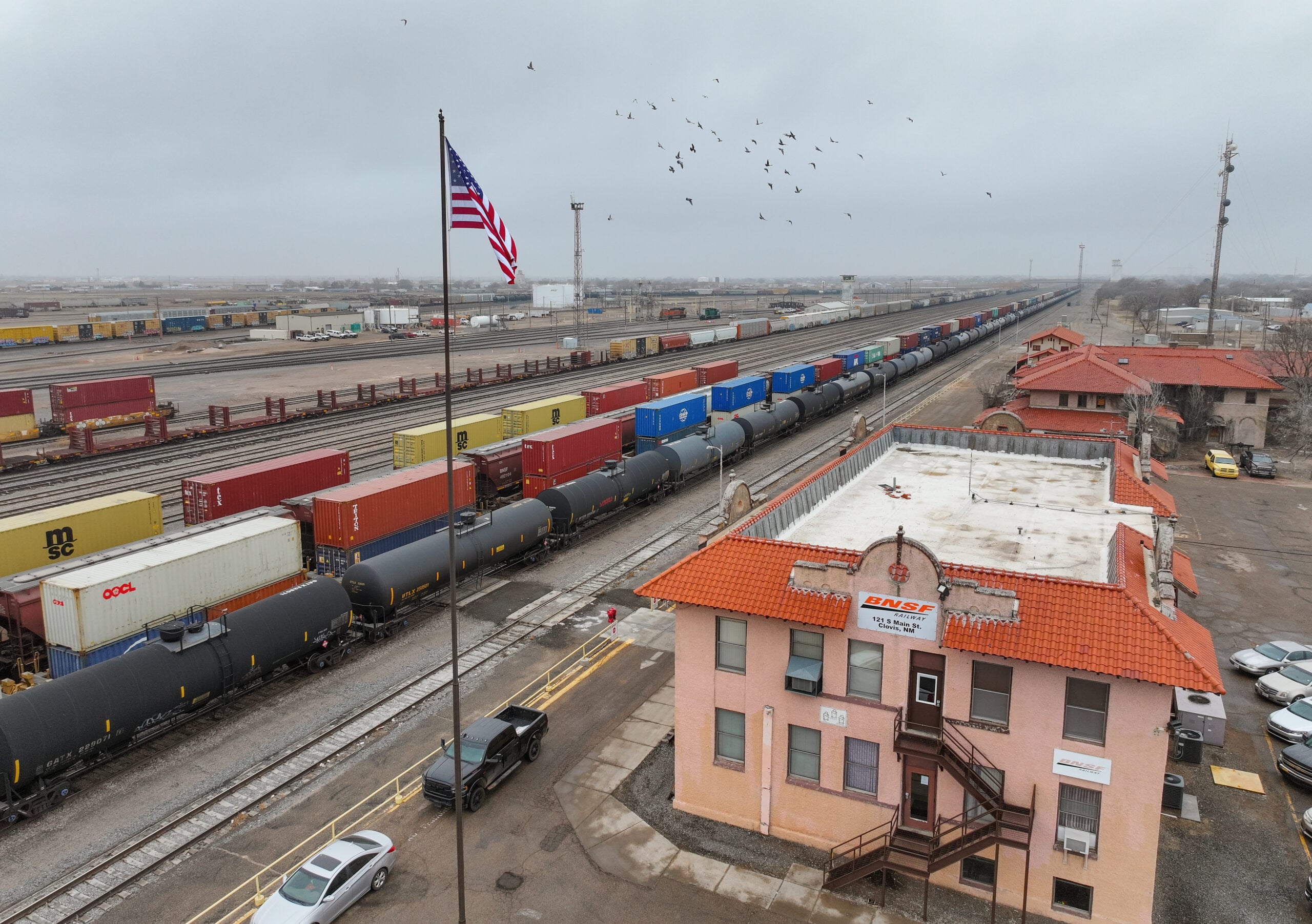
Featured image: BNSF freight operations in Clovis, New Mexico, photographed January 29, 2025. Archival image illustrating the railroad’s regional network; not the October 2026 flood damage. Photo: Quintin Soloviev / Wikimedia Commons, CC BY 4.0.
The first restored track does not restore a freight network.
That distinction matters after flooding affected two BNSF routes in New Mexico: the Gallup Subdivision on the Southern Transcon between Southern California and the Midwest, and the El Paso Subdivision between Belen and El Paso, Texas.
In an October 28 update, BNSF said both Gallup main tracks had returned to service—one late Monday and the second Tuesday afternoon. Trains were moving through the area at precautionary reduced speeds while the railroad worked through backlogged traffic.
The same update said the El Paso Subdivision remained out of service between Sabinal and La Joya. Water had again risen above the rail south of La Joya, no restoration estimate was available, and BNSF had issued embargo BNSF001326 for some traffic originating on or destined to the subdivision, including interchange traffic at El Paso, Texas, and Rincon, New Mexico.
BNSF warned customers to expect continuing delays and nonstandard routings while Gallup traffic recovered and El Paso repairs continued.
The disruption was part of a wider flood emergency. New Mexico’s governor said the federal emergency declaration approved October 26 covered Cibola County and Laguna Pueblo, along with other counties and tribal jurisdictions, and authorized direct federal assistance.
The operational finding for shippers is larger than either outage: the two affected routes meet at Belen, so Southern California–Midwest freight and El Paso/Mexico gateway freight cannot be treated as independent recovery problems. The same regional network must absorb repairs, held trains, crew and locomotive repositioning, route changes and the release of accumulated traffic.
The decision point is therefore not simply whether a track is open. It is whether the shipment has a credible path through the recovery queue.
What the public advisory established—and what it did not
BNSF described the Gallup Subdivision as part of its Southern Transcon route between Southern California and the Midwest. Floodwater rose rapidly near Laguna, about 70 miles west of Belen, and took both main tracks out of service before their phased restoration.
Both mains have now reopened, but trains were operating at reduced speeds and traffic accumulated during the outage still had to be sequenced through the recovery area. Two available tracks improve physical capacity; they do not instantly restore normal train position, crew balance, terminal flow or customer ETA reliability.
South of Belen, the El Paso Subdivision remained out of service between Sabinal and La Joya. The route supports traffic moving between Belen and the El Paso gateway, including freight connected to Mexico. The new embargo means some customers face an acceptance and interchange constraint in addition to uncertain transit time.
The update did not provide shipment-specific delays, a universal recovery time or an El Paso restoration estimate. It cautioned that customers could continue to see delays and nonstandard routings.
That limits what a shipper can responsibly infer from a broad reopening update. “Open” is a network status—not an ETA.
FIR’s finding: Belen links two different customer promises
The Gallup and El Paso subdivisions carry different traffic flows, but both connect through Belen. That creates a shared recovery constraint.
An importer moving an international container from Southern California toward the Midwest may be watching the Gallup route. A manufacturer moving parts through El Paso may be watching the north-south route. Their purchase orders and customer commitments may be unrelated, yet their recovery depends partly on the same regional operating plan.
That matters for contingency design. A company may classify one movement as domestic intermodal and another as cross-border rail, assign them to different teams, and use different customer-service rules. During a simultaneous regional disruption, those separate workflows can conceal a common exposure.
The useful question is not, “Which subdivision is our shipment on?” It is: What other affected traffic must the railroad process before our shipment can return to its expected path?
Why the queue can outlast the repair
Five recovery tasks can continue after the physical route reopens:
- Held trains must be resequenced. Trains stopped on both sides of an outage cannot all enter the repaired territory at once.
- Rerouted freight must be reconciled. A tracking record that shows an unusual interchange or location may reflect an operating workaround rather than an error.
- Crews and locomotives may be out of position. Restoring the track does not automatically restore the resources assigned to the original train plan.
- Terminal and drayage appointments can become misaligned. A container released later than planned can miss a prebooked delivery window even after line-haul movement resumes.
- New traffic continues entering the network. Recovery freight competes with scheduled trains that did not disappear while the route was unavailable.
This is why a shipper should manage recovery velocity rather than wait for a binary open-or-closed signal.
What shippers should do now
1. Separate track status from shipment status
Ask the carrier or intermodal provider for the shipment’s last confirmed location, current routing, interchange status and revised availability estimate. Do not convert a network reopening statement into a customer delivery promise without shipment-level evidence.
Record the time of the status confirmation. Recovery information can age quickly.
2. Identify every movement exposed to the Belen recovery area
Search active shipments by route and gateway—not only by the words “New Mexico” or “BNSF.” Include Southern California intermodal flows, Midwest connections, El Paso traffic and Mexico-related rail moves that may pass through the affected regional network.
Group them by business consequence: production-critical parts, customer orders with appointment penalties, temperature-sensitive freight, inventory replenishment and shipments that can tolerate delay.
3. Rebuild ETAs from the next verifiable milestone
A useful ETA should be tied to the next observable event: departure from the held location, interchange completion, terminal grounding, customs release or final drayage appointment.
Avoid repeatedly adding a standard number of hours to the original schedule. A disruption queue is not necessarily first-in, first-out, and rerouted freight may follow a different sequence.
4. Protect appointments before freight becomes available
Notify warehouses, plants, customers and drayage providers that the rail ETA is conditional. Establish the latest time an appointment can be shifted without a fee or lost slot.
For containers, confirm how free time, storage and chassis arrangements will be treated if the train’s arrival changes. Do not assume a line-haul delay automatically prevents downstream charges.
5. Use a conversion threshold—not a blanket modal switch
Truck conversion can be appropriate for a production-critical shipment, but the decision should compare the full recovery cost: transload availability, equipment, handling, highway transit, cancellation terms, rail charges already incurred and the value of meeting the customer or production deadline.
Do not convert merely because the rail route experienced an outage. Convert when the avoided business loss exceeds the credible incremental cost and the alternate move can actually be executed.
6. Check the weather-recovery overlap
BNSF’s October 28 update said another round of rain was forecast beginning Friday and continuing through the weekend, and that crews were reinforcing affected areas with additional rip rap. The National Weather Service’s Albuquerque office also showed renewed precipitation risk, including a stronger system expected late in the weekend.
Weather forecasts do not establish railroad operating conditions, but they should inform the timing of contingency decisions. A shipment that can wait safely for recovery today may require a different plan if the operating window narrows again.
A practical recovery control sheet
For each exposed shipment, record:
- Shipment or container number.
- Last confirmed physical location and timestamp.
- Original route and any revised routing or interchange.
- Next verifiable milestone.
- Current provider ETA and the time it was issued.
- Delivery or production deadline.
- Appointment-change cutoff and potential accessorial exposure.
- Truck-conversion cost and decision deadline.
- Person responsible for the customer update.
The purpose is not to create another dashboard. It is to prevent different teams from making customer promises from different versions of the same disrupted movement.
The recovery signal that matters
The strongest evidence of recovery will not be the first announcement that a track has reopened. It will be a series of shipment-level milestones showing that trains are moving through the constrained area, unusual routings are resolving, terminal availability is becoming predictable and revised delivery appointments are being met.
BNSF’s update established that Gallup’s physical route had reopened while the broader regional recovery remained incomplete. It did not provide a universal transit-time adjustment or an El Paso reopening estimate.
For shippers, that means the defensible response is neither panic nor passive waiting. It is a controlled recovery process built around verified location, next movement, business consequence and a clearly timed alternate-mode decision.
Research cutoff: October 29, 2026, 5:00 a.m. Central. Shipment-level decisions require current carrier confirmation.
Editorial note: This article provides general transportation and operational information. It does not provide a shipment guarantee, legal advice or a carrier operating instruction. Conditions and routing can change quickly; organizations should confirm current shipment status directly with their carrier, intermodal provider, railroad and other responsible parties.
Primary sources
- BNSF Railway, “Update: Flooding Impacting Southwest Operations,” October 28, 2026.
- BNSF Railway, “Flooding Impacting Southwest Operations — Gallup and El Paso Subdivisions Out of Service,” October 26, 2026.
- Office of the Governor of New Mexico, “Feds partially grant emergency declaration for northern NM flooding,” October 26, 2026.
- National Weather Service Albuquerque, watches, warnings and forecast outlook checked October 29, 2026.

Leave a Reply