
A freight bid can show an acceptable safety record, an insurance certificate and a competitive rate while leaving a consequential question unanswered: if a serious event occurs, who can actually pay, for what, and when?
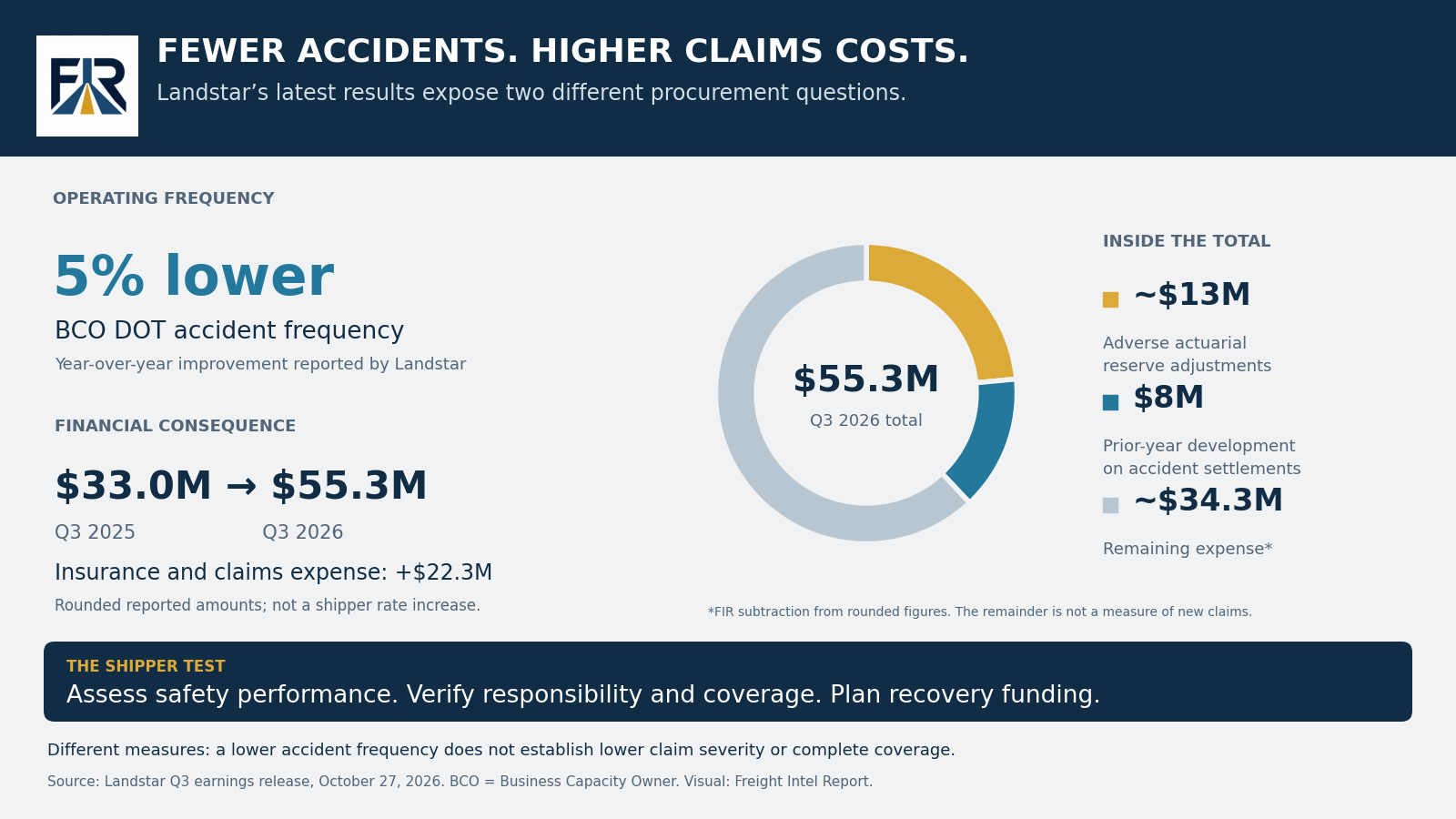
Landstar’s October 27 earnings release brings that question into focus. The company reported a 5% year-over-year improvement in its business capacity owners’ DOT accident frequency. Its third-quarter insurance and claims expense nevertheless rose to $55.3 million from $33.0 million a year earlier. Approximately $13 million reflected adverse actuarial reserve adjustments, while $8 million concerned prior-year development on settlements involving a 2024 brokered-truck accident and a 2025 BCO accident.
These figures do not establish that Landstar became less safe. Nor are they a measure of cargo theft, a universal carrier cost increase or a forecast of what shippers will pay. They show that the cost recognized today can come from freight events that occurred years earlier.
For shippers preparing 2027 agreements, the implication is practical: past incident frequency, the financial consequence of an incident and the protection available to a customer belong in separate reviews. A single “approved carrier” field cannot explain all three.
A completed delivery does not close every financial exposure
A clean proof of delivery closes an important operating milestone. It does not establish that all liabilities associated with the movement have been resolved. An accident, damage allegation or other claim may take time to investigate and settle; estimates can change as information develops.
An adverse reserve adjustment means a company has increased its estimate of claim costs. It is not necessarily a new accident or a cash payment made in the reporting quarter. Mixing these concepts produces a weak procurement conclusion: a large accounting expense becomes a proxy for current safety without examining what caused it.
The opposite mistake is equally consequential. A favorable accident-frequency trend does not establish that the remaining events are inexpensive, fully insured or irrelevant to the customer.
Landstar’s release also reported approximately $351 million in cash and short-term investments at September 26. Its claims disclosure should not be converted into an unsupported claim of financial distress. The appropriate use of the evidence is to improve the buyer’s questions, not issue a verdict about a provider from one expense line.
The broader evidence supports separating frequency and severity
ATRI’s May 2026 insurance research examined an earlier period, 2021–2024. It reported an 18.6% increase in liability premiums per mile while industry heavy-duty truck-involved crash rates fell 2.6%. Respondents’ liability losses per mile rose an average 33.1%.
That is supporting context, not a like-for-like comparison with Landstar. The populations, periods and measures differ. Neither dataset proves the cause of an individual provider’s claim or the price a particular insurer will quote.
Together, however, they challenge a shortcut in bid evaluation: assuming that fewer incidents must mean a proportionate reduction in financial exposure.
Build three separate risk records
The first record is operating performance. Identify the actual transportation entity, its role, the freight it will handle and the service conditions. Evaluate relevant safety and service evidence over a stated period. Distinguish company-owned or leased capacity from brokered capacity and document who selects a substitute provider.
The second record is the allocation of responsibility. Have the appropriate commercial, legal and insurance specialists review what the contract says about cargo loss, third-party claims, subcontracting, notice, defense and payment. Identify provisions that require interpretation rather than assuming an indemnity sentence settles every scenario.
The third record is financial recovery. Establish which policy or other financial resource may respond, the applicable conditions and limits, and the time and expenditure the shipper might carry while responsibility is being determined.
These records should refer to the same entity and operating scenario. A policy issued to one company, an agreement signed by another and a truck supplied by a third require an explanation before tender—not after an incident.
A regulatory filing is a different test from cargo protection
FMCSA’s insurance chart distinguishes public-liability requirements from cargo-insurance filing requirements. For example, it lists $750,000 in bodily injury/property damage financial responsibility for qualifying non-hazardous for-hire property carriers operating vehicles of at least 10,001 pounds, while listing no federal cargo-insurance filing requirement for that category. Other categories have different requirements.
This does not establish that such carriers lack cargo coverage. Many commercial relationships impose requirements beyond the federal filing minimum. It means that regulatory authority and public-liability filings do not, by themselves, answer whether a particular shipment has the protection its owner expects.
The shipper should ask its insurance adviser to reconcile the agreement, policy evidence and actual exposure. The review should distinguish third-party injury or property claims from loss of the shipped goods, and both from business interruption or the expense of restoring service. Do not assume that one limit covers every consequence.
Ask what happens to a real load
Select representative shipments before the annual award: a high-value load, a time-critical replenishment, a temperature-sensitive movement where applicable, and a shipment that may pass through a broker, terminal or transload facility.
For each, have the responsible teams work through an incident scenario. Who receives notice? Who preserves photographs, temperature records or shipment instructions? Which company held the freight at the relevant handoff? Who contacts the insurer? Who authorizes a replacement movement? Which costs require separate approval?
Ask the provider to identify its process and responsible contacts, rather than disclose private claim files. Where available, request dated, consistently defined measures of claims handling and resolution. Compare similar types of business and distinguish open claims from settled losses.
The purpose is to find an execution gap. A detailed policy review offers limited practical protection if the shipping desk cannot identify the correct entity or notify the right party promptly.
Calculate the cash needed to recover before counting reimbursement
Consider a hypothetical manufacturer that must purchase $180,000 of replacement goods, spend $12,000 on expedited transport and incur $8,000 of additional handling after a disruption. If those amounts must all be funded before any reimbursement, its immediate gross cash requirement is $200,000.
That is a cash-timing scenario, not an estimate of an insured loss. Some costs may be recoverable, some may be excluded or disputed, and some may not represent an incremental economic loss after accounting for inventory and eventual proceeds. Finance must avoid counting the same loss twice.
The useful executive question is whether the company can fund the required response while the claim is assessed. A potential recovery is not cash available for tomorrow’s replacement order.
Keep this contingency separate from the transportation rate. Otherwise, procurement may report a saving while operations has no authorized source of funds to restore a critical delivery.
Do not turn the finding into a blanket insurance surcharge
A provider’s rising claims costs do not establish that every customer owes a higher rate or a separate fee. Conversely, a buyer cannot assume those costs have no commercial consequence for capacity, contract terms or future pricing.
When a provider cites insurance pressure in negotiations, request the proposed commercial change, its scope and the service or risk obligations it supports. Evaluate it alongside operating performance and alternatives. The decision should concern the value and terms being purchased, not an automatic pass-through of an earnings expense.
Brokers can make that discussion more useful by identifying the capacity model, selection controls, substitution process and incident-response ownership. Carriers can distinguish safety improvements from the cost of resolving older claims. Shippers can supply accurate commodity, value, packaging and handling information so the parties assess the exposure actually being tendered.
What to change before the next award
Add a short incident-response schedule to the commercial review. It should name the contracting and performing entities, escalation contacts, evidence requirements, decision authority for recovery spending and unresolved coverage questions assigned to qualified advisers.
Set review triggers for a provider substitution, material commodity change, policy renewal, major change in shipment value or a serious incident. Apply those triggers to the affected operation rather than treating every change as a reason to shut down the network.
Measure completion by whether the team can explain the response to a representative loss. A folder containing certificates is an input; an executable recovery plan is the deliverable.
The FIR assessment
The new claims disclosures do not justify treating a reliable provider as unsafe, or a low quote as inherently risky. They justify a more complete purchase decision.
Safety performance describes one part of the exposure. Agreements allocate responsibilities. Insurance and financial resources may fund particular obligations. Operations still has to restore the shipment, and finance may have to fund the gap.
A well-prepared 2027 freight bid makes those relationships explicit before the load moves.
Sources and scope
Landstar System, October 27, 2026, third-quarter earnings release, company-issued through GlobeNewswire. https://www.globenewswire.com/news-release/2026/10/27/3389612/0/en/landstar-system-reports-third-quarter-revenue-of-1-512b-and-earnings-per-share-of-1-42.html
ATRI, May 2026, New ATRI Research Analyzes Motor Carrier Responses to Rising Insurance Costs. Historical study period: 2021–2024. https://truckingresearch.org/2026/05/new-atri-research-analyzes-motor-carrier-responses-to-rising-insurance-costs/
FMCSA, Insurance Filing Requirements, current chart checked October 28, 2026. Reference address: www.fmcsa.dot.gov/registration/insurance-filing-requirements . Visit the official government website directly to verify current requirements.
This is original FIR procurement analysis based on public evidence, not an independent audit of a provider’s claims or an assessment of a specific policy or legal obligation. The $200,000 scenario is hypothetical. Qualified advisers should determine policy response and contractual or legal applicability.
Leave a Reply