
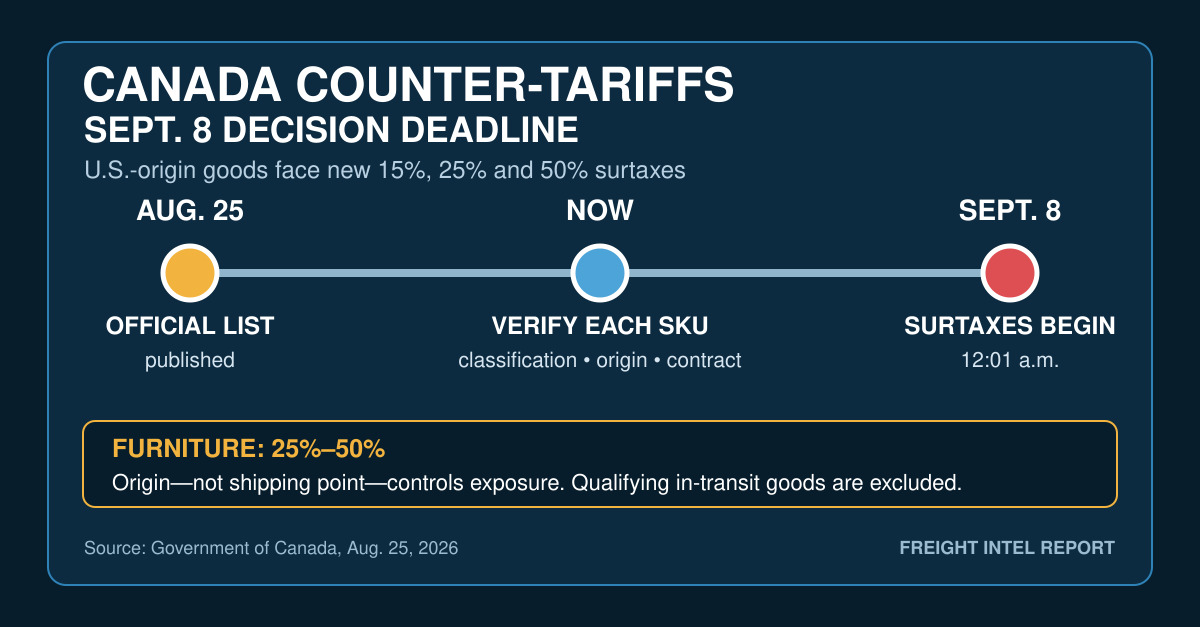
Canada has moved from warning to implementation. On August 25, 2026, the Department of Finance published a tariff-item schedule imposing new 15%, 25%, and 50% surtaxes on C$27.6 billion of U.S.-origin goods beginning at 12:01 a.m. on September 8.
The broad political headline is retaliation. The freight decision is more specific: companies now have less than two weeks to determine which Canadian tariff classifications are covered, prove origin, identify qualifying in-transit shipments, recalculate landed cost, and decide who bears the new duty under each contract.
What Canada has formally announced
Canada will apply additional tariffs to U.S.-origin products at rates intended to match the U.S. Section 338 and Section 232 treatment of comparable Canadian goods. The measures cover C$27.6 billion in imports and focus on steel, aluminum, furniture, clothing, dairy, seafood, appliances, agricultural equipment, pulp and paper, electronics, lighting, and other products.
The official tariff-item schedule states that the surtax applies only to goods considered U.S.-origin under Canada’s CUSMA country-of-origin marking rules. Cargo does not become covered merely because it ships from a U.S. warehouse or crosses the land border from the United States.
Canada also provides an in-transit exception: U.S. goods already in transit to Canada when the measures take effect are not subject to the new counter-tariffs. The government has not yet published the detailed Canada Border Services Agency Customs Notice that will control entry administration.
Furniture is one of the most exposed categories
The official list puts much of the furniture sector at the top 50% rate. Covered classifications include:
- 50%: metal furniture; wooden bedroom furniture; other domestic and non-domestic wooden furniture; plastic furniture; most non-upholstered wooden seats; metal-frame seats; and several lighting classifications.
- 25%: upholstered seats with wooden frames; wooden kitchen furniture; wooden furniture parts; and certain furniture fittings.
These are classification-level descriptions, not a substitute for a binding determination. A sofa, chair, cabinet, component, or lighting product should be mapped to the exact Canadian tariff item before the duty is priced or communicated to a customer.
For furniture manufacturers and distributors, a 25% or 50% duty can overwhelm ordinary freight savings, promotional margins, and dealer allowances. It also changes decisions about purchase-order timing, inventory already positioned near the border, Canadian fulfillment, returns, warranty replacements, and the use of U.S. distribution centers for goods made elsewhere.
Five controls shippers should activate now
1. Build the tariff-item exception file
Do not manage this through broad commodity labels. Match every Canada-bound SKU to the Canadian tariff item, listed rate, declared origin, supplier documentation, customer, Incoterm, and shipment status. Separate confirmed exposure from items still awaiting customs review.
2. Establish origin before pricing the shipment
The legal test is origin under Canada’s CUSMA marking rules. U.S.-made goods may be covered; foreign-origin goods moving through a U.S. facility may not be. Procurement, customs, finance, and transportation teams should use the same origin record rather than making independent assumptions.
3. Preserve the in-transit evidence
For goods moving before September 8, retain bills of lading, carrier acceptance records, pickup timestamps, export documents, and routing evidence. The exception could depend on proving when the shipment entered the transportation stream, not when the purchase order was issued or the warehouse appointment was requested.
4. Reprice landed cost and contractual responsibility
Review duty clauses, delivered-price commitments, change-in-law provisions, customer allowances, and broker instructions. A carrier or customs broker should not be expected to resolve a commercial dispute at the border. The importer of record, duty payer, and escalation authority should be determined before tender.
5. Create a September 8 decision clock
Identify orders that can legitimately move before the deadline without compromising service, documentation, or compliance. Avoid rushed movements that merely replace tariff exposure with premium transportation, detention, storage, damage, or classification risk.
What remains unresolved
The tariff schedule and effective date are official. Several administrative details remain pending, including CBSA entry-reporting instructions, documentation required for the in-transit exception, remission procedures, treatment of repairs and returns, and shipment-specific origin questions.
Canada says its existing auto countermeasures remain in place. Separately, President Trump has threatened another U.S. tariff increase on Canadian vehicles, trucks, parts, and steel for January 1, 2027, but no implementing proclamation, Federal Register notice, HTS amendment, or CBP instruction has yet made that later announcement executable.
Why this matters beyond customs
The immediate consequence is a duty. The network consequence may be a change in shipment timing, sourcing, Canadian inventory placement, cross-border equipment demand, and return flows. U.S. exporters may lose price competitiveness; Canadian importers may accelerate substitution; and carriers could see abrupt lane and equipment imbalances rather than a uniform decline in freight.
Canada also announced a C$7.5 billion support package for affected businesses and workers, including liquidity, diversification, worker-retention, and retraining measures. That support may influence which manufacturers preserve production, redirect sourcing, or change distribution networks rather than exit a market.
Executive takeaway
September 8 is now a real operating deadline. The defensible response is not a blanket rush to the border. It is a SKU-level decision table connecting Canadian classification, origin, in-transit status, landed cost, contract responsibility, and shipment timing.
Discussion: Which will change first in your network—pricing, sourcing, inventory positioning, or cross-border capacity?
Stay ahead of consequential freight developments. Subscribe free to Freight Intel Report for sourced, decision-useful analysis across transportation, trade, regulation, and supply chains.
Sources: Department of Finance Canada, August 25, 2026; official product schedule, August 25, 2026; CBP CSMS #69606660, August 21, 2026.
Government services: For government services, verification, registrations, forms, reporting, or instructions, always navigate to the official agency website directly. Independently verify its address before entering credentials or business information.


Leave a Reply