
Would a shipper be better served by one logistics partner with a broader network, or several independent providers competing for its freight? A larger network may reduce handoffs, improve matching and simplify accountability. More independent providers may offer different service ideas, stronger negotiating options and separate paths to recovery. Both approaches also carry costs.
The proposed C.H. Robinson–RXO combination brings those tradeoffs into focus. Its announcement raises questions about scale, competition and service, but it does not establish which supplier structure will work best for a particular shipper or carrier. A national revenue ranking cannot answer what happens on a specific lane.
Two possibilities deserve equal scrutiny: consolidation could improve coordination while customers retain workable alternatives; it could also reduce independent options without delivering enough operating benefit to compensate. The question is what evidence would distinguish those outcomes.
The deal is a starting point, not the whole story
On October 5, 2026, C.H. Robinson and RXO announced an acquisition agreement with an implied transaction value of $5.8 billion. Closing is expected in the first half of 2027, subject to regulatory and RXO shareholder approval and other conditions. C.H. Robinson projects approximately $300 million in net annual run-rate cost synergies within two years after closing. These are management expectations, not savings already realized or promised reductions in shipper rates.
The companies describe broader capabilities across brokerage, managed transportation, forwarding, expedited freight and last mile. That creates two operating questions: where could a denser network remove unnecessary work, and where might combining systems, teams or processes interrupt service?
The proposed transaction remains subject to closing. Customers can assess its potential while separately measuring how each company performs today.
What the revenue figures can—and cannot—tell us
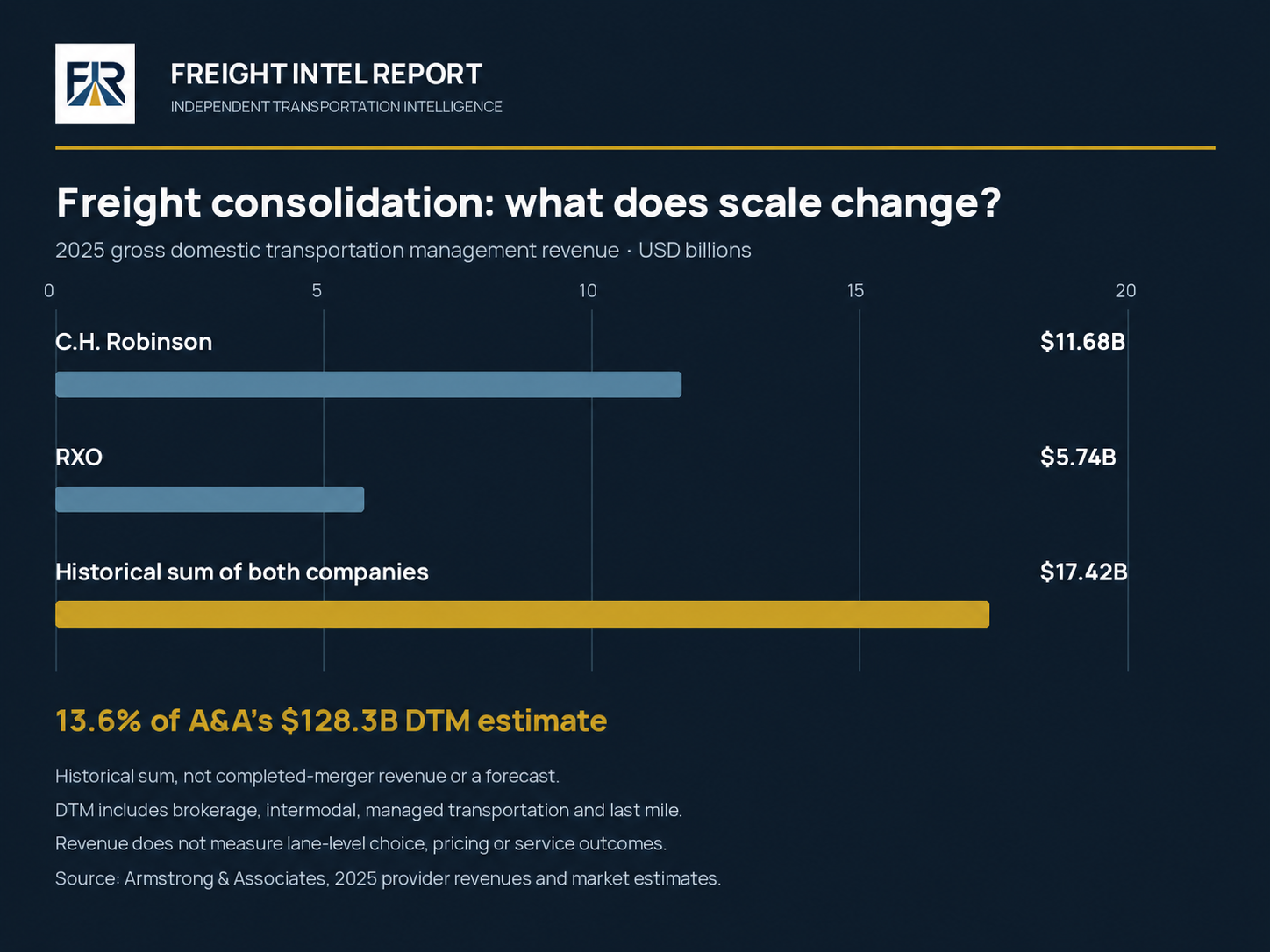
Armstrong & Associates lists 2025 gross domestic transportation management (DTM) revenue of $11.678 billion for C.H. Robinson and $5.742 billion for RXO. Their sum is $17.420 billion. Compared with A&A’s $128.3 billion DTM segment estimate, that is approximately 13.6%.
This is a historical revenue comparison, not a merger forecast or a precise U.S. truck-brokerage market share. A&A’s DTM definition includes brokerage, intermodal, managed transportation and last-mile services, with movements in North America. Its provider figures are company-reported or estimated. Gross revenue includes amounts used to purchase transportation; it is not the same as a broker’s retained revenue or profit.
The comparison describes scale. It does not measure whether a shipper has three suitable bidders for a difficult lane, whether a carrier can replace a major customer, or whether prices and service will improve. It cannot settle the competition question in either direction.
Freight consolidation: what does scale change?
2025 gross domestic transportation management revenue · USD billions
13.6% of A&A’s $128.3B DTM estimate
Source: Armstrong & Associates, 2025 provider revenues and market estimates.
Bars animate for presentation; revenue labels remain fixed at historical values.
Are we entering a consolidation phase?
RXO completed its acquisition of Coyote from UPS on September 16, 2024. C.H. Robinson now proposes acquiring RXO. But a sequence of transactions cannot by itself prove an inevitable march toward only a few national providers. Demonstrating a broad trend would require consistent market definitions, ownership-adjusted shares over time, and evidence about entry, exits and customer switching.
The economic logic for further consolidation is plausible. Technology, insurance, compliance, fraud controls and customer integrations impose costs that can be spread over more transactions. Denser networks can improve matching and backhaul opportunities. Acquisitions can also purchase relationships and service capabilities that take years to build organically.
The counterforces are substantial too. Specialized freight needs, local relationships, entrepreneurial entry and direct carrier procurement can sustain alternatives. Smaller operators can use commercially available technology rather than reproduce every large company’s platform. Whether that is enough depends on execution, financial strength and access to customers—not simply company size.
The strongest case for more independent options
Credible alternatives give a shipper a practical way to reject a poor offer. They can challenge rate assumptions, introduce different equipment or routing ideas, and compete through responsiveness or specialist knowledge. A regional carrier or focused broker may understand an unusual facility, commodity or delivery condition better than a broad national network.
Choice also creates recovery options. A failed tender, system outage or deteriorating service relationship need not stop freight if an independent provider is already qualified and ready. Keeping a usable alternative can make a primary supplier’s performance commitments more meaningful.
However, more names do not automatically produce lower total cost. Several brokers may approach the same carriers. A fragmented panel can create duplicate work, inconsistent tracking, repeated onboarding and unclear exception ownership. Spreading volume too thinly may reduce the commitment each provider can make. The lowest quote can be expensive if it produces more failures, claims or emergency recoveries.
The strongest case for fewer, larger providers
A larger provider can offer broader coverage, consistent processes, stronger investment capacity and fewer handoffs across modes and services. Volume density may support better matching, more reliable repeat lanes and lower administrative cost. A single accountable team can be valuable when a shipment crosses several services.
Carriers may benefit too: recurring freight, easier integrations, more backhaul opportunities and predictable payment processes can improve equipment utilization and reduce administrative friction. These advantages are commercially meaningful when they can be demonstrated.
But scale is not a promise of customer savings. Cost efficiencies can flow to shareholders, service investment, carrier payments or shipper prices in different proportions. Integration can temporarily disrupt people, systems and escalation paths. Fewer independent bids may weaken negotiating alternatives, while bundled services and proprietary data can make switching harder. A large platform failure can also affect many customers at once.
What if more freight moved through a few large platforms?
Consider a hypothetical future—not today’s established market—in which most enterprise freight procurement passes through a few large platforms. Those companies would not need to own all the trucks to influence how freight is allocated. Their power could sit in customer contracts, carrier access, payment processes, shipment histories and the systems through which work is tendered.
In a constructive version, competing large networks lower coordination costs, invest in reliability and compete hard for customers. Smaller carriers remain independent but gain easier access to consistent freight. Specialists retain room to solve needs the large networks do not serve well.
In a less constructive version, shippers face high switching costs, carriers depend on fewer buyers of their capacity, and specialist brokers struggle to reach customers. Savings from automation do not necessarily reach either side. Standard service packages may make exceptions harder to accommodate.
Neither outcome follows automatically from the number of firms. An industry with many suppliers can still offer weak competition on a difficult lane. A market with a few strong suppliers can still be competitive if customers can switch, new providers can enter and alternative capacity remains accessible.
The DOJ/FTC merger guidelines examine relevant products and geographic markets. Their buyer-competition framework also considers effects on suppliers. For freight, that makes carrier-facing terms part of the discussion alongside shipper prices. These principles explain what to investigate; they are not a conclusion about the legality or likely regulatory outcome of this proposed transaction.
Does consolidation lower or raise freight cost?
FIR’s analytical framework separates three channels: operational efficiencies that might lower cost; changes in bargaining power that might alter who receives the benefit; and integration or dependency costs that might offset savings. None is established by an acquisition headline.
Test total delivered performance under comparable conditions. Track linehaul, fuel, accessorials, tender acceptance, on-time service, claims, recovery spend and internal administration. A lower rate coupled with more costly failures is not a better outcome. A higher quoted rate accompanied by better service may reduce total cost—but the improvement must be measured rather than assumed.
Concentration also operates on both sides of the transaction. Stronger shipper buying leverage can put pressure on brokers and carriers even in a fragmented provider market. A complete assessment asks who has alternatives, who can credibly walk away, and who bears the cost when capacity tightens.
The same decision can produce different results
Consider two hypothetical shippers with similar annual freight spending. The first moves repeat freight across many locations and spends substantial time reconciling tracking systems and resolving handoff failures. A broader provider could reduce that coordination burden. If service holds up and total cost falls, fewer suppliers may improve the operation.
The second handles irregular, specialized shipments with difficult appointments and frequent changes. Independent specialists may offer distinct capacity and faster local problem-solving. If a consolidated panel loses those capabilities, a simpler contract structure could create more expensive recoveries.
Either result could reverse. A large network might develop stronger specialist coverage; several independent providers might coordinate effectively through shared tools. The deciding variables are the freight, the service design and demonstrated performance—not supplier count alone.
What would change the assessment?
The case for consolidation would strengthen if comparable shipments show lower total cost, more reliable acceptance and service, fewer handoff failures, and better carrier utilization or payment experience. The case for preserving more independent providers would strengthen if credible bids disappear, switching becomes harder, specialist service weakens, or integration and recovery costs outweigh the efficiencies.
Those comparisons need consistent lanes and service requirements. Fuel, seasonality and the freight cycle can change rates and performance even without a merger. A lower rate during a weak market is not, by itself, proof of a consolidation benefit; a higher rate during a capacity shortage is not proof of consolidation harm.
How shippers, brokers and carriers should position themselves
The practical response is to prepare for both greater scale and continued competition among independent providers. Neither requires choosing a side on this merger. Each requires knowing where a broader network creates value, where specialization matters, and how costly it would be to change relationships.
Shippers: allocate freight by operating need and measured results
Establish a baseline for rates, service, recovery spending and administrative effort on critical lanes. Give larger networks the opportunity to demonstrate coordination benefits, and give independent specialists the opportunity to demonstrate distinct capabilities. Test changes on a defined set of lanes before expanding them. Allocate volume to the mix that improves total delivered performance, with clear escalation paths and practical transition arrangements. Keep qualified alternatives where the cost of disruption justifies them; avoid maintaining a long supplier list that adds work without usable capacity.
Brokers: choose the business model that makes your value repeatable
Identify the customer problem you solve better than the next provider, then demonstrate it through service, claims, recovery and total-cost records. Invest in technology and dependable carrier relationships that support that promise. Assess whether organic growth, partnership or acquisition provides the capital and coverage needed to deliver it. Independence can support focus and responsiveness; scale can support investment and breadth. In either model, protect payment reliability, execution quality and a sustainable customer mix instead of competing on size or the lowest quote alone.
Carriers: build a freight portfolio around net earnings and dependable payment
Evaluate each broker or shipper relationship using contribution after operating costs, deadhead, dwell time, accessorial recovery and payment speed. Larger networks may deserve more business when they improve utilization and predictability; direct shippers or specialist brokers may deserve more when they improve lane fit and terms. Track exposure by ultimate ownership, so different brands do not disguise dependence on one group. Set concentration limits your cash flow can withstand and diversify where suitable freight supports the economics, rather than accepting poor freight merely to add customers.
Going forward, the common discipline is to establish a baseline, test the promised benefits, and retain the ability to adjust when results change. That approach leaves room for consolidation to earn its place and for independent providers to earn theirs. The right structure is the one that improves the operation—not the one that wins the argument about size.
Sources and chart notes
The operating scenarios and tradeoffs are FIR analysis, not forecasts of this transaction. The chart adds historical figures without merger adjustments: $11.678B + $5.742B = $17.420B; $17.420B ÷ $128.3B = 13.6%, rounded. The ratio uses A&A’s research framework rather than a regulatory market definition.
Leave a Reply