
What changed on July 24
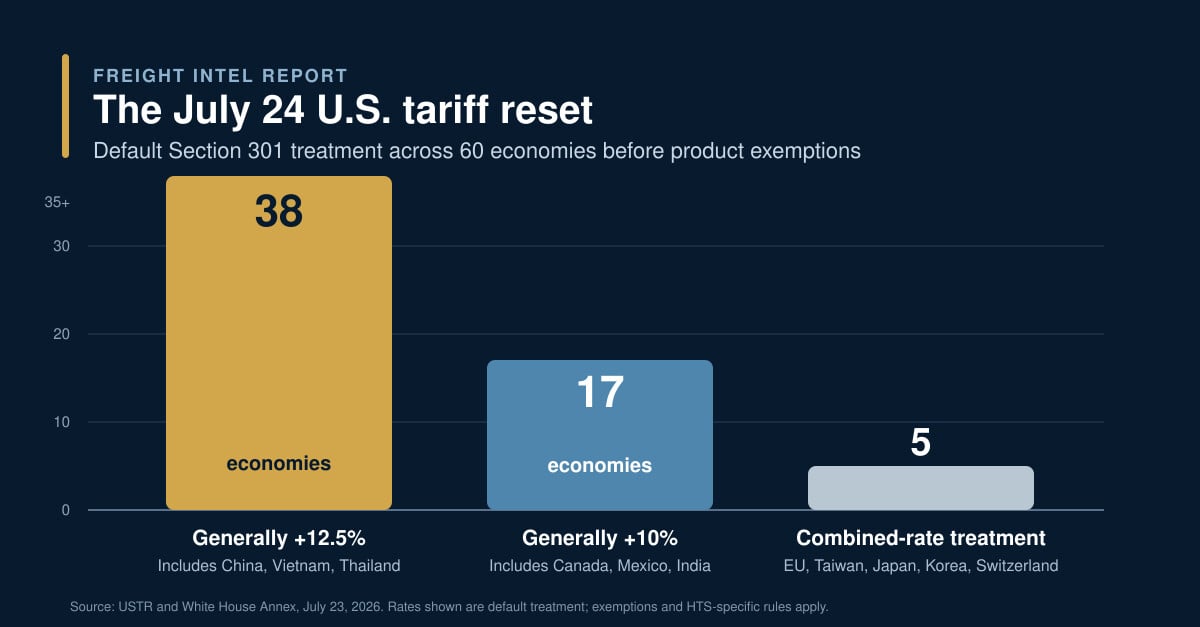
The White House imposed the Section 122 surcharge in February for the statutory maximum of 150 days. Its implementing proclamation stated that the 10% duty would run through 12:01 a.m. Eastern time on July 24 unless Congress extended it. On July 23, USTR announced final action in 60 separate Section 301 investigations concerning whether trading partners had imposed and effectively enforced prohibitions on imports made with forced labor. The accompanying White House memorandum and 55-page tariff annex made the new treatment effective for goods entered for consumption—or withdrawn from warehouse for consumption—on or after 12:01 a.m. Eastern time on July 24. The default treatment is divided into three groups:- Generally 10% additional Section 301 duty: 17 economies, including Canada, Mexico, India, Bangladesh, Cambodia, Indonesia, Malaysia and the United Kingdom.
- Generally 12.5% additional Section 301 duty: 38 economies, including China, Hong Kong, Vietnam, Thailand, the Philippines, Singapore, Australia and Brazil.
- Combined-rate treatment: Goods from the European Union and Taiwan are generally brought to a combined most-favored-nation and Section 301 rate of 10%; goods from Japan, South Korea and Switzerland are generally brought to 12.5%. If the underlying MFN rate already meets or exceeds the applicable threshold, the new Section 301 duty may be zero.
Why the headline can mislead landed-cost planning
Much of the public discussion treated July 24 as either the expiration of a global tariff or the beginning of a new forced-labor tariff. Both descriptions are incomplete for an operating company. The more useful question is: What changed for this country of origin, this HTS line, this entry date and this exemption status? The old Section 122 surcharge and the new Section 301 duties do not have identical legal foundations or implementing instructions. A product exempted under one structure is not automatically exempted under the other. Goods from China that fall under the new default treatment use a different Chapter 99 provision than goods from Canada, Mexico or the European Union. The five combined-rate economies require a calculation rather than a simple flat addition. That makes the transition more than an accounting issue. It can affect:- purchase-order economics and supplier negotiations;
- customs bonds and duty cash requirements;
- inventory valuation and margin forecasts;
- routing through foreign-trade zones or bonded facilities;
- the timing and viability of sourcing changes;
- customer price commitments made before July 24; and
- demand for ocean, air, drayage, intermodal and truckload capacity when importers alter origin or timing.
The legal challenge adds uncertainty—not an operating exemption
Two U.S. small businesses filed a challenge in the U.S. Court of International Trade on July 24, arguing that the administration used Section 301 to recreate a broad tariff program without the country- and practice-specific findings the statute requires. The government maintains that USTR completed 60 investigations, reviewed more than 1,600 written comments, held public hearings and selected remedies designed to change the identified foreign practices. That dispute matters, but it should not be confused with current entry treatment. At the time of publication, the official Section 301 action and HTS modifications remain the operative instructions. Importers should not stop paying or coding duties based solely on the existence of litigation. The prudent response is to preserve options: maintain entry-level documentation, monitor liquidation dates, track the challenged duties separately and obtain customs or trade counsel on protest and refund-preservation strategy. Companies should neither assume the tariffs are permanent nor budget as if a future refund is guaranteed.A seven-step importer audit
1. Build a SKU-country-HTS matrix
List every active imported SKU with its country of origin, base HTS classification, ordinary duty rate, applicable Chapter 99 provision, Section 232 exposure and claimed exemption. Do not audit only by supplier or purchase order.2. Reconcile broker instructions issued before July 24
Confirm that customs brokers removed expired Section 122 coding and applied the correct Section 301 provision. Review actual entry summaries rather than relying only on a written assurance.3. Verify exemptions against the annex
Broad descriptions such as “electronics,” “raw material” or “medical product” are not enough. Match the precise HTS provision and any conditions in the official annex.4. Recalculate landed cost at line level
Update duty, merchandise processing, harbor maintenance, brokerage, bond, transportation and financing costs. For the five combined-rate economies, model the underlying MFN rate before adding any Section 301 amount.5. Review contracts and price commitments
Identify who bears a tariff change under current purchase orders, Incoterms and customer agreements. Escalate ambiguous provisions before the next shipment, not after an invoice dispute.6. Preserve the litigation record
Track entry number, entry date, liquidation status, duty amount and the specific Section 301 code used. Coordinate any protest strategy with qualified customs counsel; do not rely on a generalized expectation of refunds.7. Stress-test sourcing changes before moving freight
Compare total landed cost, supplier reliability, origin substantiation, transit time, port and drayage capacity, minimum order quantities and inventory exposure. A nominally lower tariff does not automatically create a lower-risk supply lane.What shippers, brokers, carriers and executives should do
Importers and shippers should complete the entry audit first and then update procurement, inventory and transportation forecasts. Customs classification and freight planning should use the same SKU-level assumptions. Freight brokers and forwarders should prepare for lane-specific volume changes, but avoid presenting transportation advice as customs advice. When a customer changes origin or routing, validate lead time, transload, drayage and final-mile capacity before pricing the move. Carriers should watch for shifts in port, border and inland-market demand rather than assuming a uniform import slowdown. The tariff structure can redirect freight as easily as it suppresses it. Executives and finance teams should maintain at least three scenarios: current duties remain in place; selected exemptions or trading-partner treatment change; or litigation alters collection or refund rights. Each scenario should connect duty exposure to working capital, gross margin and transportation demand.Executive takeaway
The July 24 event was a tariff reset, not a clean tariff expiration. Broad import-cost exposure continued under a new statute, with different country tiers, product exemptions and entry requirements—and with active litigation creating a second layer of uncertainty. The immediate management task is not to predict the court. It is to make sure every affected entry, landed-cost model and freight plan is using the correct rule today while preserving the records needed if the rule changes tomorrow. Discussion prompt: Has your organization completed a post–July 24 entry audit, or are procurement, customs and transportation teams still working from different tariff assumptions? For independent, source-linked transportation intelligence built for decisions, subscribe free to the Freight Intel Report.Sources and dates
- Office of the U.S. Trade Representative: Final Section 301 action, July 23, 2026.
- USTR fact sheet: rates, scope and exclusions, July 2026.
- White House memorandum directing the Section 301 actions, July 23, 2026.
- Official 55-page HTS annex, effective July 24, 2026.
- White House proclamation imposing the temporary Section 122 surcharge, February 20, 2026.
- Liberty Justice Center: Burlap & Barrel, Inc. et al. v. Greer, filed July 24, 2026.
Government services: For government services, verification, registrations, forms, reporting, or instructions, always navigate to the official agency website directly. Independently verify its address before entering credentials or business information.
Leave a Reply