
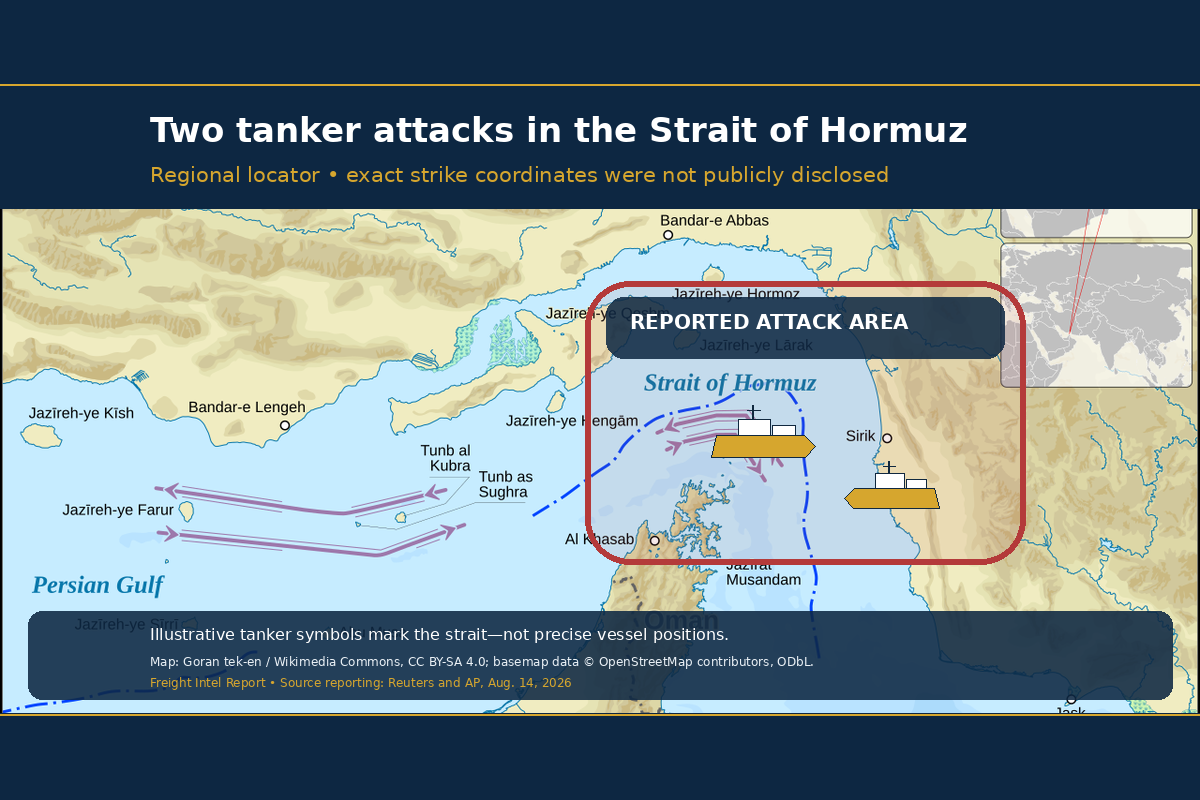
Two tankers operated by the United Arab Emirates’ state-owned ADNOC were attacked by drones while transiting the Strait of Hormuz, according to UAE statements reported by Reuters and the Associated Press. No injuries were reported, and ADNOC said the incidents were under control.
Update — September 5, 2026
U.S. military action has now expanded to the deliberate disabling and destruction of oil carriers. U.S. Central Command said September 5 that American forces struck three Iranian crude-oil tankers after Iran launched ballistic missiles at two U.S. Navy ships. CENTCOM said no American personnel were harmed. The command’s official media page identifies the operation as “CENTCOM Destroys 3 IRGC Oil Tankers After Iran Targets 2 U.S. Navy Warships.”
The Associated Press, citing the U.S. military statement, reports that two oil carriers were permanently disabled and a third, unladen tanker was destroyed. One tanker was struck near Kharg Island, another near Jask east of the Strait of Hormuz, and the unladen vessel in the Gulf of Oman. Those damage descriptions and the tankers’ alleged connection to an IRGC funding network are U.S. government claims; complete cargo volumes and any environmental effects had not been independently established when this update was published.
The latest verified cost baseline predates the Saturday strikes. Brent settled September 4 at $96.28 per barrel and WTI at $91.48, while AAA’s U.S. diesel average reached a record $5.85 per gallon. Only four commodity vessels transited Hormuz on Thursday versus a recent 10-day average near 15. Markets had closed before the tanker strikes, so those prices should not be described as the market reaction to the September 5 attack.
Shipper action: Treat weekend fuel and accessorial quotes as subject to rapid repricing; require the benchmark, effective date and documentary basis for emergency fuel, marine-fuel and war-risk charges; and confirm whether cargo insurance, force-majeure language and alternate-routing provisions address a deliberate attack on carrying capacity rather than only a strait closure.
FIR assessment: Three tanker strikes do not by themselves prove that Hormuz is closed or that a global supply shortage has already occurred. They do move the risk from threatened passage to confirmed loss of vessel availability. Carriers and underwriters may tighten voyage approvals and terms before physical supply statistics show the full effect, creating a timing mismatch freight buyers should manage now.
Update — September 4, 2026
U.S. diesel has now crossed its prior nominal record. GasBuddy’s live national average reached $5.820 per gallon on September 3, narrowly exceeding the $5.819 record set on June 17, 2022. GasBuddy’s figure is a real-time retail average; it should not be substituted into contracts tied to the separate EIA weekly on-highway diesel series, which measured $5.599 for the week of August 31 and is next scheduled to update September 9.
The supply signal is equally important. The EIA Weekly Petroleum Status Report released September 2 covers the week ending August 28. Reuters’ analysis of the underlying EIA series found that U.S. distillate inventories averaged their lowest August level for that time of year since 1982, while East Coast stocks fell to 19.3 million barrels—a record low in data extending to 1990. The U.S. diesel crack spread also reached a record intraday $108.02 per barrel on September 2. These measures indicate genuine product tightness, not simply a crude-oil headline.
Shipper action: Audit the index, reset date, lag and cap in every fuel-surcharge schedule; compare spot offers on an all-in basis; and require documentation before accepting extraordinary fuel or war-risk pass-throughs. The gap between a live retail average and an EIA-based contractual benchmark can materially change invoice timing even when both measures are directionally rising.
The second tanker attack now has a confirmed fatality and salvage consequence. Joint Maritime Information Center Update 093 identifies the Saudi-flagged tanker Sidr and states that its owner confirmed two crew fatalities after the vessel was attacked at 2050 UTC on August 31 while transiting outbound through the Strait of Hormuz. Bahri subsequently identified the dead as two Filipino seafarers. JMIC reports that Sidr anchored approximately 1.7 nautical miles north of Jazirat Tawakkul and remains there awaiting salvage assistance.
JMIC continues to rate the Strait of Hormuz threat level SEVERE, with deliberate hostile action considered highly likely. Its traffic data also show why vessel-count claims require careful qualification: independent tracking recorded single-digit traffic, while U.S. Naval Cooperation and Guidance for Shipping reported more than 20 U.S.-facilitated transits per day over the prior week. Those sources cover different vessel populations and should not be treated as measurements of one identical traffic universe.
FIR assessment: Saudi Arabia attributes the attack to Iran. JMIC confirms the attack and fatalities but does not independently establish responsibility in Update 093. For freight buyers, the confirmed operational signal is that the attempted Saudi crude restart has now produced both a disabled tanker requiring salvage and loss of life—raising the probability of tighter voyage approvals, higher war-risk premiums and persistent fuel-cost volatility.
Update — September 3, 2026
The cost and traffic signals have tightened again. Reuters reported on September 3 that Brent crude reached $97.29 per barrel and West Texas Intermediate reached $93.04—fresh six-week highs—after renewed U.S. strikes in Iran and further threats of retaliation. The figures are market prices at the time reported, not forecasts of where fuel will settle.
Commodity-vessel traffic through Hormuz remained constrained: six vessels transited Wednesday, September 2, compared with a recent 10-day average of about 13, according to preliminary Kpler data reported by Reuters. AIS-based counts can be revised and may omit vessels operating without visible transponders. For U.S. freight buyers, the actionable issue is the continued combination of elevated crude, uncertain tanker access and lagged fuel-surcharge formulas. Procurement teams should identify which contracts reset weekly, which use delayed benchmarks and which permit extraordinary war-risk or marine-fuel charges before accepting a surcharge as unavoidable.
FIR assessment: This is a material escalation in cost exposure, but it is not evidence that all Hormuz traffic has stopped. The corridor is still moving some cargo at a pace well below its recent average, while energy markets price a larger risk premium.
Update — September 1, 2026
The attempted restart of outbound Saudi crude movements now has a confirmed disabled-vessel consequence. Joint Maritime Information Center Update 092 identifies Senegal Prosperity and reports that three projectiles struck its port-side engine room and ballast tank. The loaded VLCC lost shipboard communications, went dead in the water, listed to port, dropped anchor and remained not under command. Local authorities evacuated the crew, and no casualties were reported. JMIC did not identify the attacker.
Reuters, the Financial Times and The Wall Street Journal independently identified two loaded very large crude carriers—Sidr and Senegal Prosperity—as having been struck minutes apart. Each reportedly carried approximately 2 million barrels of Saudi crude loaded at Juaymah. Their operators, Bahri and Sinokor, had not publicly confirmed the vessels’ damage or operating status when this update was prepared.
The operational signal is broader than the individual vessels. Kpler data reported by Reuters counted only five commodity-vessel transits through Hormuz on August 31, versus a 10-day average near 14; none was a liquid tanker. The count excludes vessels with deactivated transponders, so it should not be treated as a complete traffic census.
Brent crude settled at $94.65 per barrel and West Texas Intermediate at $90.22 on September 1, while U.S. diesel futures reached a 52-month high. For U.S. freight buyers, the immediate risk is transmission through diesel, marine fuel, war-risk insurance and surcharge formulas—not proof that all Gulf exports have stopped.
FIR analysis: This is no longer simply a report of strikes with unknown consequences. A loaded VLCC is officially identified as disabled, listing and not under command as diesel futures reach a 52-month high. That combination materially increases the risk of war-risk restrictions, voyage refusals and transportation surcharges. The attacker, the condition of Sidr, any environmental impact beyond the initial reports and the timing of sustained liquid-tanker transit remain unconfirmed.
The UAE attributed the attacks to Iran. That attribution has not been independently established, and Iran had not publicly responded when this analysis was prepared. The confirmed freight signal is narrower but still consequential: two more commercial energy vessels were attacked while traffic through one of the world’s most important energy corridors remained constrained.
Locator map: tanker symbols mark the Strait of Hormuz generally; exact strike coordinates were not publicly disclosed. Map by Goran tek-en via Wikimedia Commons (CC BY-SA 4.0); basemap data © OpenStreetMap contributors (ODbL).
Traffic improved—but remained below August’s pace
Reuters reported on August 14 that commodity-vessel transits increased to nine on Thursday, August 13, from five on Wednesday. That was still below the August average of 12 per day, based on Kpler data cited by Reuters. These figures cover commodity vessels and should not be treated as a count of all ship traffic.
The direction matters as much as the count. A movement from five to nine shows that the waterway is not completely closed. Remaining below the monthly average after additional attacks shows that owners, charterers, insurers and crews are still making unusually constrained operating decisions.
The U.S. freight exposure starts with fuel—but does not end there
Oil markets reacted immediately. Reuters reported Friday that Brent crude rose $1.43 to $88.50 per barrel and West Texas Intermediate gained $1.56 to $82.81. Large U.S. inventories and weaker demand forecasts could limit the increase, so a sustained diesel spike is not yet certain.
- Trucking: Retail diesel and contract fuel-surcharge tables can reset on different schedules. A rapid fuel move can temporarily transfer cost to a carrier, broker or shipper depending on the index, base price and adjustment timing in the contract.
- Ocean freight: Repeated attacks can affect war-risk premiums, voyage approvals, security requirements and vessel availability before a formal closure or service suspension occurs.
- Manufacturing and agriculture: Hormuz exposure includes petroleum, LNG, petrochemicals and fertilizer inputs. Higher landed costs can reach companies whose own cargo never passes through the strait.
- Brokerage and procurement: Extraordinary fuel and security charges can create disputes when contracts do not specify the index, trigger, documentation requirement or effective date.
What decision-makers should do now
- Verify the fuel index, base price, reset day and lag built into every material truckload and dedicated-transport agreement.
- Require documentation for extraordinary war-risk, security or emergency fuel charges rather than accepting an undefined pass-through.
- Ask ocean providers whether voyage approvals, insurance terms, load ports or vessel-substitution rights have changed since the latest attacks.
- Model a short disruption and a prolonged restriction separately. They create different inventory, cash-flow and capacity decisions.
- Identify energy-, fertilizer- and petrochemical-intensive inputs that could move in cost even when transportation capacity remains available.
What remains unknown
For the August 14 incidents, public reporting has not established the vessel names, cargoes, extent of damage or operating status. The identity of that attacker remains an attribution by the UAE, not an independently verified fact. For the August 31 incidents, JMIC now identifies Senegal Prosperity and confirms its damage and disabled condition. The condition of Sidr, operator confirmations and responsibility for the attacks remain unavailable. It is also unknown whether insurers will change terms, whether operators will suspend additional voyages or whether liquid-tanker traffic can resume and be sustained.
Freight Intel Report analysis: The pivotal development is the combination of repeated vessel attacks and traffic that remains below the month’s already-constrained pace. For U.S. freight decision-makers, the immediate task is not to assume a worst-case closure. It is to identify where fuel, insurance and emergency-cost language can transmit the disruption into transportation budgets before the impact becomes visible in a monthly report.
Primary and corroborating sources
- Reuters: Hormuz traffic slows after two additional vessel attacks — August 14, 2026.
- Associated Press: Two UAE tankers attacked while transiting the Strait of Hormuz — August 14, 2026.
- Reuters: Oil-price response and supply context — August 14, 2026.
- International Maritime Organization: Safety warning following attacks on commercial shipping — July 8, 2026.
Executive takeaway: Treat the latest attacks as a contract and contingency trigger—not proof that all Hormuz traffic will stop.
Discussion: Which cost exposure is hardest for your organization to manage quickly—fuel resets, war-risk charges, inventory buffers or supplier pass-throughs?
Subscribe free to the Freight Intel Briefing for sourced transportation intelligence built for shippers, carriers, brokers and logistics leaders.
Government services: For government services, verification, registrations, forms, reporting, or instructions, always navigate to the official agency website directly. Independently verify its address before entering credentials or business information.
Leave a Reply