
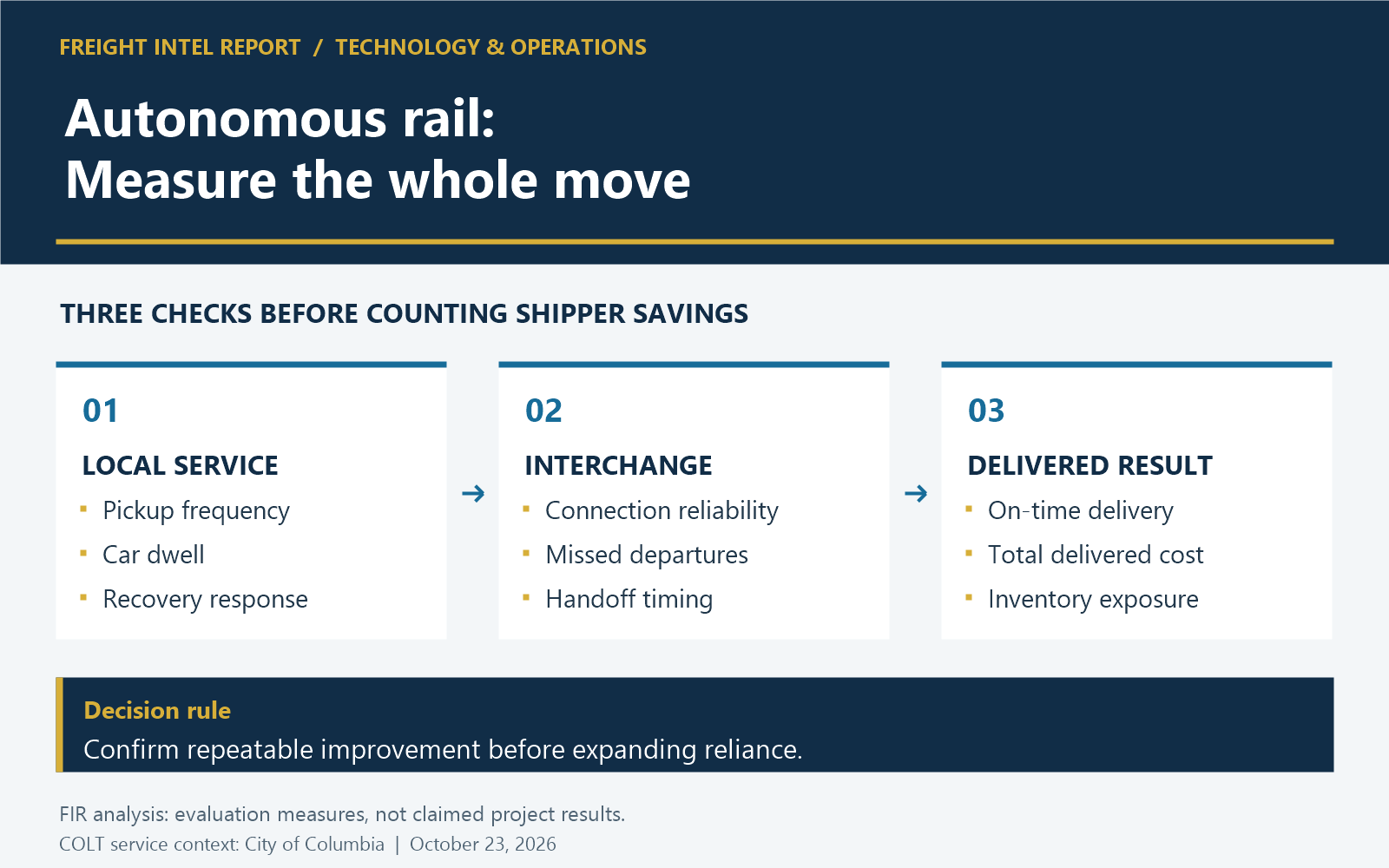
Diagram: FIR’s shipper evaluation framework. These measures are checks to perform, not claimed project results. Open the full-size diagram. COLT service context: City of Columbia.
Federal funding could help demonstrate a different model for local rail service. Shippers should watch delivered cost, dependable pickups, and interchange performance.
A newly selected federal investment in Missouri will test whether autonomous rail technology can improve something shippers already understand: getting freight collected and delivered when their businesses need it.
The Federal Railroad Administration selected the City of Columbia for up to $16.207 million through its Consolidated Rail Infrastructure and Safety Improvements program. The Columbia Terminal Railroad modernization project combines autonomous railcar deployment, track improvements, research, and workforce training. Its stated objectives include greater service frequency and eventual autonomous revenue freight operations. FRA project selections, page 17
For shippers, that creates an opportunity worth following. More frequent local rail movements could improve inventory flow, reduce waiting, and strengthen access to the national network. Those benefits remain outcomes to demonstrate. Funding selection establishes support for the project; it does not establish that autonomous operations have already delivered better service.
Columbia offers a useful setting because its railroad connects local freight activity with a larger transportation system. The city owns and operates COLT, which interchanges with Norfolk Southern in Centralia. Its transload facility also connects rail movements with warehousing and truck distribution. The city directs shippers to Norfolk Southern for car supply, tariffs, billing, and related commercial arrangements. City of Columbia railroad overview
That connection matters. Improving a local movement creates the greatest value when it helps freight make the next connection. Moving a car sooner within a terminal will have limited effect if it still misses the connecting railroad’s departure or reaches a receiver that cannot unload it.
The technology itself represents a change in how individual freight cars can move. Intramotev describes its TugVolt system as a retrofit that adds batteries, motors, and perception equipment to conventional railcars, allowing them to propel themselves. Its product offerings distinguish manual control, autonomous trips, and coordinated fleet functions. Columbia’s Railroad Advisory Board reviewed TugVolt technology at its March meeting. Intramotev technology description, city meeting minutes
Those distinctions are important when evaluating deployment announcements. A remotely controlled move, an independently executed trip, and coordinated operation involving several vehicles require different capabilities. Buyers should establish which functions operate at their proposed site, under what conditions, and with what human supervision.
There is operating experience beyond demonstrations. Intramotev describes a Carmeuse application involving three powered railcars and three conventional cars, initially using human-dispatched control. Its published case study reports diesel reductions and estimated operating savings. These are supplier-reported results from a particular application, rather than an independently established savings benchmark for other railroads. Intramotev case study
FIR’s assessment is that service frequency deserves as much attention as propulsion technology. A shipper’s transportation bill captures only part of the cost of an inconsistent pickup. Delays can leave loaded cars occupying scarce space, require additional inventory, disrupt production sequencing, or force an expensive truck shipment.
If powered railcars make smaller, more frequent movements economically practical, some facilities could gain flexibility. A plant might release finished product closer to the time it becomes ready. A transload operator might better coordinate rail arrivals with warehouse capacity and truck appointments. These are potential benefits to test against actual operations.
The financial question is whether the entire movement becomes less expensive and more dependable. A lower switching expense can be offset by equipment charges, charging infrastructure, maintenance, software support, insurance, or additional handling. Savings achieved by the railroad also do not automatically become lower prices for its customers.
A useful evaluation therefore needs two views of performance: the operator’s cost to provide service and the shipper’s total cost to receive it. Commercial agreements should explain how improved productivity affects rates, service commitments, or available capacity.
Reliability will require similar scrutiny. Shippers considering this technology should ask how the system responds to an obstruction, a communication failure, depleted batteries, or equipment trouble. They should establish who can intervene, how quickly conventional assistance can arrive, and what happens to other movements while a disabled car occupies the track.
Charging and maintenance also belong inside the service plan. Buyers need operating estimates that reflect their actual loads, grades, weather, and duty cycles. Published equipment specifications help define a starting point, but the supplier’s own performance qualifications illustrate why a nameplate capability should not become an unconditional service promise. Intramotev specifications
Federal policy is helping this project advance through financial support and an established process for evaluating departures from existing safety requirements. FRA explains that its Railroad Safety Board considers waiver petitions following technical evaluation and, when needed, field investigation. Decisions must satisfy the statutory public-interest and railroad-safety standard. FRA waiver and approval process
Funding selection and operating permission answer different questions. Shippers should request the actual approvals and conditions governing a proposed service, including its permitted territory, operating procedures, and restrictions. A successful application at one location cannot establish readiness for every railroad, crossing, commodity, or operating environment.
Workforce preparation is another practical requirement. FRA’s selection summary specifically includes a training curriculum. For a shipper, the relevant questions concern responsibilities: who authorizes movements, performs inspections, manages exceptions, maintains equipment, and responds during an emergency? Those duties need clear ownership as technology changes how work is performed. FRA project summary
The adoption timetable should follow demonstrated milestones. The federal summary identifies project development, final design, and construction, but gives no commercial launch date. The immediate development is a selected modernization project. Its objectives should be evaluated as equipment, infrastructure, training, and authorized operations progress. That evidence will determine how quickly the approach can support dependable service elsewhere.
Shippers can prepare now without making their networks dependent on an unproven timetable:
- Establish a baseline. Record switching frequency, pickup reliability, car dwell, inventory exposure, accessorial charges, and emergency truck spending.
- Identify a suitable movement. Look for a recurring local problem with measurable costs and clearly defined operating requirements.
- Test the complete connection. Include interchange schedules, loading and unloading capacity, and any truck distribution in the evaluation.
- Define responsibility. Document service commitments, intervention procedures, liability, maintenance support, and backup arrangements.
- Require repeatable results. Evaluate performance over sustained operations, including disruptions and difficult conditions, before expanding reliance on the system.
The next useful indicators are equipment entering service, verified operating permissions, completed infrastructure, trained personnel, and measured changes in freight performance. Columbia’s project will become more consequential if those milestones produce pickups shippers can plan around—and savings that remain after the full cost of service is counted.

Leave a Reply