
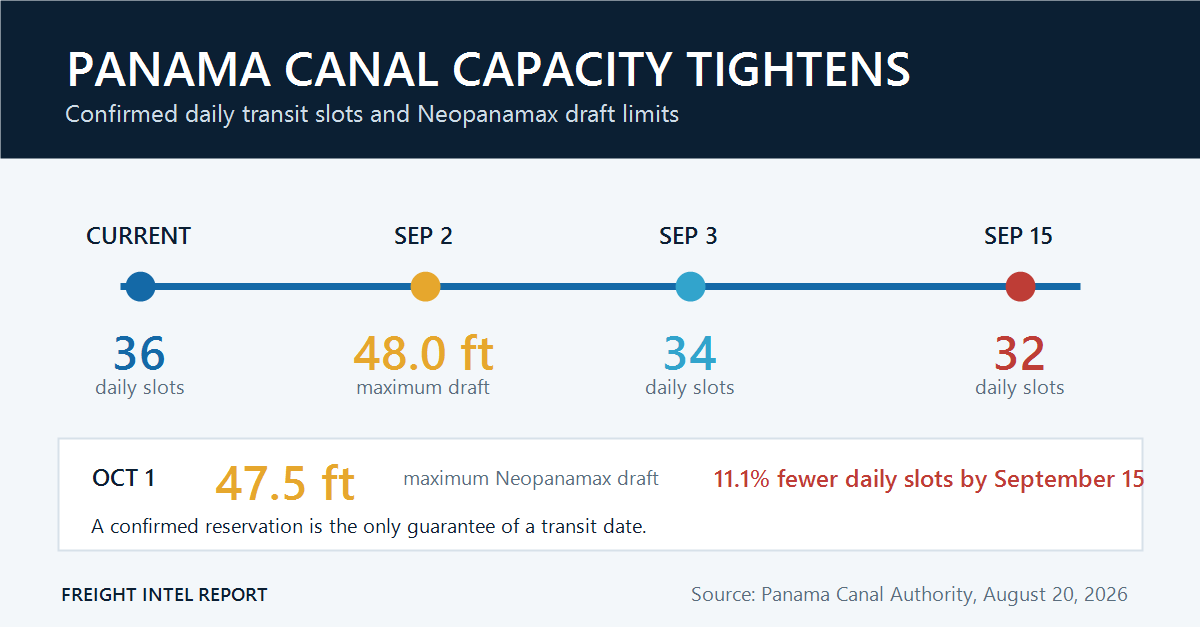
The Panama Canal is moving from water conservation to measurable capacity control. Beginning September 3, the canal will offer 34 daily transit slots—nine at the Neopanamax locks and 25 at the Panamax locks. On September 15, Panamax availability falls again to 23 slots, bringing total daily capacity to 32.
That is an 11.1% reduction from the current 36-slot schedule. For shippers, however, the operational risk is not the percentage alone. It is the combination of fewer slots, a new auction structure, changing draft limits and the canal authority’s warning that an unreserved vessel may wait longer.
What the canal authority confirmed
The Panama Canal Authority announced the measures on August 20, citing lower-than-forecast precipitation in the canal watershed despite the rainy season and existing water-saving measures.
- September 3: nine daily Neopanamax slots and 25 Panamax slots, for 34 total.
- September 15: Panamax slots fall to 23, reducing the total to 32.
- September 2: the maximum authorized Neopanamax draft moves to 48.0 feet.
- October 1: the next Neopanamax draft reduction—to 47.5 feet—takes effect.
The draft dates matter because lower allowable draft can reduce how much cargo a vessel can carry. The authority postponed both reductions from earlier dates, which provides temporary cargo flexibility even as slot availability tightens.
Reuters reported on August 20 that rainfall from May through August was 34% below the historical average and watershed inflows were 44% below normal. Reuters also noted the canal had averaged about 35 daily transits through June, against capacity of roughly 40.
The reservation—not the headline—is the control point
The canal authority says a confirmed reservation is the only mechanism that guarantees a transit date. It specifically warns that waiting times may rise for vessels arriving without one.
That distinction should drive shipper conversations. A carrier’s planned routing through Panama is not the same as a secured slot. Importers and exporters should ask whether the operating vessel has a confirmed booking, what contingency applies if the reservation changes, and how any auction premium or delay will be handled commercially.
The authority is also restructuring daily auction slots into four cargo groups: LNG/LPG; dry bulk/general cargo; container, vehicle/RoRo and refrigerated vessels; and chemical/crude/product tankers. Full container vessels with the highest TEU capacity receive priority in the Neopanamax allocation process, with customer ranking used as a tiebreaker.
This is not a blanket prediction of a container-rate spike. Most vessels use reservations, and carriers can absorb a modest capacity reduction without the kind of queue seen during the 2023–2024 drought if water levels and demand cooperate. The immediate issue is increasing dispersion: reserved versus unreserved vessels, high-priority versus lower-priority cargo, and ships that can maintain payload under tighter draft limits versus those that cannot.
What each stakeholder should do now
Shippers and importers: identify Asia–U.S. East and Gulf Coast shipments scheduled to reach the canal from early September onward. Ask the carrier or forwarder to confirm the reservation status, cutoffs and alternative routing—not merely the planned canal.
Ocean carriers and NVOCCs: separate confirmed-slot exposure from unreserved exposure, quantify draft-sensitive cargo plans and communicate any surcharge or service change before booking acceptance.
Ports, drayage providers and warehouses: model arrival bunching rather than only average delay. Even small shifts in vessel arrival patterns can create short, sharp demand for labor, chassis, appointments and storage.
Executives and procurement teams: require a decision trigger. Define the waiting-time, surcharge or schedule threshold that justifies an alternate service before the vessel is committed to a constrained queue.
What remains unknown
The duration of the restrictions, the path of rainfall and Gatun Lake levels, actual waiting times, auction premiums, and carrier schedule changes remain uncertain. The canal authority says operating conditions are changing rapidly and additional adjustments may follow.
Executive takeaway: The September schedule is not yet a systemwide crisis, but it is a confirmed capacity reduction at a critical U.S.–Asia gateway. The right response is to verify reservations and decision triggers now—before a planned transit becomes an unpriced delay.
Discussion: Which canal-risk trigger would cause your organization to change routing: an unconfirmed slot, a specific delay threshold, a draft-related payload cut or a new surcharge?
Subscribe free to Freight Intel Report for verified, decision-useful transportation and supply-chain intelligence.
Government services: For government services, verification, registrations, forms, reporting, or instructions, always navigate to the official agency website directly. Independently verify its address before entering credentials or business information.
Leave a Reply