
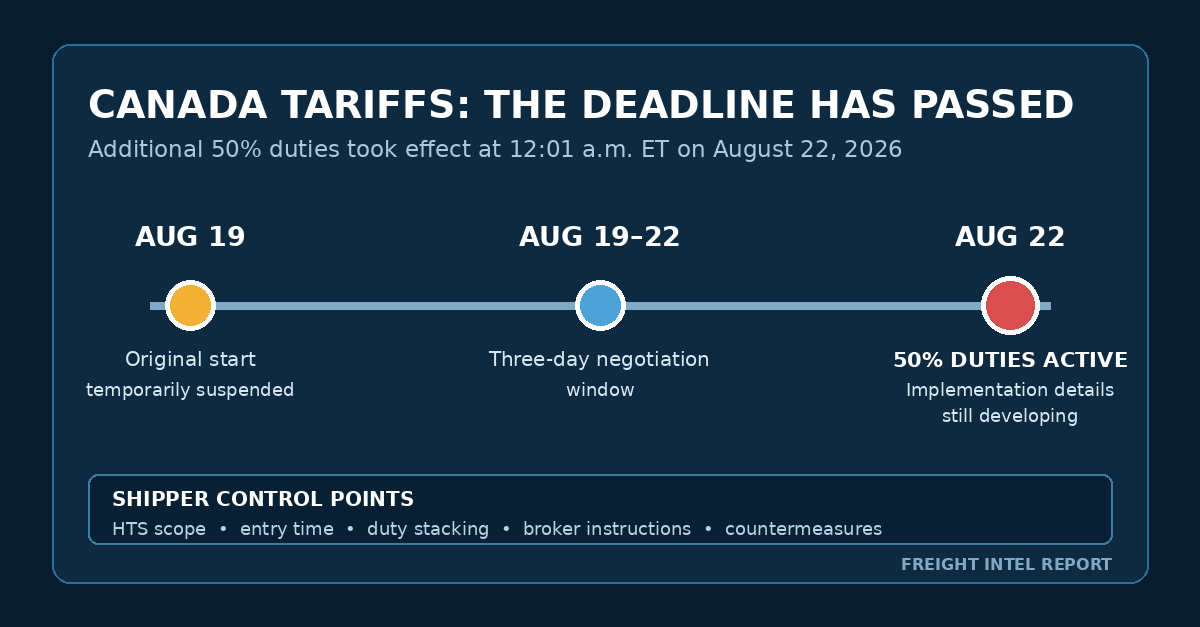
The United States’ additional 50% tariffs on specified Canadian goods took effect at 12:01 a.m. Eastern on August 22 after last-minute negotiations failed to produce a final agreement.
The action ends the three-day suspension that had temporarily postponed the duties. The affected trade is valued at approximately US$20 billion, according to the Associated Press. Canada has announced dollar-for-dollar retaliation and suspended the negotiations. Reuters reported on August 22 that no further talks were scheduled. CBP has now issued U.S. entry-filing instructions; Canada’s tariff-level product list remains pending.
Update — August 22: Canada has now set September 8, 2026 as the start date for its retaliatory tariffs. Prime Minister Mark Carney said Canada will match the U.S. action dollar for dollar; the Canadian government values the affected U.S. action at approximately C$28 billion, broadly consistent with the approximately US$20 billion figure reported by U.S. news organizations. Reuters reported that the Canadian measures will reach steel, dairy, appliances, agricultural equipment, pulp and paper, and electronics. The tariff-level product list and border-administration instructions remain pending. U.S. exporters and Canada-bound shippers should therefore identify exposure now but should not infer coverage from a broad sector label alone.
CBP implementation update — August 23: CBP’s Cargo Systems Messaging Service has published the filing instructions that importers and brokers were awaiting. CSMS #69606660, issued at 11:16 p.m. Eastern on August 21, directs filers to headings 9903.03.12 through 9903.03.16 for covered Canadian goods entered for consumption, or withdrawn from warehouse for consumption, on or after 12:01 a.m. Eastern on August 22.
What changed
The White House’s August 18 proclamation suspended collection only until 12:01 a.m. Eastern on August 22. It did not cancel the underlying Section 338 actions. With no superseding proclamation published before the suspension expired, the duties resumed under the controlling legal framework.
The Associated Press reported on August 22 that the tariffs took effect after negotiations broke down. The duties cover specified goods identified in the annexes to the three July 20 proclamations concerning Canadian treatment of U.S. motor vehicles, dairy products and alcoholic beverages.
Scope clarification: the title of the motor-vehicle proclamation describes the Canadian policy the United States is responding to; it does not mean Annex II is a list of Canadian automobiles. The official annex instead lists hundreds of specific HTS provisions spanning products such as wood and furniture, electronics, apparel, machinery, household goods, toys and sporting equipment, among others. Importers must test the exact HTS provision rather than rely on the proclamation’s subject label.
This is no longer a forecast or negotiating threat. Entries made after the effective time must be evaluated against the applicable Harmonized Tariff Schedule and Chapter 99 provisions.
What CBP now requires
CBP assigns the 50% additional ad valorem duty to headings 9903.03.12, 9903.03.13 and 9903.03.14. The agency lists headings 9903.03.15 and 9903.03.16 at a 0% additional Section 338 rate for specified categories, including certain metals, vehicles and parts, wood products, semiconductors, patented pharmaceuticals, civil aircraft and related components. That does not make those goods universally duty-free: CBP states that antidumping, countervailing and other applicable duties, taxes, fees and trade remedies continue to apply.
For foreign-trade zones, covered merchandise generally must enter in privileged foreign status unless it qualifies for domestic status. CBP also confirms that the additional duty is eligible for drawback and provides a required reporting sequence for Chapter 98, Chapter 99 and the Chapter 1–97 commodity classification.
Filing caution: the CSMS message consistently identifies 9903.03.12–9903.03.16 as the implementation headings, but its later Chapter 98 and drawback paragraphs refer to 9903.04.12–9903.04.14. That internal inconsistency should not be silently normalized. Filers handling Chapter 98, foreign-trade-zone or drawback entries should reconcile the attached HTS list and current tariff schedule with their CBP client representative or the agency’s Trade Remedy Branch before transmitting an entry.
The immediate control points
Importers: confirm the HTS classification, origin, entry time and total duty stack for every potentially covered Canadian product. USMCA eligibility should not be assumed to remove a Section 338 duty unless the governing annex or customs instruction expressly provides an exclusion.
Customs brokers: obtain written importer instructions where exposure is uncertain, retain the entry-time record and document any decision to delay entry, use a bonded facility or pursue an alternative customs treatment.
Shippers and transportation providers: separate freight already in transit from goods not yet released for entry. Border congestion, holds and invoice disputes can develop even when physical capacity remains available if tariff responsibility and documentation are unresolved.
Finance and procurement teams: update landed-cost assumptions immediately. A 50% additional duty can overwhelm ordinary freight savings and supplier-price concessions, especially when the affected merchandise has already been purchased or is moving under terms that leave tariff responsibility ambiguous.
What remains unknown
- Whether CBP will correct or clarify the inconsistent 9903.04 references in the Chapter 98 and drawback portions of CSMS #69606660.
- The tariff-level product scope and border administration of Canada’s retaliatory tariffs scheduled for September 8.
- Whether negotiations will resume and produce another modification.
- How quickly importers will change sourcing, entry timing or inventory positions.
Because these questions remain open, companies should preserve both the legal authority and the broker instructions supporting each entry decision. News reports are useful confirmation of the diplomatic outcome, but they do not replace the tariff annexes or customs guidance.
The decision for supply-chain leaders
The correct response is not a blanket halt to Canadian freight. It is a controlled exposure review: identify covered SKUs, quantify the duty impact, assign authority for entry decisions and establish the trigger for rerouting, delaying or renegotiating a shipment.
Executive takeaway: the negotiation window has closed, the additional duties are active and U.S. filing instructions are now available. Importers should move from scenario planning to documented entry control, while escalating the CSMS heading inconsistency before filing complex Chapter 98, foreign-trade-zone or drawback entries.
Primary sources: CBP CSMS #69606660; White House temporary-suspension proclamation; motor-vehicle proclamation; dairy proclamation; alcoholic-beverage proclamation; and Prime Minister of Canada remarks.
Government services: For government services, verification, registrations, forms, reporting, or instructions, always navigate to the official agency website directly. Independently verify its address before entering credentials or business information.
Leave a Reply