
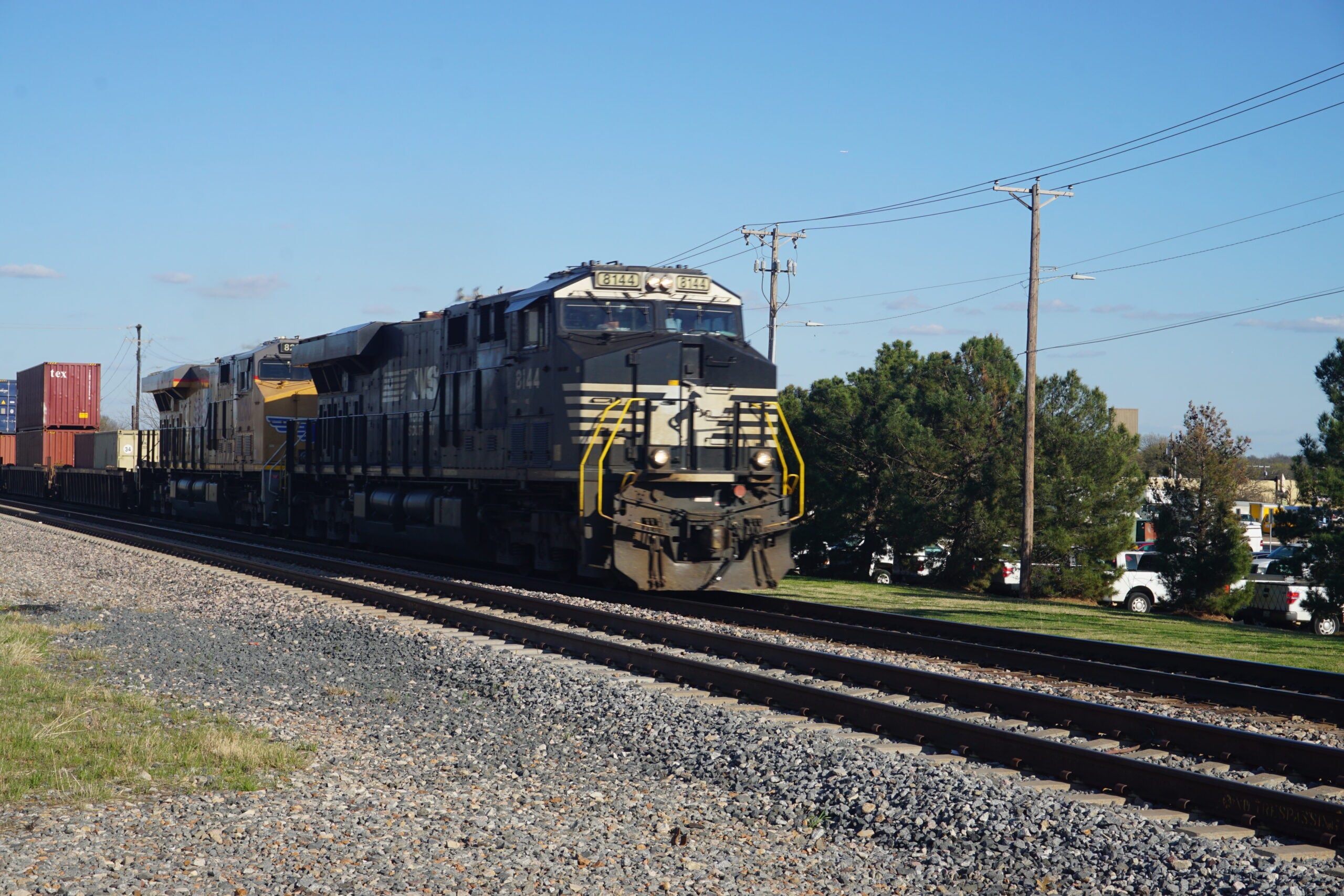
Archival photograph: Norfolk Southern 8144 and Union Pacific 8200 in Arlington, Texas, March 19, 2021. Not an image of the current merger proceedings or evidence of a merged operation. Photo: Michael Barera / Wikimedia Commons, CC BY-SA 4.0. No substantive alterations.
Updated November 5, 2026
CPKC has asked the Surface Transportation Board to terminate the Union Pacific–Norfolk Southern merger proceeding, alleging that Union Pacific’s conduct has discouraged rail customers from speaking openly about the transaction.
The October 30 filing turns a dispute over shipper participation into a request to end the review itself. It does not stop the merger, change a freight contract or establish that retaliation occurred. Those are matters for the regulator to assess.
For transportation decision-makers, the immediate question is how to protect commercial options while the outcome remains unsettled. A promised future network should not become the foundation of a binding freight commitment before its service, price and operating conditions can be tested.
Update—Union Pacific met the video-certification deadline
The Surface Transportation Board served Decision No. 45 on November 4. The Board denied Union Pacific’s appeal of the order making the Southwest Association of Rail Shippers conference video public, ordered UP to remove the confidential label and provide the redesignated copy to all parties, and required a verified certification by 5:00 p.m. ET on November 5.
Union Pacific filed the certification on November 5. The verified statement says UP removed the confidential label and provided a redesignated copy to all parties of record at 3:30 p.m. ET that day. That filing means the certification-based abeyance described by the Board was not triggered.
The Board also said it will accept comments by interested persons through the November 18 comment deadline even if they did not previously file a notice of intent. A comment and notice of intent filed and served by that date will make the filer a party unless the Board orders otherwise. The applicants must respond to CPKC’s October 30 letter by November 19, and UP must file retaliation-related documents and verified statements by December 4.
The practical point is that three different clocks now serve three different purposes: November 18 is the participation clock, November 19 is the applicants’ response clock, and December 4 is the evidence-production clock. None is an announced date for a merger decision. Shippers should check the controlling docket before relying on any deadline because the Board can still modify the schedule.
What changed—and what remains pending
In its October 30 public filing in Finance Docket 36873, CPKC argues that alleged intimidation has compromised the public participation needed for a fair review. It asks the Board to terminate the proceeding without granting the requested control authority. The filing draws on disputed remarks by UP Chief Executive Jim Vena at a March shipper conference and concerns raised by shipper associations.
CPKC is a competing railroad and an opponent of the transaction. Its claims and legal arguments must be read as an interested party’s position, not as findings adopted by the STB. Portions of the public filing are redacted; FIR is not reconstructing the underlying speech from those omissions.
Union Pacific disputes opponents’ account of the transaction. In a July 9 customer letter, the railroad argued that competitors face a stronger rival and alleged that some customers experienced pressure from competing railroads. Those allegations are also disputed. UP’s commercial case emphasizes fewer interchanges, faster movement and new single-line intermodal lanes. These remain company claims about prospective benefits, rather than measured results from a combined railroad.
The Board’s September 18 decision denied earlier, separate motions for summary denial while expressly declining to decide the transaction’s merits. Decision No. 45 likewise says the Board has not determined how it will resolve requests concerning continuation of the proceeding. It ordered the applicants to respond to CPKC by November 19 and said it will address CPKC’s request in a subsequent decision.
The November 18 comment date remains active following UP’s November 5 certification unless the Board issues a later order changing it. The Board has not announced a merger decision date.
The commercial issue: an alternative must be usable
FIR’s assessment is that this dispute makes the quality of a shipper’s alternatives more important than its public position on the deal.
A second railroad on a map is not necessarily a competitive option for a particular facility. The alternative may require switching access, an interchange agreement, suitable equipment, a transload, additional drayage or a longer inventory cycle. A proposed single-line route may remove a handoff while leaving an origin pickup, terminal or destination delivery constraint unresolved.
Build a lane file that distinguishes three things: the service available today, the change promised under the merger, and the commercial protection required if that change does not arrive. Give each an operating owner, a cost and a date for reassessment.
If the review continues
If the STB declines to end the proceeding or continues developing the record, neither action establishes that the merger will ultimately be approved.
Shippers should document specific benefits and concerns while they can still influence the record: current interchange delay, access to competing carriers, local switching performance, equipment supply and the consequences of service failure. Separate measured shipment history from an expectation about the combined network.
For commercial negotiations, request a lane-specific service proposal with defined pickup and delivery responsibilities, an implementation sequence, exception contacts and remedies. Compare total delivered cost under the current and proposed arrangement. Do not credit a hypothetical reduction in transit time unless the business can actually reduce inventory, avoid expedites or improve customer service.
If the process is delayed, stayed or placed on hold
A procedural delay would extend uncertainty; it would not by itself suspend existing freight obligations or guarantee additional capacity.
Keep current interchange and equipment arrangements workable. Where commercially feasible, negotiate review dates, limited initial volume commitments and a clear process for revising an award if the expected network change is postponed. Identify the financial consequence of missing a minimum-volume commitment before agreeing to it.
Maintain a priced recovery option for production-critical freight. That may mean another rail routing, transload access or truck capacity for exceptions. Test the fallback’s availability and lead time. An unconfirmed quotation is not reserved capacity.
If the proceeding ends or the merger is rejected
Termination of this proceeding and a final rejection on the merits are different outcomes; the wording and scope of any order would control what happens next.
In either case, transportation teams should remove unsupported merger-dependent assumptions from their operating plans. Reassess current carriers on the service and rates they can offer independently. Retain useful interchange arrangements and alternative sourcing work rather than abandoning them with the transaction thesis.
A failed transaction would not automatically reduce rates, restore a particular service or create a new competitive route. Those outcomes require their own commercial evidence.
If approval eventually comes
Any eventual approval would need to be read alongside its conditions, implementation requirements and effective dates. Approval alone would not demonstrate that a shipper’s proposed route is ready.
Before shifting substantial volume, validate the timetable, equipment, billing, claims responsibility and recovery process on the affected lanes. Use measured shipment performance to determine whether to expand. Keep contingency capacity until the new operation can reliably support customer commitments.
What decision-makers should do now
Procurement, operations and finance should agree on one set of assumptions. Which lanes depend on the transaction? Which savings require a service improvement? Which commitments survive a delay? Who has authority to change routing when a trigger is reached?
If a shipper intends to participate by November 18, its submission should distinguish measured operating facts from forecasts. Retain dated communications, contract and rate terms, service records and the people involved. A rate change by itself is not proof of retaliation. If a company believes it has experienced improper pressure, preserve the underlying evidence and obtain appropriate advice before making an accusation or disclosing confidential commercial information.
The next evidence to watch is the applicants’ November 19 response to CPKC, UP’s December 4 production, any Board ruling on CPKC’s request, and any later change to the procedural schedule. The November 18 comment date is a participation milestone, not a merger decision date.
We will continue to follow this story as it develops.
The decision today is to preserve options that work under more than one outcome. A freight plan should remain executable whether the review advances, slows or ends.
Sources and reporting note
Research checked after the certification deadline on November 5, 2026. This update uses STB Decision No. 45, Union Pacific verified statement 312802, CPKC’s October 30 public filing, the STB’s published merger materials and September 18 announcement, and Union Pacific’s customer and service communications. The request for termination and the Board’s November 4 action are developing matters that have received prior coverage. FIR is not claiming first or exclusive reporting. Scenario recommendations are FIR analysis, not predictions of the Board’s decision.
Primary sources
- STB Decision No. 45, Finance Docket 36873, served November 4, 2026: https://dcms-external.s3.amazonaws.com/DCMS_External_PROD/1793829754220/53312.pdf
- Union Pacific verified statement 312802, filed November 5, 2026: https://dcms-external.s3.amazonaws.com/DCMS_External_PROD/1793914355118/312802.pdf
- STB UP–NS merger resources and filing instructions: https://www.stb.gov/resources/major-railroad-mergers/
- CPKC October 30 filing 312764: https://dcms-external.s3.amazonaws.com/DCMS_External_PROD/1793380696099/312764.pdf
- FIR live canonical checked November 5, 2026: https://freightintelreport.com/cpkc-up-ns-merger-review-shipper-options/

Leave a Reply