
Update — September 11, 2026: AAR’s week ending September 5 recorded 299,148 U.S. intermodal units, up 18.0% year over year but down 1.3% from the prior week. Labor Day fell inside the 2025 comparison week and outside the 2026 week; year-to-date growth was 4.2%. Read FIR’s holiday-adjusted interpretation and Q4 bid controls. The original July price comparison below retains its observation period; the September 10 analysis covers August freight prices and the latest diesel release.
Truck freight prices cooled in July, but the year-over-year gap with rail remains wide enough that shippers should be testing—not merely discussing—intermodal conversion.
New U.S. Bureau of Labor Statistics data show that producer prices for truck transportation of freight fell 1.8% from June to July. That monthly decline may look like relief. It does not erase the larger signal: truck freight prices remained 10.9% above July 2025, while rail freight and mail prices were only 1.3% higher.
At the same time, rail demand is not waiting for the trucking market to settle. U.S. intermodal volume through the first 32 weeks of 2026 reached 9.0 million containers and trailers, 3.8% above the same period last year, according to the Association of American Railroads. In the week ending August 15 alone, intermodal volume rose 2.7% year over year.
The implication is not that every long-haul truckload should move to rail. It is that the commercial window for testing rail is widening—and shippers that wait for a dramatic capacity shock may discover that the best service plans, terminal slots and drayage partners are already committed.
Update — September 6, 2026: AAR’s latest weekly release strengthens the demand signal without proving that every added intermodal unit shifted from highway. For the week ending August 29, U.S. railroads handled 303,191 intermodal containers and trailers, up 5.7% from the comparable 2025 week. Through 34 weeks, U.S. intermodal volume reached 9,605,177 units, up 3.9% year over year; carloads rose 2.7%, and combined traffic rose 3.3%. North American weekly intermodal volume increased 6.0%. These figures reinforce the case for controlled lane tests, but they do not establish universal rail capacity, service or savings.
Two freight markets are moving at different speeds
The pricing comparison is unusually stark. BLS measures the average change in selling prices received by domestic producers. For July 2026, its selected transportation indexes showed:
- Truck transportation of freight: down 1.8% month over month, but up 10.9% year over year;
- Rail transportation of freight and mail: unchanged month over month and up 1.3% year over year;
- Water transportation of freight: up 1.5% month over month and 17.2% year over year; and
- Arrangement of freight and cargo: unchanged month over month and up 2.2% year over year.
These indexes are not lane quotes, and they do not establish that rail is cheaper on every movement. They do show that the inflation path for trucking and rail has diverged materially.
That divergence matters most on freight that can tolerate a longer and more structured operating cycle: dense, repeatable volumes moving 700 miles or more; import freight leaving major port gateways; replenishment inventory with predictable demand; and products that can be consolidated into container or trailer blocks.
Intermodal growth confirms interest—but not automatic conversion
U.S. railroads handled 291,838 intermodal containers and trailers during the week ending August 15, up 2.7% from the comparable 2025 week. Year to date, intermodal volume was up 3.8%, compared with a 2.7% increase in carloads.
Across North America, the weekly signal was stronger. Intermodal traffic increased 5.1% year over year, including a 7.9% gain in Canada and a 53.0% increase in Mexico for the week. Mexico’s percentage is amplified by a smaller base, but the direction is commercially relevant as nearshoring, automotive and cross-border supply chains create more opportunities for rail-truck coordination.
Volume growth alone does not prove that freight is shifting directly from highway to rail. International containers, import timing, commodity cycles and network comparisons all influence the numbers. The correct conclusion is narrower: intermodal is absorbing more freight while truck pricing remains well above last year, giving shippers a stronger reason to run controlled conversion tests.
The real decision is door-to-door, not ramp-to-ramp
Rail economics can look compelling until the full movement is assembled. A shipper must price the linehaul together with origin drayage, destination drayage, fuel, chassis, lift charges, storage exposure, equipment costs and the inventory expense created by longer or less predictable transit.
The key comparison is not the truck rate against the rail linehaul. It is total landed transportation cost against the service level the customer actually requires.
A conversion that saves $600 on linehaul but adds two days of inventory, a missed delivery appointment and terminal storage is not a saving. A conversion that saves $350, holds schedule reliably and protects scarce truck capacity during peak periods may be strategically valuable even if the percentage reduction appears modest.
Five screens every conversion lane should pass
1. Distance and density
Intermodal becomes more competitive as the rail portion grows and drayage represents a smaller share of the total move. Consistent volume also improves equipment planning and pricing leverage. Irregular freight can still work, but it is less likely to receive the same economics or operating priority.
2. Terminal geometry
A facility may be hundreds of highway miles from the best rail ramp even when a closer terminal appears on a map. Congestion, cut-off times, appointment rules, chassis availability and the quality of local drayage capacity determine whether a terminal is commercially usable.
3. Transit tolerance
Shippers should compare scheduled door-to-door transit and variability—not best-case rail time. Customer delivery windows, production requirements and inventory policy must be able to absorb the realistic service range.
4. Freight characteristics
High-value, theft-sensitive, temperature-controlled, fragile or time-critical freight requires additional controls. Securement, container integrity, monitoring, claims responsibility and handoff procedures should be designed before the first load moves.
5. Recovery options
Every conversion plan needs a failure mode. Identify who can dray a container when the primary carrier misses, how freight will be recovered after a service interruption, and when a load should revert to truck. A rail plan without a highway contingency is incomplete.
A practical 30-day shipper test
Shippers do not need to redesign an entire network to determine whether the pricing gap creates value. A disciplined pilot can produce usable evidence within one procurement cycle.
- Select three to five candidate lanes. Prioritize long-haul, repeatable freight with balanced origin and destination drayage markets.
- Build the true baseline. Capture truck linehaul, fuel, accessorials, detention, on-time performance, claims and current inventory days.
- Obtain complete intermodal pricing. Include both dray legs, rail, lifts, chassis and likely accessorial exposure.
- Define service before price. Establish acceptable transit, variability, tracking events and escalation response.
- Run enough volume to see a pattern. One successful load proves little. Use a sample large enough to expose terminal and day-of-week variation.
- Score the result door to door. Compare total cost, on-time performance, damage, visibility, administrative effort and customer outcome.
The pilot should also identify the break point at which the lane returns to truck. That could be a missed cut-off, an inventory threshold, a seasonal demand surge or a customer order requiring expedited service.
Do not convert the core and leave the edges unmanaged
The rail move is only the middle of an intermodal shipment. Origin and destination drayage frequently determine whether the conversion succeeds.
Procurement teams should verify:
- drayage carrier depth at both ramps;
- chassis sourcing and responsibility;
- free-time and storage rules;
- cut-off and availability timing;
- weekend and after-hours recovery capability;
- container tracking and exception alerts; and
- who owns communication across each handoff.
This is especially important for import freight. A shipper that coordinates ocean arrival, port drayage, rail departure and final delivery as separate transactions can lose the cost advantage in handoff delays. The commercial opportunity lies in designing the entire chain as one operating plan.
What the pricing gap does—and does not—mean
The 10.9% year-over-year increase in truck freight prices does not mean truckload capacity is unavailable. July’s 1.8% monthly decline shows that near-term trucking prices can soften even while the annual comparison remains elevated.
Nor does rail’s 1.3% annual increase guarantee stable contract pricing for every customer. Rail rates depend on equipment, corridor, commodity, service plan, volume commitment and competitive access.
What the gap does provide is a measurable trigger for procurement review. Shippers should no longer treat intermodal conversion as a sustainability exercise or a contingency reserved for the next truck-capacity crisis. On the right lanes, it is a current cost and capacity strategy.
Freight Intel Report assessment
The truck-to-rail shift is not a single national event. It is a series of lane decisions.
The strongest opportunity sits where three conditions overlap: truck prices remain elevated, intermodal service is operationally viable, and the shipper can commit enough repeatable volume to support a disciplined plan.
Rail traffic growth shows that more freight is already moving through the network. The pricing data show why additional shippers should test it. But conversion should be earned through door-to-door performance, not assumed from a national average.
The shippers most likely to benefit are those that act before capacity tightens again—using today’s market to validate routes, secure drayage partners and establish performance baselines while they still have negotiating room.
Sources: U.S. Bureau of Labor Statistics, July 2026 Producer Price Index Table 2; Association of American Railroads, weekly rail traffic for the week ending August 15, 2026; and Federal Railroad Administration, Freight Rail Overview; and Association of American Railroads, “Weekly Rail Traffic for the Week Ending August 29, 2026,” released September 2, 2026.
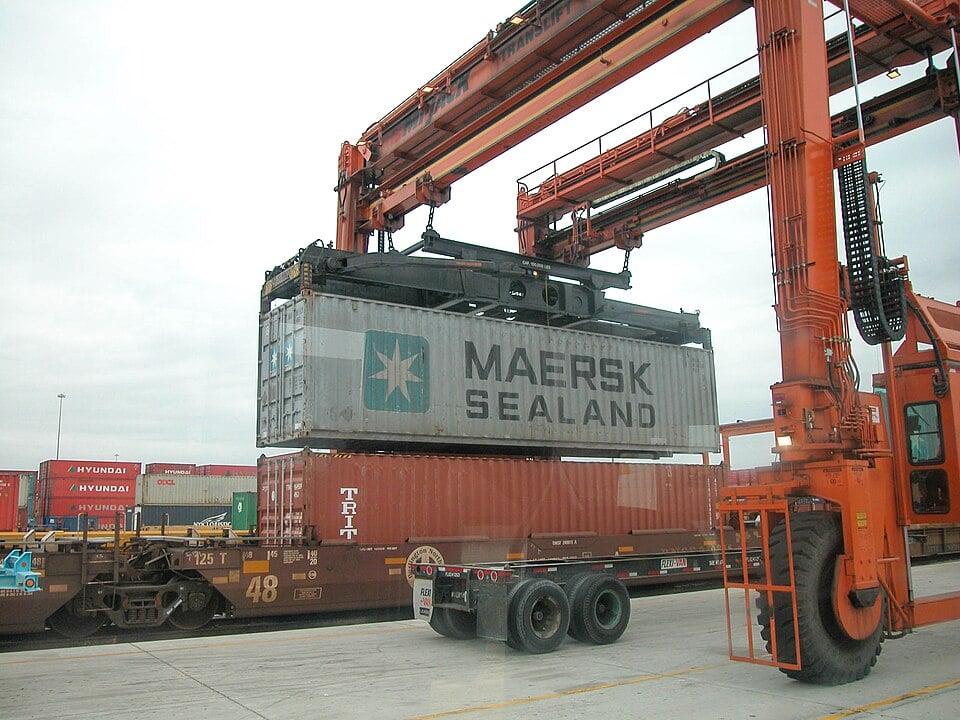
Photo: Rubber-tired gantry crane loading a 40-foot container at a BNSF intermodal terminal. David Wilson via Wikimedia Commons, CC BY 2.0. No material alterations.
Government services: For government services, verification, registrations, forms, reporting, or instructions, always navigate to the official agency website directly. Independently verify its address before entering credentials or business information.



Leave a Reply