
U.S. rail exporters now face a firm no-data/no-move compliance framework. U.S. Customs and Border Protection has finalized mandatory electronic export manifests for every train departing the United States, creating new filing deadlines, clearer responsibility rules and a direct operational connection between incomplete shipment data and whether a train can cross the border.
The final rule takes effect October 26, 2026. Enforcement begins October 26, 2027, giving exporters, railroads, customs brokers and freight forwarders one year to rebuild the data handoffs behind U.S.–Canada and U.S.–Mexico rail movements.
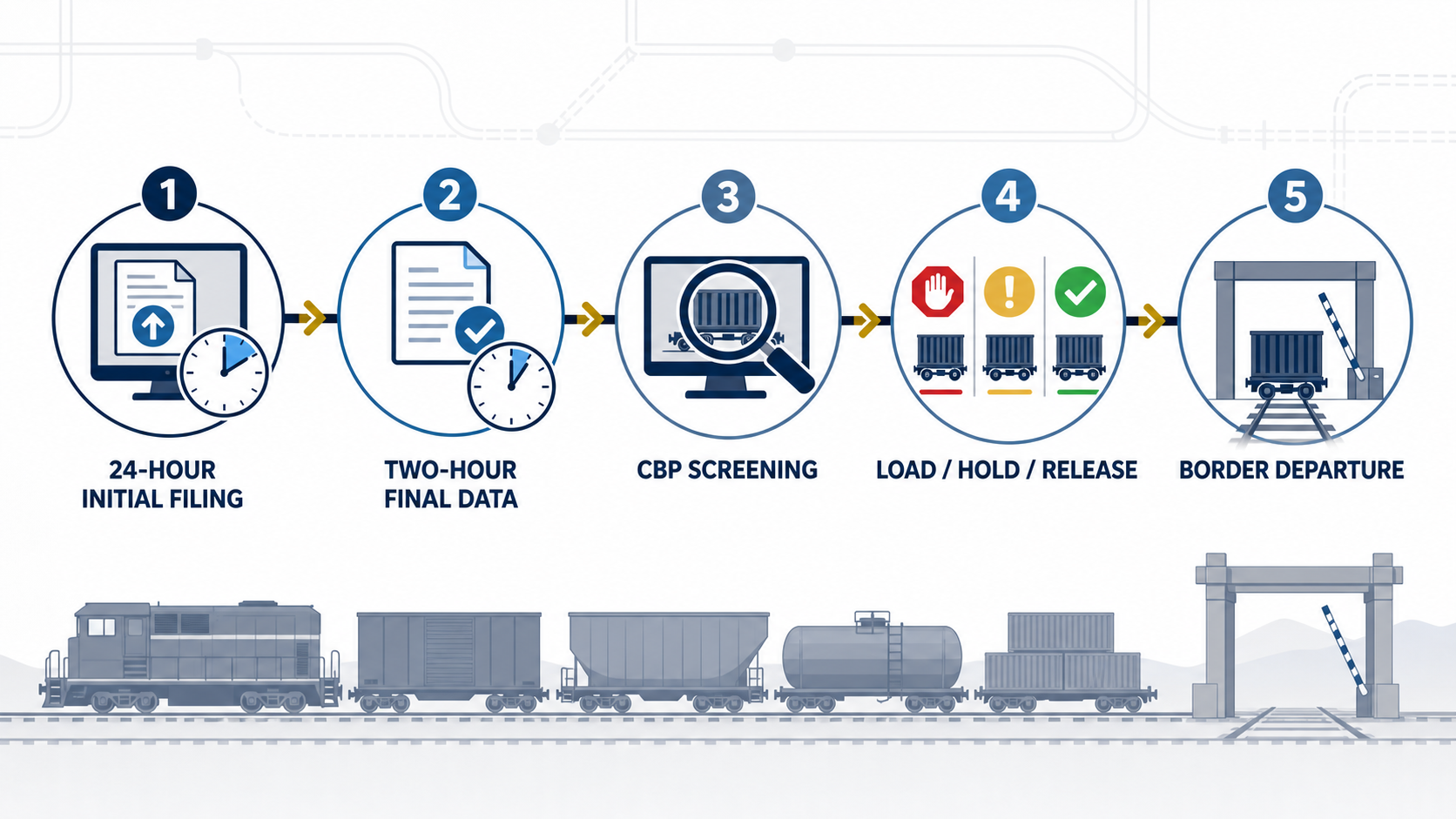
The rule creates two filing clocks
Seven initial shipment data elements must reach the Automated Commercial Environment no later than 24 hours before train departure: bill of lading number, quantity, weight, precise cargo description, shipper, consignee and filer identification.
Remaining cargo and transportation data are generally due two hours before departure. The practical implication is that a railroad cannot treat export-manifest completion as a last-minute border task. The first deadline reaches upstream into shipper order management, forwarder documentation, broker workflows and carrier cutoffs.
Why this is a no-data/no-move control
CBP may issue a Do-Not-Load or Hold instruction after screening the filing. Cargo subject to either instruction cannot cross the border until CBP releases it. If an unresolved hold applies to cargo already loaded, the issue can prevent the train’s departure.
That changes the consequence of weak export data. A missing consignee identifier, vague commodity description, late weight or mismatch between commercial and transportation records is no longer merely a documentation exception. It can become a border-delay, terminal-congestion and train-fluidity risk affecting cargo beyond the shipment that triggered the hold.
Who is responsible for filing?
Exporters, authorized agents, customs brokers and freight forwarders may transmit applicable information. But the outbound railroad becomes the fallback filer when no other eligible party files. A qualifying customs bond will secure compliance.
The fallback provision should not be mistaken for a workable operating model by itself. Railroads may possess transportation data without receiving complete commercial shipment data early enough to meet the 24-hour deadline. Exporters and service providers therefore need an explicit filing owner, a documented backup and contract language governing incomplete or late information.
The stakeholders most exposed
- U.S.–Canada and U.S.–Mexico rail exporters
- Automotive and industrial shippers
- Agricultural exporters
- Chemical producers and other regulated-cargo shippers
- Railroads and intermodal operators
- Customs brokers, freight forwarders and authorized agents
The largest implementation risk may sit between organizations rather than inside any one system. A shipper may believe its forwarder is filing; a forwarder may expect the broker to file; and the railroad may receive the shipment without the data or authorization needed to complete the record.
A one-year implementation checklist
- Assign filing ownership. Name the primary and fallback filer for every export flow, customer and border lane.
- Move cutoffs upstream. Translate the 24-hour and two-hour deadlines into customer, broker, terminal and railroad cutoffs with escalation time built in.
- Map the seven early data elements. Identify the source system and accountable party for each field, including precise cargo description and filer identification.
- Validate ACE readiness. Test formats, identifiers, acknowledgments, corrections and record reconciliation before enforcement begins.
- Review bond coverage. Confirm that the responsible parties maintain the qualifying customs bond required for compliance.
- Design exception management. Create operating procedures for rejected filings, missing data, corrections, Do-Not-Load instructions, loaded-cargo holds and release communication.
- Rewrite contracts and tariffs. Allocate responsibility for data accuracy, transmission timing, accessorial costs, train delays and cargo held after loading.
- Run border simulations. Test realistic failures with exporters, forwarders, brokers, railroads and terminals—not only successful submissions.
What remains unresolved
The final rule establishes the federal framework, but several operating questions remain: carrier-specific filing workflows; contractual allocation of responsibility; ACE readiness among smaller exporters and forwarders; correction procedures near cutoff; and how individual border ports will manage examinations and hold resolution.
Those details will determine whether the industry uses the implementation year to create a disciplined handoff—or reaches October 2027 with responsibilities still buried in emails, spreadsheets and assumptions.
The FIR view
The strategic change is simple: export documentation is becoming a train-movement control. Shippers should treat filing readiness with the same rigor applied to equipment cutoffs, dangerous-goods documentation and border contingency planning.
The strongest implementation programs will not stop at technical ACE connectivity. They will establish filing ownership, hard data cutoffs, validation rules, bond coverage, exception playbooks and contractual accountability across every party touching the move.
Primary sources: CBP final rule in the Federal Register; CBP announcement. Additional compliance context: KPMG summary.
Featured photo: The International Railroad Bridge between Buffalo, New York, and Ontario, Canada. Photo: U.S. Customs and Border Protection.
Government services: For government services, verification, registrations, forms, reporting, or instructions, always navigate to the official agency website directly. Independently verify its address before entering credentials or business information.


Leave a Reply