
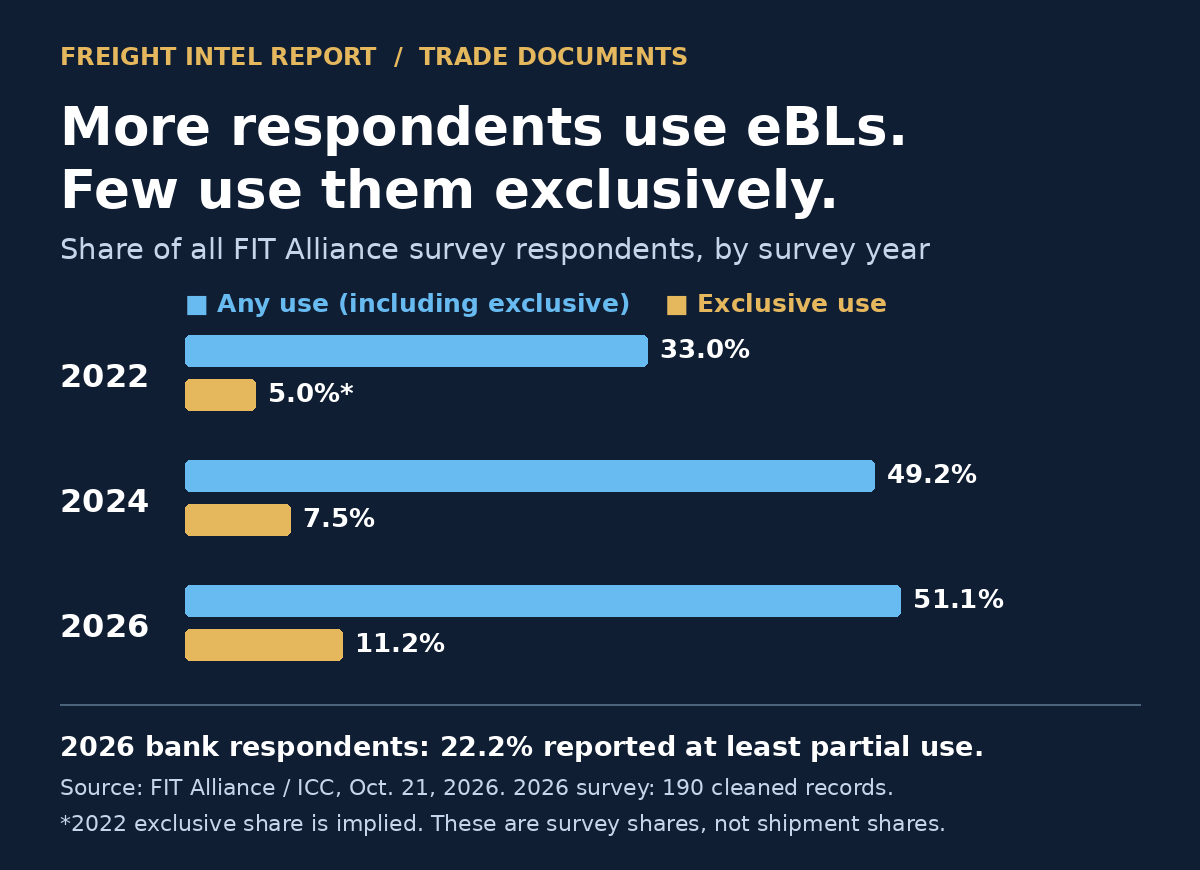
Chart: Reported eBL use across FIT Alliance survey rounds. The banking figure refers only to bank respondents. Source: FIT Alliance / ICC, October 21, 2026. Open the full-size chart.
Reported use of electronic bills of lading rose across the FIT Alliance survey rounds. The next test for shippers is whether their documents can move reliably between the carrier, buyer, bank and cargo-release team.
The FIT Alliance’s October 21 survey release reports that 51.1% of respondents use electronic bills of lading, either exclusively or alongside paper. Exclusive use reached 11.2%, while only 22.2% of bank respondents reported at least partial use.
The research draws on 190 cleaned records collected through alliance member networks. Those figures describe participating organisations, not the percentage of worldwide shipments moving electronically. FIT Alliance survey, published by ICC
That distinction matters when choosing a logistics technology. A carrier offering an electronic bill does not establish that the buyer’s bank can receive it, that the next platform can accept control, or that the destination release process is ready.
The advance is the handoff
DCSA describes a network framework combining a technical exchange standard, a Control Tracking Registry and a shared legal annex. It reports that CargoX, edoxOnline, TradeGo, WaveBL and eTEU adopted version 2 of its interoperability annex in June 2026 with International Group of P&I Clubs approval. That builds on a live CargoX–edoxOnline transaction in May 2025. These are identifiable interoperability milestones; they do not establish universal compatibility across every provider or trade lane. DCSA’s account of the framework
The practical advance is being able to transfer a document without requiring every participant to select the same platform. Shippers should ask which providers and functions are supported today, which legal terms govern the transfer, and who resolves a disagreement about the current holder.
A PDF attached to an email does not answer those questions. UNCITRAL’s model law centres on reliable identification of the authoritative electronic record, integrity and exclusive control—the electronic counterpart to possession. Copying a file is different from transferring that control. UNCITRAL’s explanation of electronic transferable records
Where the operating value could appear
FIR’s assessment is that the strongest business case starts with an actual document bottleneck. Establish whether release is delayed by document transmission, missing approvals, discrepancies, payment arrangements or unavailable transport. Replacing paper will have limited value if the unresolved constraint sits elsewhere.
Measure the interval between document issuance and the next party’s acceptance, then between surrender and confirmation of release. Track how often staff must re-enter data or intervene. Those measures reveal whether electronic processing improves the complete transaction rather than shifting work from one company to another.
Exporters, importers and forwarders may gain from fewer manual handoffs. Banks and carriers may benefit from clearer document status. Buyers bear new operational dependence on account access, platform availability and the accuracy of the underlying data. An incorrectly entered consignee or inconsistent commercial document still requires correction when the record is electronic.
Do not build the investment case around a generic savings percentage. Request the platform subscription and transaction charges, onboarding costs, system integration, staff training and legal review. Include the cost of operating paper and electronic processes together during transition. Compare the result with the organisation’s measured handling burden and document-related exceptions.
Legal recognition enables use; it does not mandate adoption
The UK Electronic Trade Documents Act came into force on September 20, 2023. The International Group explains that it gives qualifying electronic trade documents recognition under English law and supports their legal possession and transfer. The Act contains reliability requirements; it does not make every electronic file a valid trade document. UK Act; International Group explanation
MLETR is a model law for jurisdictions to implement, rather than a worldwide mandate binding every shipment. UNCITRAL also explains that it does not replace the substantive law governing the underlying document. Shippers therefore need transaction-specific confirmation of governing law, relevant jurisdictions, counterparties’ acceptance and the applicable contractual framework.
Insurance approval is another distinct check. The International Group’s guidance differentiates assessment of platform user agreements from technological reliability under the Act. Ask the carrier and insurer to confirm the current approved system, legal documentation and applicable coverage. An approval badge alone cannot establish that a particular bank, customer or destination process accepts the proposed transaction.
Implementation needs an exception path
DCSA’s implementation guide covers much more than issuing a document: draft approval, amendment, surrender for amendment, replacement and surrender for delivery are separate processes. Buyers should require a demonstration of the functions they actually need, including unsuccessful transfers and corrections. DCSA technical implementation guide
Before a shipment moves, identify who can approve a transfer, who confirms acceptance, and who can act outside normal office hours. Establish account-recovery procedures, incident contacts and an agreed change-of-medium process if paper becomes necessary. Require a controlled procedure that prevents competing originals from remaining effective.
These are procurement and operating tests, not evidence that any named provider has failed. A demonstration should show the shipper what happens when a routine transaction becomes an exception, without creating new uncertainty about the right to obtain the cargo.
Adopt by corridor, expand by evidence
The realistic timetable depends on the least-ready participant. A repeat movement with an accepting carrier, bank and consignee may be suitable for an initial controlled deployment. A network spanning additional banks, platforms and legal systems requires separate validation. Neither the survey nor a standards announcement supplies a dependable launch date for an individual shipper.
FIR recommends selecting one recurring corridor and mapping the entire document chain before procurement. Obtain written acceptance from each participant. Test issuance, transfer, amendment, surrender and recovery. Assign a document owner and backup contact. Compare release time, intervention hours, rejected transfers and total processing cost against a documented baseline before expanding.
The next indicators worth watching are completed cross-platform transactions on the shipper’s own lanes, bank acceptance, repeatable exception handling and verified release performance. FIR’s Technology Adoption Tracker applies the same discipline: an announced capability becomes consequential when it works inside a dependable operating process.


Leave a Reply