
Rail grain transportation is entering harvest with two cost pressures moving at once: a historically high fuel surcharge and evidence of tightening equipment availability in a key producing state.
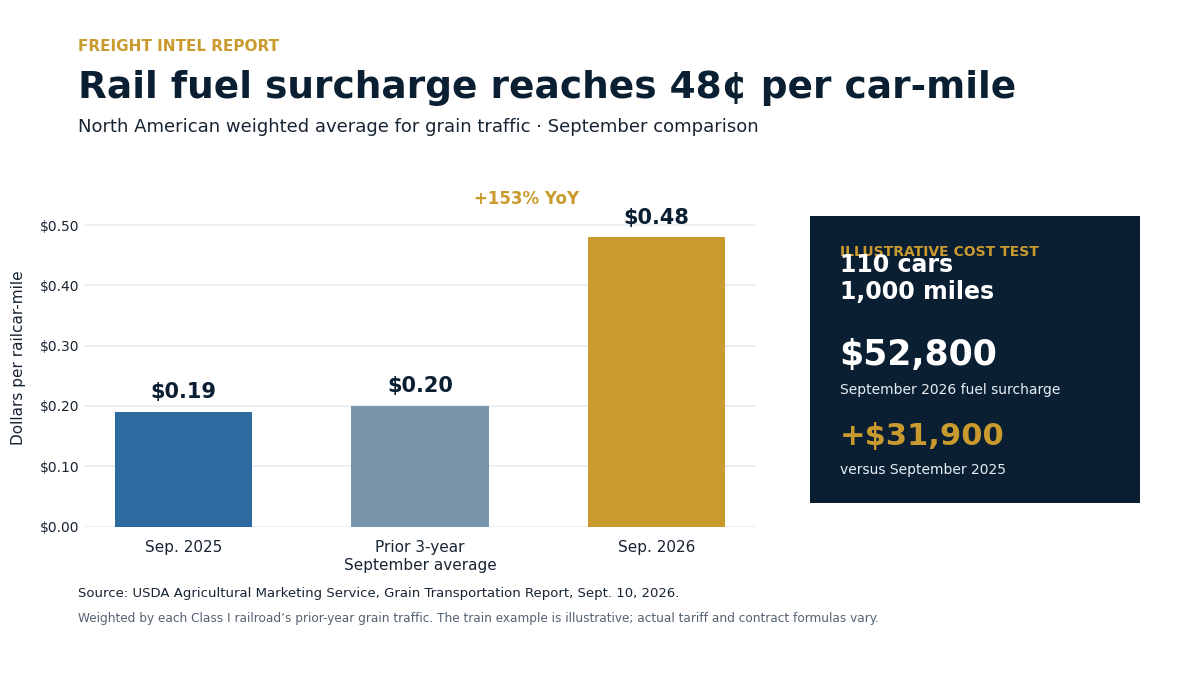
The North American weighted-average railroad fuel surcharge reached $0.48 per railcar-mile in September, according to the U.S. Department of Agriculture’s September 10 Grain Transportation Report. That is unchanged from August, but 29 cents higher than September 2025 and 28 cents above the prior three-year September average. The year-over-year increase is approximately 153%.
At the same time, Class I railroads reported 1,147 unfilled manifest grain-car orders in North Dakota for the week ending August 28—the first time that backlog exceeded 1,000 orders this year. The backlog increased by 501 orders in one week as the state’s spring-wheat harvest advanced to 86% complete, compared with a five-year average of 77%.
Those signals do not prove a nationwide rail-service breakdown. They do show that grain shippers can no longer evaluate the base rail rate, fuel surcharge and equipment market as separate administrative details. During a fast harvest, they form one procurement exposure.
The measured facts
USDA’s weighted surcharge measure is based on published programs from BNSF, Canadian National, CSX, Canadian Pacific Kansas City, Union Pacific and Norfolk Southern. It is weighted by each railroad’s share of prior-year grain traffic.
The September comparison is stark:
- September 2025: $0.19 per railcar-mile
- Prior three-year September average: $0.20 per railcar-mile
- September 2026: $0.48 per railcar-mile
For an illustrative 110-car train moving 1,000 miles, the weighted-average surcharge produces $52,800 in fuel charges. At the September 2025 rate, the same simplified calculation would have been $20,900—a difference of $31,900.
That example is not a quote. Actual charges depend on railroad, tariff or contract, route mileage, car ownership, strike price, index month and the applicable fuel-surcharge formula. USDA’s own route tables show why a national average must not be treated as an executable price: September fuel surcharges in selected corn and soybean lanes range from the low hundreds of dollars to more than $1,000 per car.
The equipment market is adding a second layer. USDA reported average September shuttle-car bids and offers of $742 per car above tariff for the week ending September 3, up $104 from the prior week and $788 from the same week in 2025. Non-shuttle bids and offers averaged only $19 above tariff, underscoring that train type and lane matter.
What the figures do—and do not—say
The 48-cent measure is a weighted market indicator. It does not mean every rail customer pays the same surcharge, and it does not establish that every railroad is earning excess revenue from fuel.
Reuters reported that Class I railroads collected $2.93 billion in fuel surcharges in the second quarter, more than 90% above the year-earlier period and equal to about 90% of their reported diesel costs in aggregate, based on Surface Transportation Board filings. The aggregate masks substantial carrier differences. Reuters separately reported in August that Union Pacific collected $91.1 million more in fuel surcharges than it paid for fuel during the second quarter, while other carriers showed smaller surpluses or deficits.
The timing mechanism matters as much as the headline number. Railroad programs commonly use the U.S. Energy Information Administration’s on-highway diesel benchmark, but the index month, strike price and trade factor can differ. A surcharge can therefore rise after the underlying fuel market has already moved—and can remain elevated after spot fuel prices begin to retreat.
USDA reported that the national on-highway diesel benchmark reached $5.967 per gallon for the week ending September 7, up 36.8 cents in one week and above the previous nominal record. That increases the probability that formulas using a lagged benchmark will continue resetting higher even if the weekly pump price stabilizes.
The Freight Intel view
The immediate risk is not simply “expensive rail.” It is a three-part cost stack:
- Base transportation rate: the tariff or negotiated linehaul amount.
- Fuel mechanism: the benchmark, strike price, mileage and formula that determine the surcharge.
- Equipment access: secondary-market bids, car supply, loading windows and penalties when service is constrained.
A shipper that negotiates only the base rate can still lose the economics of the bid through the other two layers. That is especially true when harvest demand accelerates faster than equipment can reposition.
North Dakota’s backlog is an early warning, not a national forecast. But its timing is important. Grain originations were already 11% above the comparable week of 2025 and 23% above the three-year average in the week ending August 29. A faster-than-normal wheat harvest is putting pressure on manifest service while corn and soybean harvests begin to build their own transportation demand.
The practical question is therefore not whether the national surcharge is “fair.” The shipper decision is whether the contract accurately identifies who bears the cost, which index controls the reset, and what happens when equipment scarcity adds a premium on top.
Actions for grain shippers, processors and exporters
Rebuild the bid comparison on an all-in basis
Compare tariff or contract linehaul, fuel surcharge, car-ownership economics, secondary-market premiums, demurrage, storage, switching and destination charges. A lower base rate can be the more expensive option after the full cost stack is applied.
Audit the fuel-surcharge clause—not just the current percentage
Document the published index, observation date, strike price, rate table, trade factor, mileage source and reset lag. Require the carrier or provider to identify the exact program governing the quote. Do not assume the EIA price published this week controls the invoice issued this week.
Run a lag scenario before committing volume
Model at least three surcharge cases: the current contract formula, one additional upward reset and a slower decline after diesel prices fall. The goal is not to predict oil; it is to identify how much budget remains exposed to the formula’s timing.
Separate equipment protection from rate negotiation
Confirm whether cars are railroad-owned, private or obtained through the secondary market; identify the loading window; and document remedies for missed placements. North Dakota’s backlog and the shuttle premium show that equipment availability can become a separate cost center.
Test modal alternatives with service constraints included
Barge, truck, transload and containerized-grain options should be compared on total delivered cost, available equipment, transfer losses, transit reliability and terminal capacity—not on linehaul alone. USDA reported a new Baltimore transload operation designed to move more than 200 grain containers per week, but one new facility does not create an immediate nationwide substitute for unit-train capacity.
Preserve the data needed to challenge an invoice
Retain the quote, governing tariff, surcharge table, index publication date, route mileage, car count, tender acceptance and invoice calculation. Without that chain, a dispute becomes an argument over memory rather than a document-backed reconciliation.
What remains uncertain
It is not yet clear whether North Dakota’s manifest backlog will spread to other grain regions or ease as the wheat harvest winds down. Secondary-car premiums can also move quickly as shuttle demand and export commitments change.
Fuel remains the largest uncertainty. EIA’s latest weekly diesel reading is measured; future prices are not. The key near-term indicator is whether railroad surcharge tables continue rising after the September diesel spike and whether equipment premiums broaden beyond the lanes already under pressure.
For shippers, the correct response is disciplined exposure management—not a blanket assumption that every rail lane is failing or that every surcharge is identical.
Sources
- USDA Agricultural Marketing Service, Grain Transportation Report, September 10, 2026
- USDA Grain Transportation Report landing page
- USDA Grain Transportation Report datasets
- U.S. Energy Information Administration, on-highway diesel prices
- Reuters, September 14, 2026: rail fuel surcharges and harvest exposure
- Reuters, August 17, 2026: carrier-level fuel-surcharge revenue differences
Freight decisions are increasingly being made across multiple cost clocks. Subscribe to the free Freight Intel Briefing for independent, document-based analysis of the signals that should change a shipper’s next decision.
Government services: For government services, verification, registrations, forms, reporting, or instructions, always navigate to the official agency website directly. Independently verify its address before entering credentials or business information.
Leave a Reply