
A carrier’s announced rate increase is a starting point for procurement, not a forecast of what every shipment will cost. Old Dominion’s new pricing announcement gives affected shippers a specific reason to test that distinction before October.
What changed—and who is exposed
Old Dominion announced a 4.9% general rate increase on September 21, effective October 5, 2026, for rates under its ODFL 559, 670 and 550 tariffs. Customer outcomes can differ by lane and distance. Minimum charges also increase. The announcement does not establish a uniform increase across every shipper’s negotiated agreement. Old Dominion announcement
The immediate audience is businesses whose pricing incorporates the affected tariffs. Other LTL buyers can use the same audit method, but should not assume their carrier has announced an equivalent change.
FIR’s analysis: Treat this as a contract-and-shipment repricing event, not evidence by itself of an industrywide capacity shortage. The decision is whether to accept, negotiate or selectively reroute affected freight after measuring the actual exposure.
Demand and yield are different signals
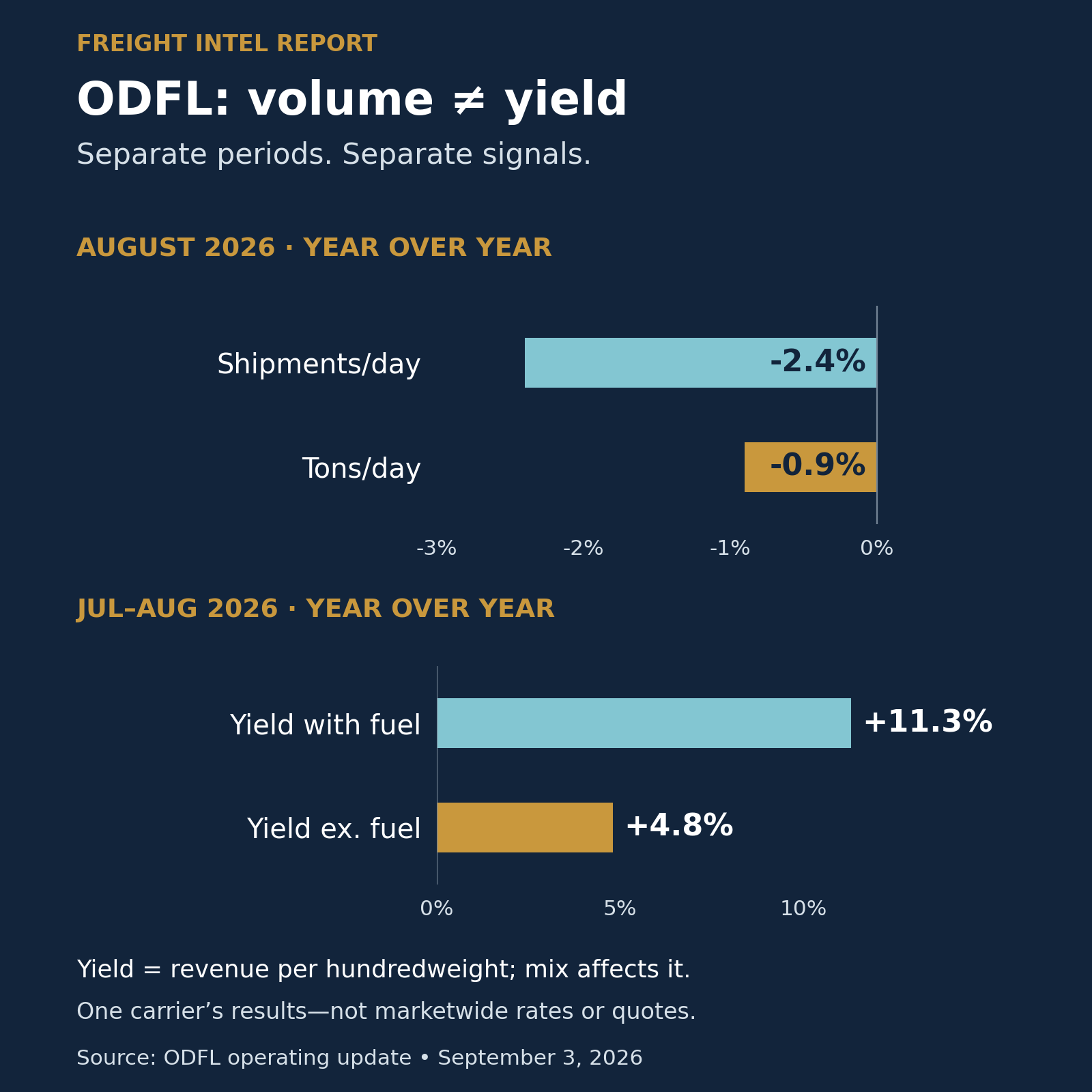
In its September 3 operating update, Old Dominion reported August shipments per day down 2.4% and tons per day down 0.9% year over year. For July–August combined, revenue per hundredweight rose 11.3% including fuel surcharges and 4.8% excluding them. Those are different observation periods and measures. Old Dominion operating update
The chart keeps them separate. Revenue yield is not a like-for-like quote: shipment mix can affect it. Nor does weaker activity at one carrier establish spare capacity on every lane. These figures support a narrower conclusion: do not infer demand strength directly from revenue growth or a pricing announcement.
Original FIR chart. Company-reported year-over-year changes; August activity and July–August yield are separate panels. Yield includes mix effects and is not a shipment quote.
Build a like-for-like test before discussing discounts
FIR recommends rerating a representative basket of recent shipments twice: once with the current applicable terms and once with the proposed terms. Keep shipment attributes fixed. Record origin, destination, weight, dimensions, classification, service, accessorial requirements and any minimum-charge treatment.
Use enough history to capture the freight you expect to ship—not just the easiest or largest loads. If next quarter’s mix will differ materially, run that planned mix separately and label it as a forecast. A historical basket is a control, not a prediction.
Ask the carrier or broker to show the effective tariff edition, negotiated discount, minimum charge, fuel basis and accessorial schedule behind both results. A larger discount against a different base does not automatically mean a lower bill. Obtain written clarification where the governing agreement is ambiguous.
The basket’s effective increase is:
(Total proposed charges ÷ total current charges − 1) × 100.
Use the sum of shipment charges, not the simple average of shipment percentage changes. The latter can give a small shipment the same influence as a much more expensive one.
Why the all-in result can differ
Consider a deliberately simplified FIR illustration—not an Old Dominion rate, surcharge schedule or forecast:
- Current discounted linehaul: $1,000; fuel assessed at an assumed 30% of that linehaul: $300; fixed accessorial: $100. Total: $1,400.
- Raise only linehaul by an assumed 4.9%, keep that fuel percentage unchanged and leave the fixed fee unchanged. New total: $1,049 + $314.70 + $100 = $1,463.70, an increase of 4.55%.
- If the hypothetical fuel percentage instead becomes 35%, total charges reach $1,516.15, or 8.30% above the original bill.
The assumptions are the lesson. A percentage-based surcharge can rise in dollars even when its percentage does not change; a fixed charge can dilute the overall percentage increase. Actual tariff mechanics may differ, including the fuel assessment base. Model the governing formula rather than importing this illustration into a budget.
Minimum-charge shipments deserve a separate exception list. Determine whether the minimum, rather than the calculated transportation charge, sets the price. Adding a headline percentage to the existing invoice will not test that boundary.
Turn the audit into a decision
Shippers: Rank exposed lanes by incremental annualized dollars and service criticality. Negotiate where the impact concentrates. Do not move a reliable lane solely to improve the displayed discount; include claims, missed appointments and recovery costs in the comparison.
Brokers and managed-transportation providers: Separate the carrier’s change from any change in your own pricing or fees. Give customers shipment-level explanations and confirm how quote validity crosses the effective date.
Carriers: A clear explanation of the affected pricing base, service commitments and exceptions gives customers something more useful than a headline percentage.
For each lane, choose an explicit response: retain, negotiate, test an alternative, or seek better information. An alternative should pass pickup, transit, appointment and claims checks before receiving critical freight.
What remains unknown
The announcement is not a customer-level rate table. FIR cannot determine an individual account’s net increase without its agreement and a rated shipment basket. This analysis does not forecast a universal LTL price increase or claim a national service crisis.
The practical deadline is to resolve exposure before affected freight moves under the new terms. After implementation, reconcile the first invoices against the approved test, investigate exceptions and correct the budget with observed—not assumed—results.
The Freight Intel View: The best answer to a general rate increase is not a general objection. It is a documented account of which shipments change, by how much, and what service value remains worth paying for.
Subscribe free to the Freight Intel Briefing for independent freight analysis that connects market signals to operational decisions.
Leave a Reply