
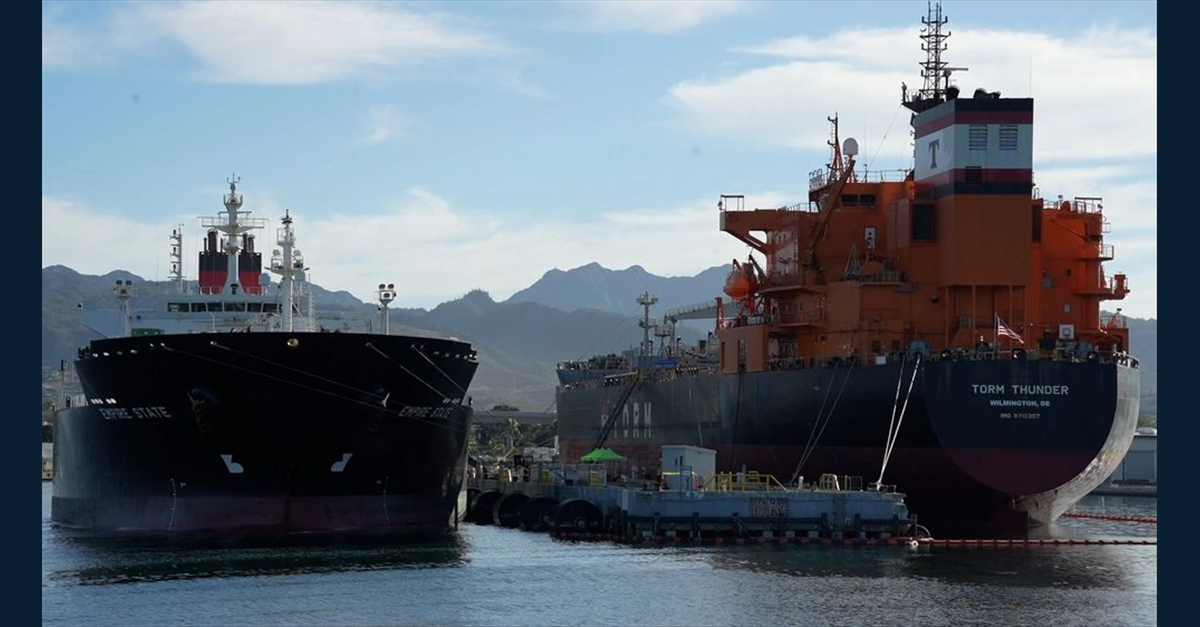
Featured image: Merchant tankers at Joint Base Pearl Harbor-Hickam, Hawaii, October 26, 2023. U.S. Air Force photo by Tech. Sgt. John Linzmeier / Joint Task Force Red Hill. Public domain via DVIDS. The appearance of U.S. Department of War (DoW) visual information does not imply or constitute DoW endorsement.
Confirmed development: U.S. Customs and Border Protection says the Jones Act waiver will continue from 12:00 a.m. Eastern on August 17, 2026, through 11:59 p.m. Eastern on November 15, 2026. The deadline applies to loading: an eligible cargo must be loaded aboard the vessel before the waiver expires.
The extension preserves a temporary path for specified energy- and agriculture-related cargoes to move between U.S. points on foreign-flagged vessels. But it replaces the prior broad operating window with a case-by-case approval process. Cargo eligibility alone is no longer enough.
What changed
Confirmed: Before a voyage begins, a prospective user must submit a written vessel-availability request to the Department of War, the Maritime Administration and CBP. The request must identify the proposed vessel and ownership, voyage dates, loading and discharge ports, cargo, expected shipment frequency, and why the transportation is in the interest of national defense.
MARAD will survey the market to determine whether a coastwise-qualified U.S. vessel is available. The Department of War will then decide whether the waiver applies to the proposed voyage and whether a foreign-flagged vessel may be used. Only after that determination should the requester arrange the foreign-flag transportation.
This makes the new extension materially narrower than the waiver expiring August 16. Under the earlier framework, a listed product could move within the waiver parameters without a voyage-specific U.S.-vessel availability determination. Beginning August 17, each proposed foreign-vessel move faces a review that can stop the booking if qualified domestic capacity is available or if the national-defense standard is not met.
The operational sequence
- Confirm cargo eligibility. Match the cargo and Harmonized Tariff Schedule classification to the current CBP list of potentially covered products. Do not assume that every energy or agricultural commodity qualifies.
- Prepare the vessel-availability request. Assemble the required voyage, vessel, ownership, port, cargo, frequency and national-defense information.
- Submit before the voyage. Send the written request to the Department of War, MARAD and CBP through the channels identified in the current guidance.
- Wait for MARAD’s survey. MARAD will test whether a coastwise-qualified U.S. vessel is available for the proposed transportation.
- Obtain the Department of War determination. A foreign-flag voyage is not authorized merely because the cargo appears on the eligible-product list.
- Book only after approval. If the proposed voyage qualifies, arrange the foreign-flag transportation with the appropriate carrier.
- Complete CBP documentation. Foreign vessels remain subject to entrance, clearance and cargo-documentation requirements, including the procedures specified by CBP.
- Report after the voyage. The required report must reach MARAD no later than 10 days after completion and include vessel, owner/operator, voyage, port, cargo and national-defense information.
Who is affected
Energy and fertilizer shippers, agricultural producers, charterers and vessel operators now have another decision gate between identifying a cargo and fixing a foreign vessel. U.S.-flag carriers gain a formal opportunity to demonstrate available coastwise capacity. Ports must coordinate vessel calls and CBP documentation only after approval is established.
The implications are especially important for Hawaii, Alaska and Puerto Rico supply chains, where waterborne transport is central to delivered cost and inventory planning. Trucking, rail and warehousing providers also have exposure: a delayed or denied ocean leg can shift inland pickup windows, equipment demand, storage duration and appointment schedules.
Freight Intel Report analysis: capacity, timing and cost
Analysis: The extension adds potential capacity, but it removes certainty. A foreign vessel may still be available in the charter market while remaining commercially unusable until the government process is complete. Shippers should therefore build approval time into tendering, nomination and terminal plans and avoid treating a conditional voyage as firm capacity.
The U.S.-vessel survey may strengthen the negotiating position of domestic carriers when they can meet the dates, ports and cargo requirements. It may also expose situations in which suitable coastwise capacity exists but is priced above a foreign alternative. The waiver process is an eligibility mechanism, not a guaranteed lowest-cost routing tool.
Compliance work will increase. Each request requires a defensible record tying the cargo, vessel, voyage and national-defense rationale together. Errors or late submissions could strand a charter plan, create terminal disruption or force a more expensive modal or sourcing response.
Delivered-cost effects remain uncertain. Foreign tonnage can sometimes lower the ocean line-haul component, but approval delay, repositioning, port costs, documentation, inland rescheduling and inventory carrying cost can offset part or all of that advantage. No shipper should promise savings until the full route and timing are modeled.
What remains unknown
- The complete current HTS product list and how CBP will treat borderline classifications.
- Typical approval turnaround times, especially during periods of heavy request volume.
- How often MARAD will identify available U.S.-flag capacity that prevents foreign-vessel approval.
- Whether approved voyages will materially reduce delivered costs after all compliance, port and inland effects are included.
Shipper checklist before booking a foreign-flag voyage
- Verify the cargo against the current eligible-product list and confirm the HTS classification with qualified trade counsel or a customs professional.
- Lock the proposed loading window, discharge window, ports, quantity and handling requirements.
- Collect vessel identity, flag, ownership and operator information.
- Document expected shipment frequency and the national-defense rationale.
- Identify a domestic-vessel fallback and an inland contingency.
- Submit the vessel-availability request before committing to the voyage.
- Do not treat the foreign vessel as approved capacity until the Department of War determination is in hand.
- Prepare CBP entrance, clearance and cargo records.
- Assign ownership for the MARAD post-voyage report and calendar the 10-day deadline.
This analysis is for operational planning and does not constitute legal advice. Shippers should confirm current requirements directly with CBP, MARAD and qualified counsel before acting.
Sources
- Reuters: U.S. extends Jones Act waiver 90 days, revises compliance rules (August 13, 2026)
- Associated Press: Trump extends Jones Act waiver 90 days (August 10, 2026)
- MARAD: Domestic Shipping and Jones Act waiver guidance
- CBP CSMS #68448732: prior waiver implementation guidance and reporting requirements
Executive takeaway: The waiver remains open through November 15, but foreign-vessel access is now conditional on cargo eligibility, a MARAD availability survey and a Department of War voyage determination. Build approval risk—not just charter availability—into every plan.
Discussion question: Will case-by-case review preserve useful emergency capacity, or will uncertain approval timing make the extension too difficult to use in real freight operations?
Get decision-useful freight analysis free: Subscribe to Freight Intel Report for breaking regulatory, market and shipper-strategy updates.
Government services: For government services, verification, registrations, forms, reporting, or instructions, always navigate to the official agency website directly. Independently verify its address before entering credentials or business information.
Leave a Reply