
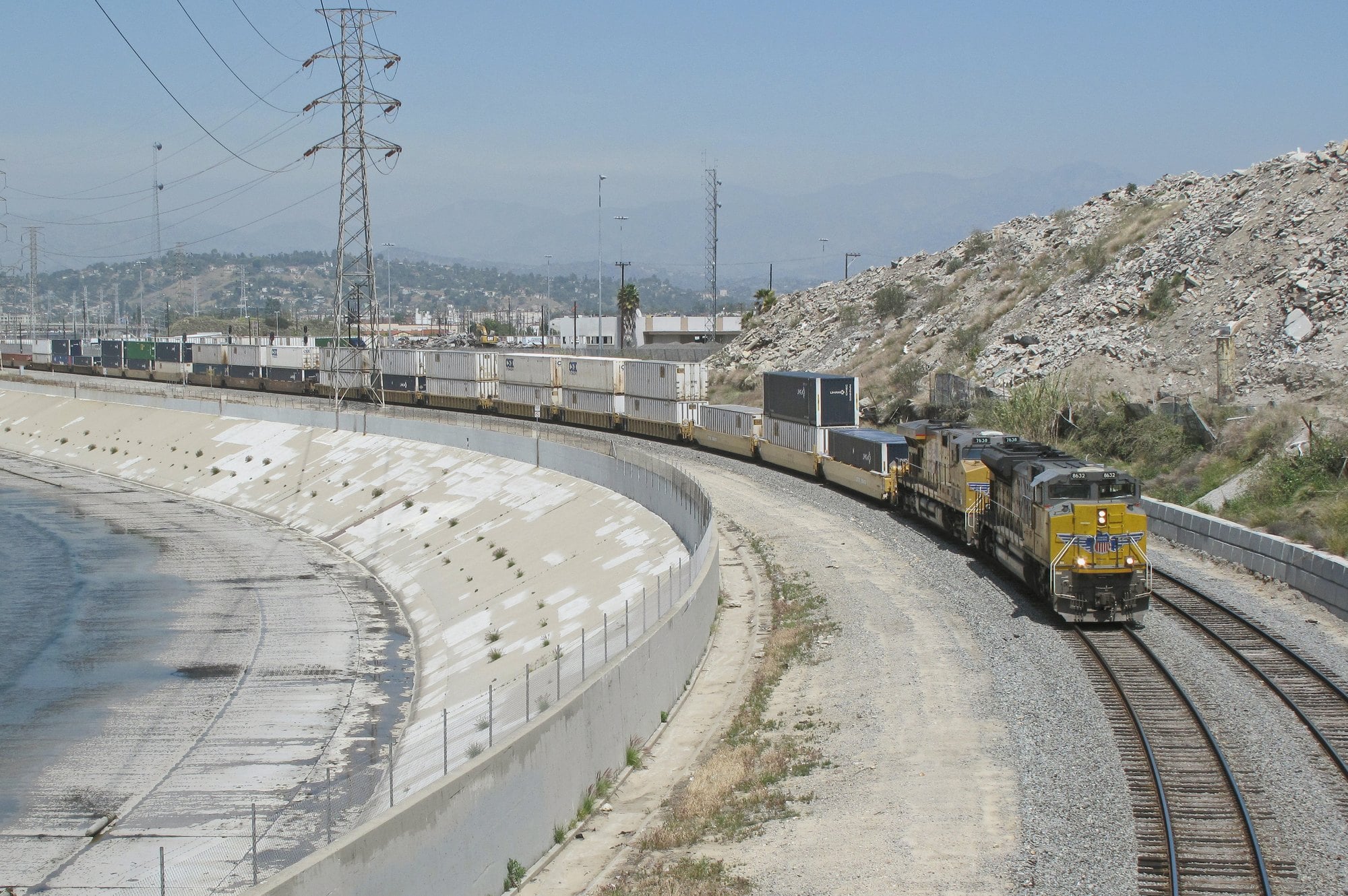
Photo: Downtowngal, “Union Pacific container train Los Angeles,” via Wikimedia Commons, licensed under CC BY-SA 3.0. Representative photograph taken in 2012.
Stronger ocean volumes are feeding into a less flexible inland network. Union Pacific’s capacity actions suggest some shippers could encounter tighter allocations and higher costs before a nationwide rail bottleneck becomes visible.
Maersk’s latest earnings contain a message that reaches well beyond container shipping.
The carrier raised its full-year outlook again as stronger demand and higher freight rates lifted its performance. Maersk now expects global container-market volume to grow approximately 4% in 2026—an important signal that more freight will continue moving through ports and into North American distribution networks.
For shippers, however, the next constraint may not be on the water.
It may be the inland network responsible for moving those containers away from the ports.
The pressure is transferring between modes
Ocean carriers can respond to stronger demand by adjusting sailings, deploying additional capacity and changing rates. Inland rail capacity is less elastic. Adding locomotives alone does not solve the problem when the binding constraint involves containers, terminal space, train slots, chassis or the positioning of equipment.
That distinction matters as intermodal demand increases.
U.S. railroads handled 7.53 million intermodal units during the first 27 weeks of 2026, an increase of 3.6% from the same period last year, according to the Association of American Railroads. In the week ending July 11, U.S. intermodal traffic was 3% higher year over year.
Those figures do not indicate a nationwide rail breakdown. They do show that more freight is entering a network whose usable capacity can tighten quickly in individual lanes and terminals.
Union Pacific has already provided an early warning.
In June, the railroad identified Los Angeles and the Inland Empire, Northern California, Laredo and Chicago as constrained markets under its Mutual Commitment Program. It imposed a $500 surcharge on qualifying shipments above established baseload volumes from Los Angeles and the Inland Empire.
UP later said it was working to unstack and reposition domestic containers while increasing train capacity where possible.
That is more consequential than an ordinary pricing announcement. It indicates that demand for domestic EMP and UMAX equipment was pressing against available capacity in several strategically important freight markets.
This is not simply an ocean-congestion story
The emerging issue is the interaction among several parts of the freight system:
Ocean demand increases. More containers arrive at gateways and require inland transportation.
Intermodal volume grows. Rail becomes increasingly important for moving freight economically over long distances.
Equipment and terminal capacity tighten. Containers must be positioned in the correct markets, while terminals need sufficient lift capacity and trains need available slots.
Railroads protect committed capacity. Baseload allocations and above-commitment surcharges are used to prioritize predictable freight and manage demand.
Shipper costs rise. Companies without protected capacity may pay more, accept longer transit times or divert freight to truckload.
The result does not have to look like the port congestion of 2021 to become expensive.
An inland squeeze can emerge lane by lane. A terminal may remain operational while appointment availability deteriorates. A railroad may continue accepting freight while charging more for volume beyond a customer’s commitment. Equipment can exist nationally but remain unavailable in the origin market where a shipper needs it.
These conditions create friction before they produce dramatic images of congestion.
What shippers should watch
The most important signal is not total national rail volume by itself. Shippers should monitor the specific markets connecting their import gateways with inland destinations.
Four indicators deserve particular attention:
- Constrained-market declarations. Additional rail origins placed under capacity controls would show that the pressure is spreading.
- Equipment availability. Persistent repositioning of domestic containers can indicate that demand and equipment supply are becoming misaligned.
- Above-allocation charges. Capacity surcharges are a more direct scarcity signal than fuel surcharges, which largely reflect changes in energy costs.
- Terminal performance. Longer dwell times, reduced appointment availability or tighter receiving windows can reveal operational strain before it appears in nationwide statistics.
Shippers expecting elevated import volume should validate their committed rail allocations now, particularly for Southern California, Northern California, Chicago and cross-border freight moving through Laredo.
They should also price contingency options in advance. Waiting until capacity is unavailable can turn truckload conversion, transloading or an alternate gateway into a much more expensive decision.
The freight bottleneck may be changing shape
Maersk’s stronger outlook is good news for container demand, but it also increases the volume that the rest of the freight network must absorb.
The evidence does not yet support declaring a nationwide intermodal crisis. Union Pacific’s actions do, however, show that capacity is already valuable enough in selected markets to warrant allocations, equipment repositioning and additional charges.
That makes inland transportation the next pressure point worth watching.
The lesson for shippers is straightforward: ocean capacity is only one part of the equation. A container has not completed its journey when it reaches the port—and the next meaningful freight constraint may appear after the vessel has already been unloaded.
Sources: Reuters reporting on Maersk’s Q2 results, Maersk’s 2026 guidance update, Association of American Railroads traffic data and Union Pacific’s constrained-market announcement.

Leave a Reply