
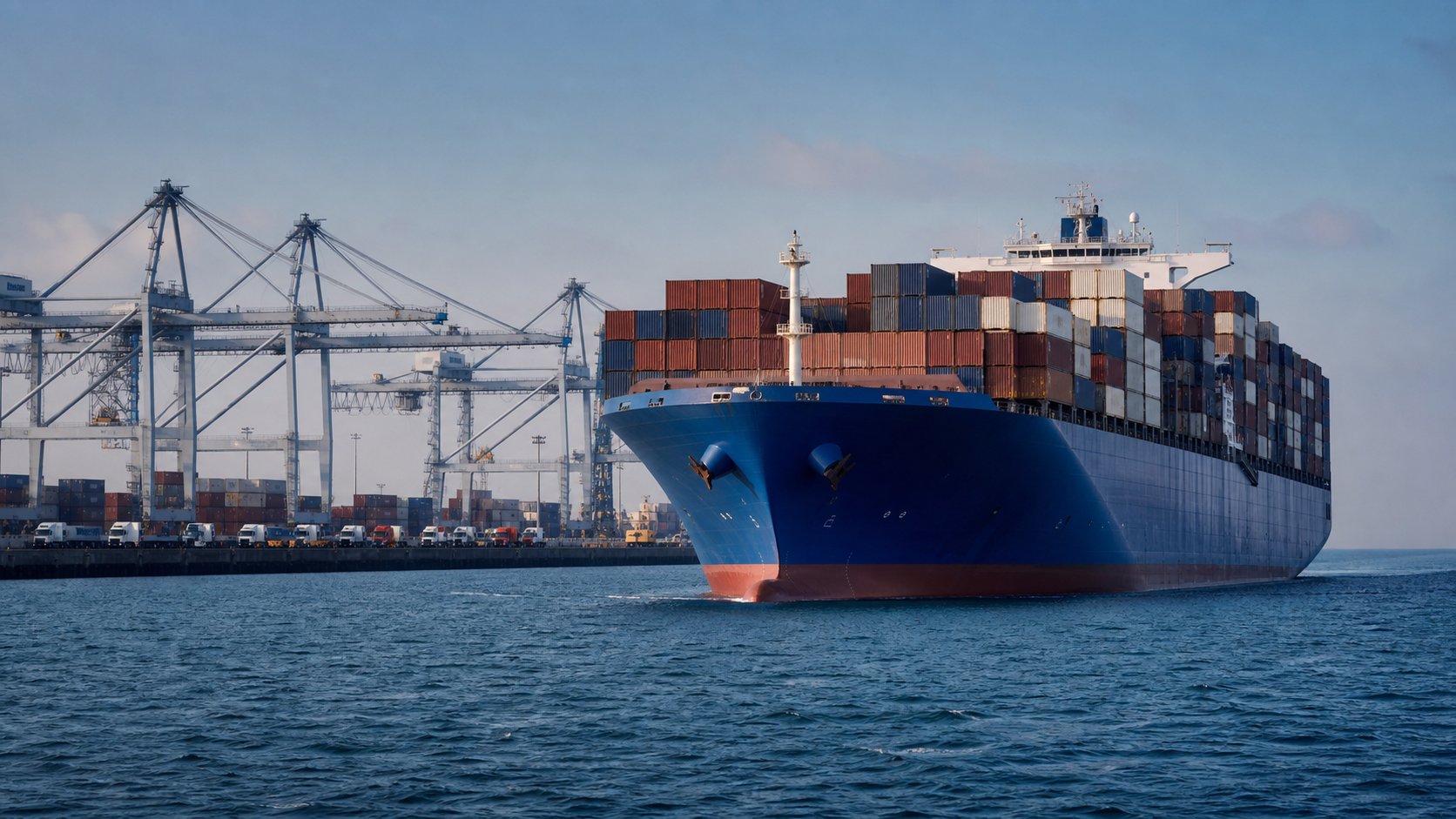
Maersk’s second-quarter numbers show that container carriers can still turn tight capacity, strong Asian exports and port congestion into higher realized pricing—even as they move more cargo. For importers, the warning is not that every lane will rise 22%. It is that waiting for broad rate relief now carries more risk.
Maersk reported that its average loaded Ocean freight rate increased 22% year over year in Q2 2026 while loaded volumes rose 4.1% and vessel utilization reached 96%. Ocean EBIT climbed to $935 million from $229 million a year earlier, helping push group EBITDA to $3.0 billion and EBIT to $1.6 billion.
The combination matters more than any single metric. Rates strengthened while volume grew and ships remained nearly full. That is evidence of carrier-level pricing power—not simply a fuel-cost pass-through or a temporary accounting lift.
Why the signal is stronger than the headline
Maersk attributed the quarter to high demand, higher Ocean spot rates, unbalanced trade flows and congestion across Europe, the Middle East, South America’s east coast and West Africa. Growth was especially strong on imports into Africa, North America and Latin America, supported by exports from the Far East.
The carrier raised its 2026 underlying EBITDA guidance to $10.5 billion–$12.5 billion, from $8 billion–$10 billion, and now assumes global container-market volume growth of about 4%. Its earnings release also shows Terminals revenue per move rising 7.1%, driven by higher rates and storage revenue. That landside figure is a second warning: congestion can raise the total cost of an import move even when the ocean line item is controlled.
Reuters independently reported in June that Maersk’s prior guidance increase was driven by strong container demand, particularly in Asia, reinforcing that the pricing backdrop was visible before the full Q2 release.
What pricing power means for importers
A carrier does not need universal scarcity to defend price. At 96% utilization, localized demand surges, blank sailings, port bunching or equipment imbalances can quickly tighten specific origins and services. Importers should therefore expect sharper lane-by-lane differences, shorter validity on spot offers and more resistance to concessions where carriers already have strong bookings.
The practical risk is paying twice: first through higher base or premium freight, then through congestion-linked storage, demurrage, detention, chassis and drayage costs. Procurement teams should evaluate the door-to-door exposure rather than treat the ocean bid as a standalone event.
Shipper playbook: five moves to make now
- Contract and bid timing: Pull forward lane-level strategy reviews, but avoid locking the entire portfolio at today’s strongest spot signal. Use staggered expirations and reopeners tied to named market indices, capacity performance and material routing changes.
- Surcharge validation: Require the tariff, trigger, effective date, affected ports and calculation basis for every emergency, congestion, fuel or peak-season charge. Separate true pass-through costs from general rate restoration.
- Carrier allocation and capacity commitments: Match committed minimum quantities to realistic forecasts. Preserve a secondary-carrier allocation on critical lanes, and put space, equipment and rollover remedies in writing—not only the rate.
- Free time, demurrage and detention: Negotiate free time before cargo moves, confirm how clocks stop during terminal or appointment unavailability, and establish a rapid dispute workflow with timestamped evidence.
- Port and drayage preparation: Pre-book drayage for constrained gateways, confirm chassis and yard capacity, monitor terminal dwell daily and define diversion options before vessels arrive.
The bottom line
Maersk’s Q2 result does not prove that every trade lane is entering a new rate cycle. It does show that carriers can convert tight utilization and disrupted networks into materially higher realized pricing while still growing volume. Importers should negotiate from the lane level, validate every add-on and secure operational commitments before peak pressure removes their leverage.
Sources: A.P. Moller–Maersk Q2 2026 Interim Report; Maersk Q2 earnings release; Reuters reporting.
Leave a Reply