
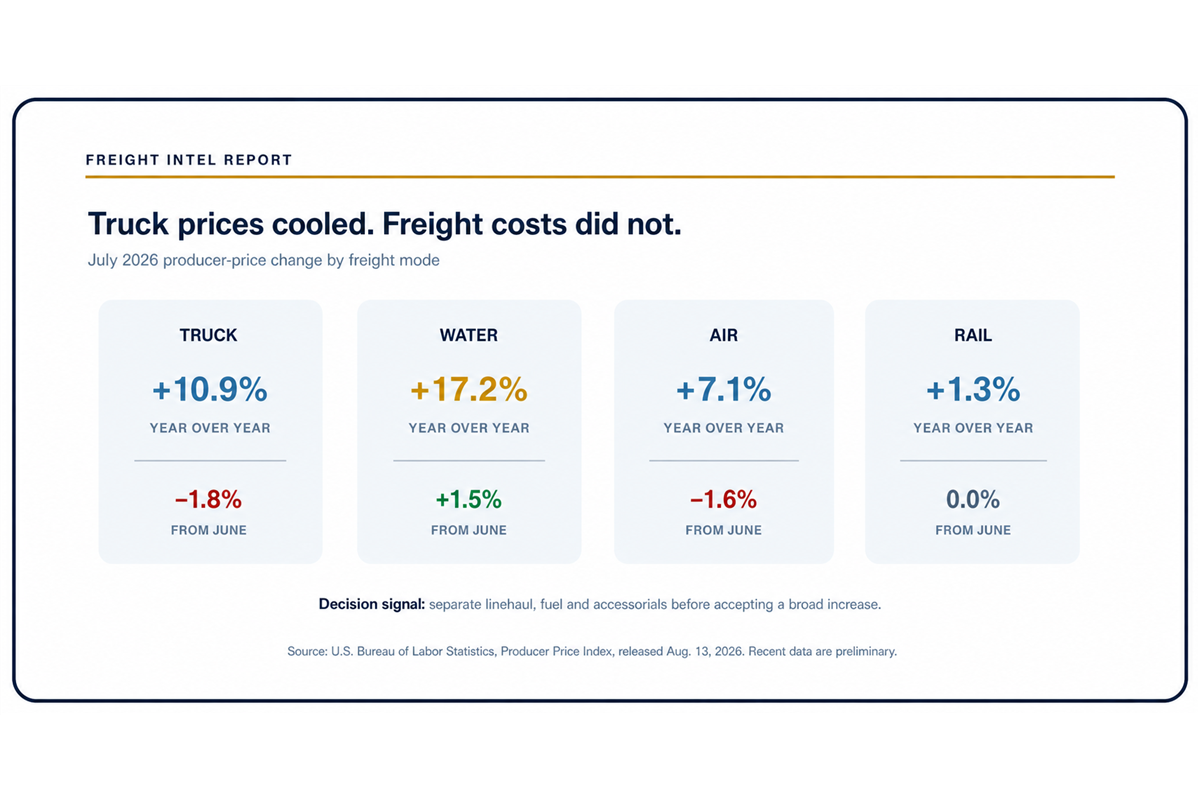
Truck-freight prices fell 1.8% in July from June. That sounds like relief—until the comparison widens.
The same federal report shows truck-freight prices still 10.9% above July 2025. Water-freight prices moved in the opposite direction, rising 1.5% for the month and 17.2% over the year.
The conclusion is not that freight costs are broadly falling. It is that pricing has split sharply by mode—and shippers should challenge any provider that uses a single market headline to justify a blanket increase.
The July freight-price split
The U.S. Bureau of Labor Statistics reported the following changes in producer prices for freight transportation services:
| Mode | July versus June | July 2025–July 2026 |
|---|---|---|
| Truck freight | −1.8% | +10.9% |
| Water freight | +1.5% | +17.2% |
| Air freight | −1.6% | +7.1% |
| Rail freight and mail | 0.0% | +1.3% |
The broader final-demand transportation and warehousing index fell 1.8% for the month but remained 10.0% higher than a year earlier. Freight arrangement was unchanged in July and 2.2% higher annually, while warehousing and storage increased 0.1% monthly and 3.9% annually.
These are national producer-price indexes. They measure prices received by providers; they are not lane quotes, spot-versus-contract comparisons, accessorial audits or proof that a specific invoice is correct. Recent values are preliminary and may be revised.
What the truck decline actually means
The 1.8% monthly decline can improve a shipper’s negotiating position, especially where fuel or short-term capacity was used to support a recent increase. It does not establish that every truckload, LTL or drayage lane should decline by the same amount.
Lane balance, equipment, lead time, commodity characteristics, appointment constraints, seasonal demand and local capacity still determine the executable price. Furniture and home-furnishings shippers, for example, may face cube constraints, floor-loading requirements, delivery appointments, driver-assist services or higher damage exposure that a national index cannot capture.
The correct response is to require a charge-level explanation rather than substitute the national index for the contract.
Water freight remains the pressure point
Water freight’s 17.2% annual increase—and its additional 1.5% rise in July—aligns with the pricing power and infrastructure congestion described in Maersk’s second-quarter results. Maersk raised its 2026 earnings outlook on August 13 after stronger freight rates and container demand lifted performance.
That does not mean every ocean increase is valid. It means importers should expect carriers and intermediaries to defend higher base rates while separately testing whether fuel, congestion, equipment and other surcharges are authorized and correctly calculated.
The shipper’s three-part charge test
Before approving a freight increase or accessorial, ask three questions:
- Authority: Where does the signed contract, rate confirmation or incorporated tariff authorize the charge?
- Evidence: What event triggered it, and what time-stamped document, gate record, appointment history or carrier notice proves that event occurred?
- Calculation: Does the amount match the agreed rate, free-time allowance, fuel table, equipment type, dates and responsible party?
If one element is missing, place the disputed amount on hold according to the contract’s dispute procedure and request the supporting record. Preserve the undisputed portion for timely payment.
Actions for decision-makers
Shippers and manufacturers
- Separate linehaul, fuel and accessorial variance in transportation reporting.
- Require lane-specific evidence for increases instead of accepting a national-market explanation.
- Confirm hours, appointments, loading method, dimensions, weight and special handling before tender.
- Review detention, layover, truck-ordered-not-used, redelivery, lumper and driver-assist terms before pickup.
Brokers and forwarders
- State the source and effective date of each pass-through charge.
- Attach the relevant carrier notice, tariff provision or operating record.
- Avoid combining distinct cost components into an unexplained “market adjustment.”
Carriers
- Document arrival, release, delays and customer-directed services contemporaneously.
- Keep fuel and accessorial schedules consistent with executed agreements.
- Distinguish legitimate service costs from general rate-recovery efforts.
Executives and procurement leaders
- Track total cost per shipment alongside base rate per mile or per container.
- Identify whether monthly variance comes from price, volume, service failure or shipment preparation.
- Audit repeat accessorials by facility, lane, provider and commodity; recurring charges often expose a process problem rather than an isolated exception.
What remains uncertain
July’s data may not fully capture oil-price increases that occurred late in the month. August freight and fuel measures could therefore change direction. The BLS figures are also preliminary and may be revised.
Freight Intel Report will track the modal indexes alongside fuel, tender-rejection, spot-rate, port and accessorial indicators. No single measure should be used as a complete freight-market forecast.
Executive takeaway
Truck-freight prices declined in July, but annual truck inflation remained substantial and water freight continued to rise. Use the monthly truck decline as a reason to reopen the evidence—not as proof that every rate should fall. The best immediate control is to separate linehaul, fuel and accessorials, then require contractual authority, operating evidence and a correct calculation for each charge.
Discussion: Which cost component—linehaul, fuel, detention, drayage, storage or another accessorial—is producing the largest budget variance in your network?
For independent, sourced freight intelligence and practical decision tools, subscribe free to Freight Intel Report.
Sources
- U.S. Bureau of Labor Statistics, Producer Price Index—July 2026, released August 13, 2026
- Reuters, “U.S. producer prices unchanged in July,” published August 13, 2026
- Reuters, “Maersk raises outlook again as strong demand, freight rates lift profit,” published August 13, 2026
Government services: For government services, verification, registrations, forms, reporting, or instructions, always navigate to the official agency website directly. Independently verify its address before entering credentials or business information.

Leave a Reply