
A $510 detention dispute took six years, two trips through the Federal Maritime Commission and two rounds at the D.C. Circuit to settle a principle that matters whenever a terminal shuts its gates: a fee must do more than keep accruing. It must remain reasonable in the actual circumstances and serve freight fluidity.
On April 28, 2026, the U.S. Court of Appeals for the D.C. Circuit denied Evergreen Shipping Agency’s challenge to an FMC order that rejected three days of detention charges during a Port of Savannah closure. The 22-page opinion in Evergreen Shipping Agency (America) Corp. v. FMC, later highlighted by the Federal Maritime Commission on July 8, reinforces a practical test: detention and demurrage charges are primarily financial incentives to promote the efficient movement of cargo and equipment.
But the decision is not a blanket rule that every terminal closure automatically erases every fee. The court upheld a fact-specific analysis. That distinction should shape how shippers, truckers, NVOCCs, brokers and ocean carriers document disruptions and review invoices.
The shipment behind the ruling
Evergreen transported Yamaha cargo from Japan to Savannah. Yamaha designated TCW, Inc. to handle the landside move to its Newnan, Georgia, plant. TCW received 21 free days for the container and four free days for the chassis. After free time expired, the agreed daily charges were $150 for the container and $20 for the chassis.
A COVID-related shutdown at Yamaha’s plant prevented TCW from retrieving the equipment earlier. TCW collected it on May 23, 2020, but the Port of Savannah was closed to returns for three consecutive days: Saturday because of reduced pandemic-era business, Sunday under its regular schedule and Monday for Memorial Day. TCW returned the equipment when the port reopened on May 26.
Evergreen invoiced TCW $1,490. TCW paid, then challenged the $510 assessed for May 23 through May 25, when the gates were closed.
Why the carrier lost
The court identified three uncontested facts that supported the FMC:
- TCW could not retrieve the equipment from Yamaha any earlier because the plant was closed.
- The port was not accepting the returned equipment during the three charged days.
- Evergreen incurred no costs from the additional delay.
Those facts gave the FMC a reasonable basis to conclude that the disputed charges served neither detention’s primary incentive purpose nor a secondary compensatory purpose. The court also upheld the Commission’s conclusion that a contract, generous free time, advance knowledge of a closure and the fact that equipment was already in detention were relevant, but not individually decisive.
That last point matters. The FMC rejected an automatic “once on detention, always on detention” approach. A container already beyond free time does not make every later charge reasonable regardless of what happens next. If the billing party argues that a charge compensates it for costs, the ruling supports requiring evidence of those costs in an adjudication.
What the ruling does not say
The D.C. Circuit did not hold that all fees assessed during a closure are invalid. In the first appeal, the court had warned that a known closure can sometimes increase the incentive to return equipment earlier. On remand, the FMC therefore evaluated the complete record instead of applying a bright-line closure rule.
The operative standard remains the FMC’s incentive principle in 46 CFR 545.5. The Commission considers whether a charge promotes freight fluidity, including whether an empty container could actually be returned, while preserving room for extenuating facts and other evidence.
There is also a separate question about who may be invoiced. In 2025, the D.C. Circuit set aside 46 CFR 541.4, the provision that had categorically limited the parties to whom an invoice could be issued. The FMC confirms that the remainder of Part 541 remains in force. A motor carrier invoice is therefore not automatically invalid merely because it was sent to a motor carrier; liability still requires review of the applicable contract, tariff, facts and law.
The three invoice gates
Before approving a demurrage or detention invoice, an accounts-payable or freight-audit team should run three separate tests.
1. Timing
Under 46 CFR 541.7, a billing party generally must issue the invoice within 30 calendar days after the charge was last incurred. A late invoice eliminates the billed party’s payment obligation for that charge. An NVOCC has a separate 30-day clock that begins when it receives the upstream invoice.
2. Required content
Part 541 requires identifying, timing, rate and dispute information, plus certifications that the charges comply with FMC rules and that the billing party’s performance did not cause or contribute to them. The rule says that omitting required minimum information eliminates the obligation to pay the applicable charge.
3. Freight fluidity
Even a timely, complete invoice can face a reasonableness challenge when equipment could not move. Terminal closure notices, rejected appointments, empty-return restrictions, unavailable return locations, consignee shutdowns and carrier instructions can become central evidence. The key question is not simply whether free time expired; it is whether the charge could realistically change behavior or compensate a documented cost.
Build the evidence file before the invoice arrives
The strongest dispute is assembled during the disruption, not weeks later. Freight teams should preserve:
- Terminal closure notices and gate schedules.
- Appointment screenshots, rejection messages and timestamps.
- Empty-return instructions and evidence that no acceptable location was available.
- Container-availability, earliest-return and last-free-day records.
- Emails showing when cargo or equipment became accessible at the consignee.
- Carrier, terminal and NVOCC instructions, including any alternate-return options.
- A day-by-day timeline separating shipper-controlled delay from periods when movement was physically impossible.
When disputing a fee, identify the exact charged dates, connect each date to the supporting evidence and cite the carrier’s own invoice data. Ask the billing party to explain both the incentive function and any compensatory cost it claims. Avoid a generic “port was closed” objection; the Evergreen ruling rewards a documented causal chain.
The 30-day response clock
A billing party must give the billed party at least 30 calendar days from invoice issuance to request mitigation, refund or waiver. After receiving a timely request, the billing party must attempt to resolve it within 30 calendar days unless both sides agree to a later date.
If an internal dispute does not resolve the issue, the FMC provides several routes: no-fee dispute-resolution assistance, a charge complaint, an informal small-claims proceeding for claims of $50,000 or less, or a formal complaint. The correct path depends on the amount, remedy and facts. Companies should involve counsel when the exposure or precedent warrants it.
What each stakeholder should change
- Shippers and beneficial cargo owners: require closure evidence and invoice review before automatic payment; ensure consignee shutdowns are communicated immediately.
- Truckers and drayage providers: capture gate, appointment and empty-return evidence in real time; do not rely on screenshots that disappear from a portal.
- NVOCCs and freight forwarders: synchronize upstream and downstream dispute clocks and notify the upstream billing party when a customer contests a passed-through charge.
- Ocean carriers and terminals: document any compensatory costs, keep return options current and consider event-based waiver rules that reduce disputes without weakening equipment discipline.
- Brokers and logistics managers: define who owns the evidence, who files the dispute and who bears unresolved charges before a disruption occurs.
Executive takeaway
The Evergreen decision does not abolish detention during port closures. It makes the reasonableness inquiry operational: could the equipment move, could the fee change behavior and did the billing party incur a cost it can substantiate? Freight teams that preserve those facts while they are fresh will be better positioned to reject improper charges and resolve legitimate ones quickly.
Discussion: Does your organization preserve gate-closure and empty-return evidence automatically, or does the dispute process begin only after an invoice reaches accounts payable?
Subscribe free to Freight Intel Report for sourced analysis that translates freight regulation, court decisions and market shifts into operational decisions for shippers, carriers and brokers.
This analysis is for general informational purposes and is not legal advice.
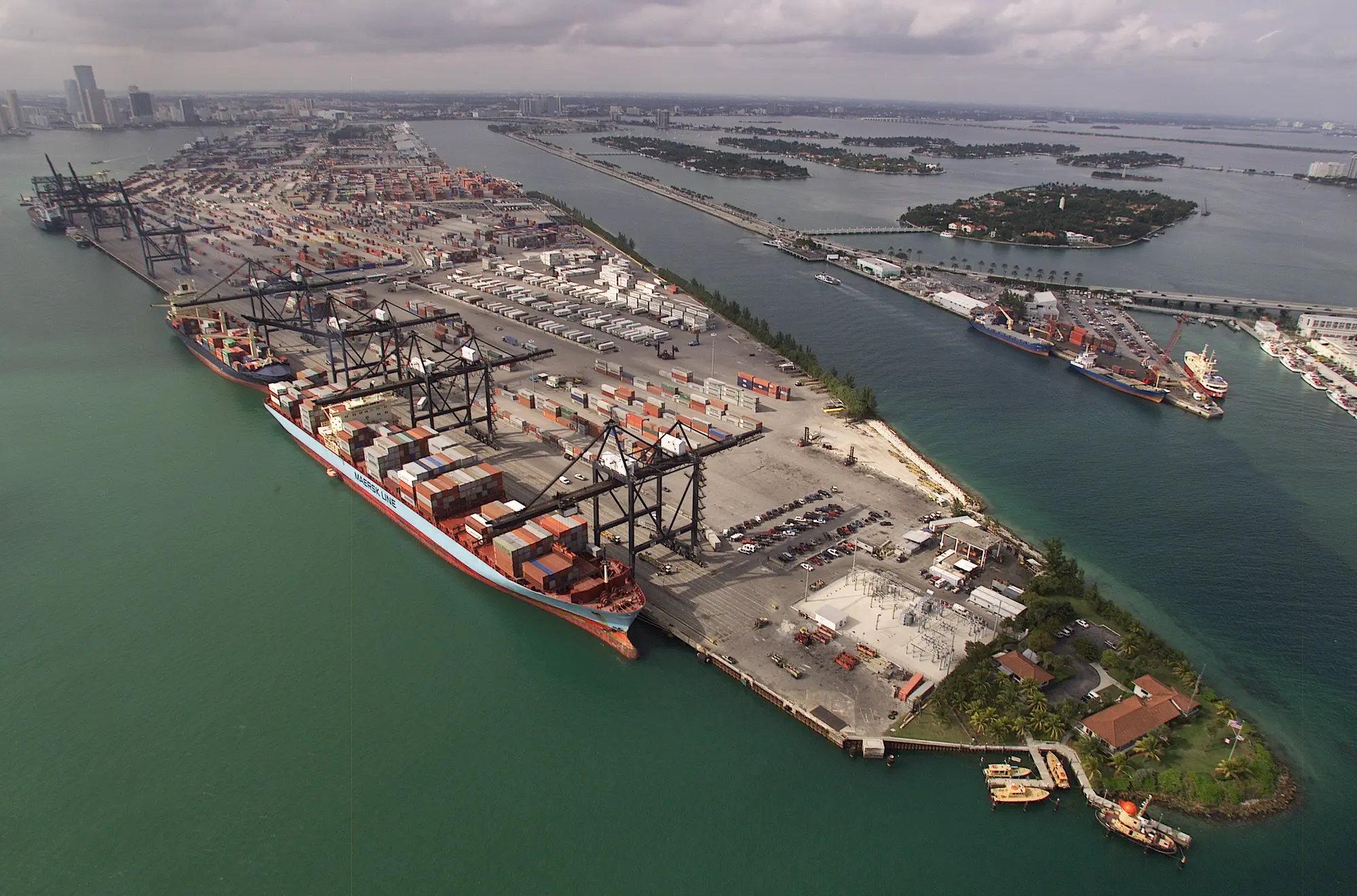
Featured image: Aerial view of PortMiami’s container terminal. Photo: James R. Tourtellotte / U.S. Customs and Border Protection, public domain, via Wikimedia Commons.
Government services: For government services, verification, registrations, forms, reporting, or instructions, always navigate to the official agency website directly. Independently verify its address before entering credentials or business information.

Leave a Reply